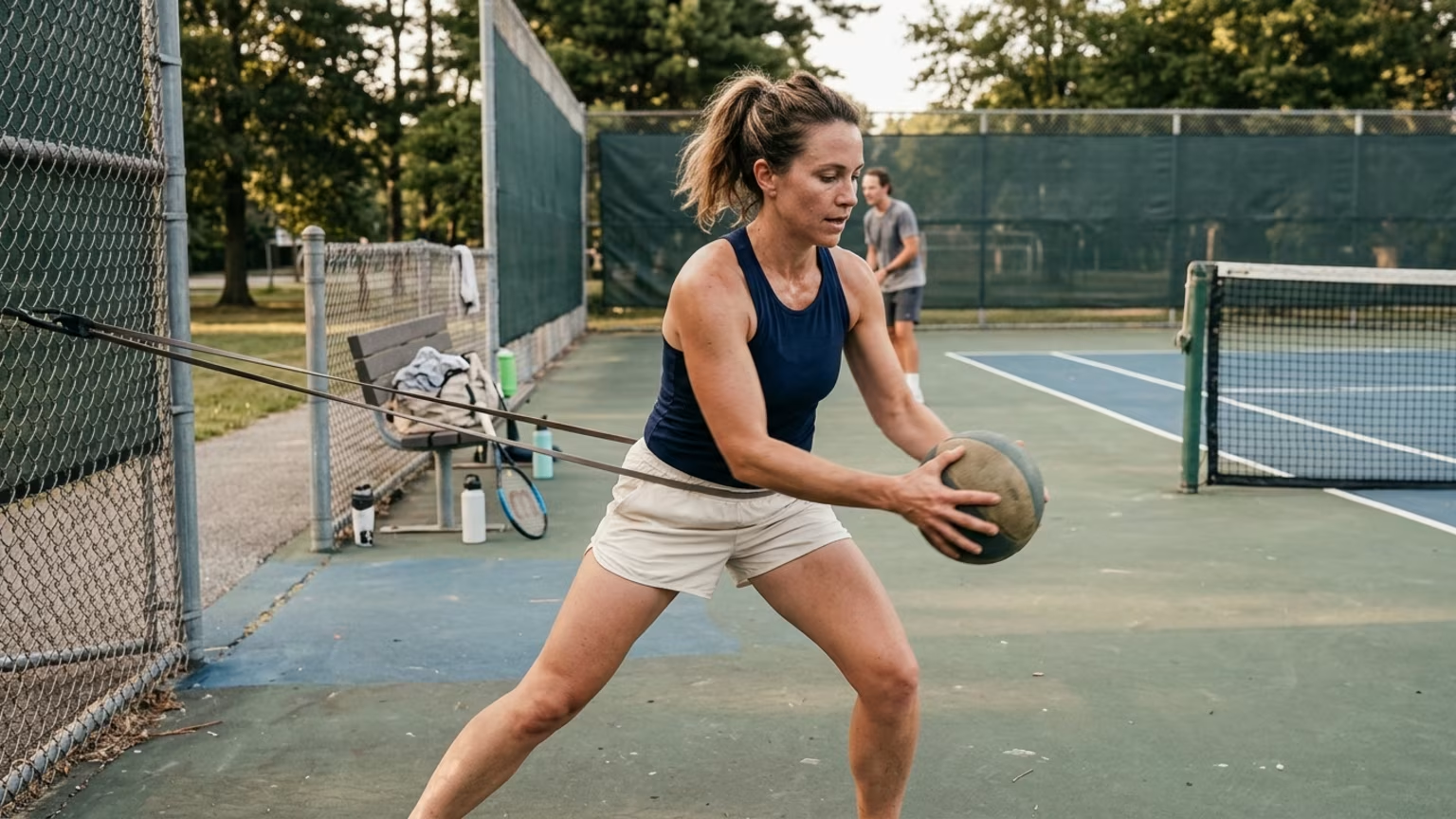

Choose strength goals around getting low, reaching and stopping, with a clear view of the evidence and when to seek individual guidance.




Strength transfer means using the strength you develop in training to handle a playing task better. For a racquet player, that task might be getting low for a ball or controlling a stop before moving again. The aim is to connect training with something you want to do more capably on court.
That connection starts with a clear question. “I want stronger legs” identifies a broad goal. “I want getting low and rising again to feel more manageable” gives the goal a playing purpose. It also creates a useful starting point for discussing exercise choices.
For tennis, pickleball and padel, consider the challenge of repeating an explosive start followed by a stop or change of direction. A training goal built around that sequence asks more than whether you can produce a strong effort once. It asks which part of the playing task you want to handle better.
The examples below are ways to describe that question in each sport:
Repeated swings introduce another distinction: producing an individual effort is not the same goal as repeating a stroke throughout play. Naming that difference helps keep the training question specific.
This is the value of thinking about starts, stops and strokes separately. “Better court strength” becomes a description of something you want to do rather than a general label for harder training.
A 2026 systematic review in BMC Sports Science, Medicine and Rehabilitation examined high-intensity interval training in tennis. It found the most consistent improvements in selected aerobic measures and tennis-specific endurance outcomes. Transfer to competitive match performance remained uncertain. This was interval-training research rather than a test of how to select strength exercises.
A secondary summary of pickleball research describes a 2025 study involving older players who had fallen or feared falling. Its 10-week programme combined strength and balance work with change-of-direction and agility exercises. That combination is relevant to discussions about court capability, but it does not isolate the contribution of a particular strength exercise.
The evidence has important boundaries. The tennis review identified small samples and varied methods, alongside risk-of-bias concerns and limited representation of women. The pickleball study was small and non-randomised, with its findings available here through a secondary account. These sources do not establish a universal strength routine or prove injury prevention, and they should not be treated as direct evidence for every older player or for padel.
The practical conclusion is to keep the claim proportional to the evidence. Choosing exercises around a playing goal is a useful organizing framework, not a validated formula for improving match results.
For adult players, athletic longevity means keeping the ability to take part in the sport they enjoy. A task-based goal keeps that purpose visible. Instead of making every training decision about a heavier weight or a harder exercise, it brings the conversation back to playing.
The framework starts by naming a task. It then connects that task with a relevant capacity and an exercise the player can perform comfortably. Progress can be considered in terms of whether the original task feels more manageable over time.
Here is how to make those descriptions useful without turning them into a fixed routine.
Lower-body strength is a capacity worth considering for lowering yourself and returning to standing. Be clear about which part matters to you. Getting down, coming back up and repeating the movement are related goals, but they are not identical descriptions of the task.
Describe the reach in the context of what comes next. Is your concern getting to the ball or feeling ready to move afterward? That distinction gives an exercise-selection conversation more direction than simply asking for greater reach.
Name the moment you want to feel more capable handling. “Controlling the finish of the movement” is a clearer goal than “being more athletic.” It leaves room for an individual discussion about an appropriate exercise rather than assuming everyone needs the same drill.
Separate the goal of producing a stronger individual stroke from the goal of repeating your usual stroke more comfortably. Write down which one matters to your playing experience. That keeps the training question aligned with the outcome you actually value.
Once the task is clear, exercise selection can focus on a related physical capacity rather than on how closely an exercise resembles a rally. The general framework is to choose something manageable and comfortable, then return to the original court question when reviewing progress. A better gym result and a more manageable playing task are separate things to notice.
This approach also gives strength work a defined place alongside playing. For more context on leaving room for both training and court time, keep the same task description at the centre of the discussion. The long-term purpose is continued participation, not completing a particular exercise for its own sake.
Falling or fear of falling is a reason to involve a qualified physiotherapist or healthcare provider rather than relying on a general exercise framework. Individual guidance is also appropriate when discomfort makes it difficult to find a comfortable exercise or when you are unsure which movements suit your health and ability.
A useful consultation starts with a description of what is happening during play. Explain which task feels difficult and whether that concern is changing how you move or participate. You do not need to identify an injury or arrive with an exercise solution.
Today, write down the court task that feels least manageable so you can describe it clearly to a qualified professional.
Follow Evercourts for practical insights on tennis, pickleball and padel performance, movement, recovery and healthy ageing. Stay connected for new articles, research-led guidance and ideas to help you play well and keep playing for years.


Learn how to turn, track and recover for pickleball lobs with a gentle partner drill, plus what fall research says about balance and footwork.

Tennis match data explain why conditioning involves repeated bursts and recovery. Apply the pattern without treating research averages as personal targets.

A flexible pickleball warm-up progressing from easy movement to controlled lunges, side steps, shadow swings and dinking, with readiness-based adjustments.
Read practical guidance for better movement, smarter preparation and a game that keeps working for you.
explore the Blog
