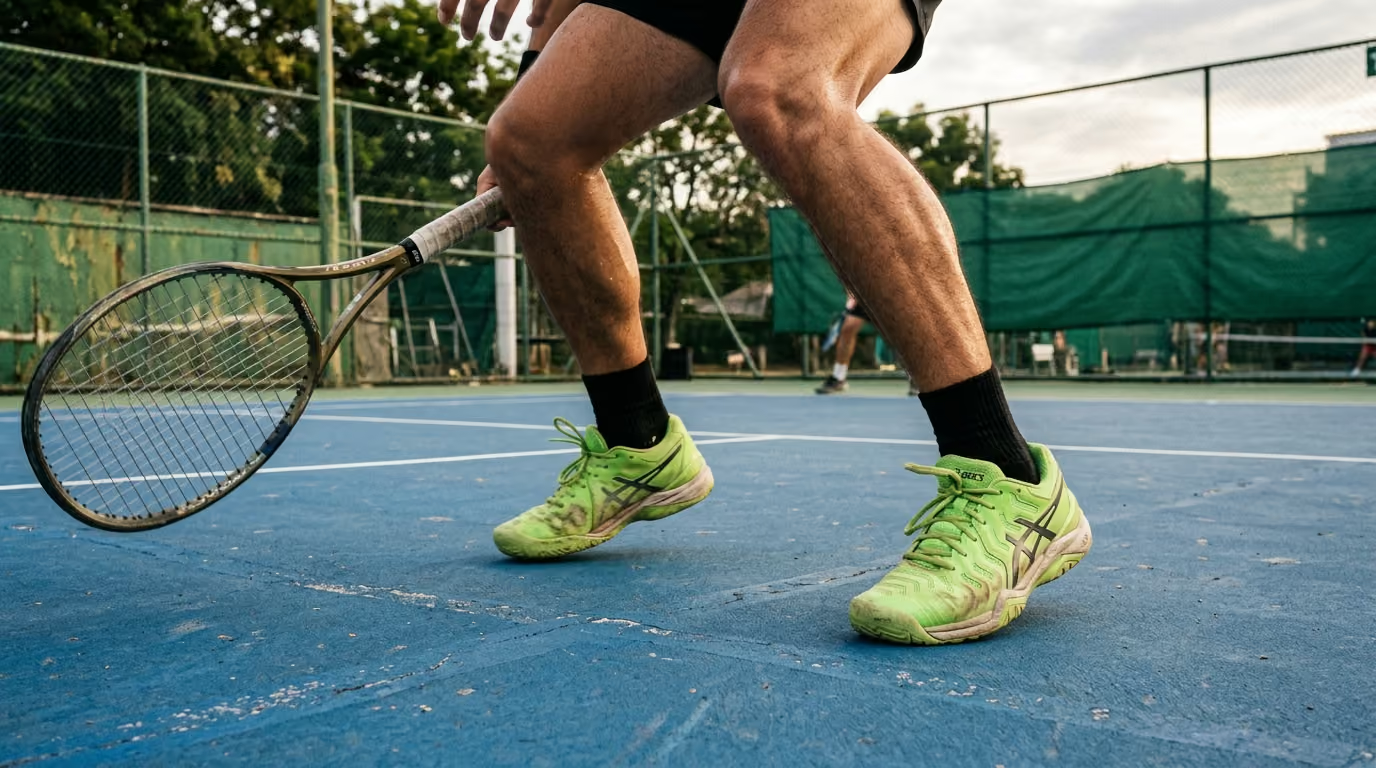

Reaching difficult returns on court depends on correct split step timing and wide stance mechanics that instantly launch your initial movement.




Many racquet sports players believe that running faster is the most important part of quick court movement. They spend hours performing sprint drills to shave fractions of a second off their baseline runs. In reality, the fastest footwork is not about raw sprinting speed. It is about reducing the time it takes to start moving in the first place.
On court, your movement is a complete perception, decision, and action loop. If your eyes do not read the ball early, your feet cannot react in time. If your feet are not in a balanced state of readiness, you cannot push off with maximum power.
A properly timed split step converts your existing movement into directional readiness at the exact moment your opponent strikes the ball. By preloading your muscles and landing just as the ball direction becomes readable, you can initiate your first step much faster. This structural approach improves your court performance and saves valuable energy during long, demanding matches.
To understand why this works, we must look at how the body interacts with the court surface. Footwork is not a series of isolated steps. It is a continuous loop that begins before your opponent even touches the ball.
The performance chain always follows a specific order:
This framework applies to tennis, pickleball, and padel. However, your physical response must adapt to different court dimensions and ball speeds. By studying the mechanics of each step, you can build a more efficient movement profile.
To appreciate the split step, we must look at the biomechanics of muscle preloading. The human body uses a mechanism called the stretch-shortening cycle. When you land from a brief jump, your lower-body muscles undergo a rapid eccentric contraction. This action stretches the muscle-tendon unit and stores elastic energy.
This stored energy can be used to power the subsequent concentric contraction. This means your first step away from the split step is powered by both active muscle contraction and passive elastic recoil. If you stand completely still, you lose this natural assistance.
A key study conducted by Nieminen and colleagues evaluated the physical impact of the split step. The researchers tested nine skilled male tennis players in a simulated response task. The participants had to react to a sudden visual cue and move 2.70 meters to the side.
The study revealed that players were 13.1% faster over this short distance when using a split step compared to starting from a stationary position. The researchers looked deeper into the force data to find out why. They discovered that the split step did not simply make the players run faster once they were moving. Instead, the biggest improvement occurred before the physical movement even started.
The time from the visual stimulus to the onset of force production was 43.6% faster in the split-step condition. Additionally, the split step helped players produce much more power against the ground. The split-step condition resulted in a 15.7% increase in mean vertical force. It also produced a 60.0% increase in peak vertical force.
The researchers found strong negative correlations between the vertical force produced and the total response time. The mean vertical force had a correlation value of r = -0.813. The peak vertical force had a correlation value of r = -0.765. These values indicate that players who could direct more force into the ground moved much faster.
However, this does not mean you should jump as high as possible. A high jump increases your airtime and delays your contact with the ground. If you are airborne when your opponent hits the ball, you cannot change direction. The ideal split step is a low, quiet unloading action that keeps your head relatively level.
Another factor is your individual leg stiffness. Leg stiffness refers to how well your lower limbs resist deformation when landing under a load. Research shows that world-class players have highly individualized split-step timing. A study on professional and junior players found that timing strategies changed depending on the stroke and match situation.
The study showed that players with higher leg stiffness often initiated their initial foot movement slightly later. Their stiff tendons allowed them to store and release energy very quickly. Players with less native stiffness may need to start their movement slightly earlier. This highlights the importance of finding a rhythm that matches your physical capabilities.
Before you can split step, you must establish an effective ready stance. A quality ready stance preserves your ability to move in all directions. It must allow you to move forward, slide laterally, or retreat backward without losing balance.
Your ready position is defined by four main elements:
Your base width should be slightly wider than shoulder width. If your feet are too close together, you will lack lateral stability. If your feet are too wide, you will find it difficult to transition your weight. A moderate, athletic width allows your hips to sit comfortably between your knees.
Your center of mass must be kept low and centered. Keep your knees flexed and your torso slightly inclined forward from the hips. Your spine should remain neutral rather than hunched. This slight forward lean prepares your core muscles to stabilize your hips during sudden movements.
Your pressure distribution should favor the balls of your feet. Do not sit back on your heels, as this locks your ankles and delays your reaction. Conversely, do not lean so far forward that your toes claw the ground. Keep your weight distributed across the forward half of your feet so you can push off instantly.
Your foot orientation should remain relatively neutral. Your toes should point generally forward or slightly outward. This positioning keeps your ankles, knees, and hips aligned. It also reduces torque on your knee joints when you pivot to chase a ball.
Once you move toward the ball, you must select a hitting stance. Your stance choice affects your balance, your power, and your recovery speed. Racquet sports players use three primary hitting stances.
In a neutral stance, your feet align with the intended direction of your shot. Your front foot steps forward and across, placing your body sideways to the net. This stance is highly effective when you have ample time to run behind the incoming ball.
The primary advantage of a neutral stance is linear weight transfer. It allows you to drive your body weight forward through the ball. This is especially useful for driving deep baseline shots or stepping into short balls.
However, the neutral stance has clear limitations. It takes more time to set up because you must step across your body. It is also less efficient for wide balls because it closes off your hips. This closing of the hips makes it harder to recover back to the center of the court quickly.
In an open stance, your feet remain parallel to the net. Your hips and chest face the opponent as you prepare to hit. You load your outside leg by bending your knee and rotating your upper body.
The open stance is highly efficient for wide balls and high-tempo rallies. Because you do not step across your body, you can prepare your racquet much faster. It also keeps your hips open, which facilitates rapid lateral recovery.
To use the open stance effectively, you must have strong torso rotation. You cannot rely on forward foot steps for power, so you must use rotational force instead. If your core is weak, open stance shots can become unstable and arm-dominant.
The semi-open stance strikes a balance between the neutral and open positions. Your feet sit at a diagonal angle relative to the net. This position allows you to use partial body rotation while still driving your weight slightly forward.
This stance is incredibly versatile for modern baseline play. It provides a stable base for medium-width balls. It also allows you to recover faster than a neutral stance while offering more forward drive than a fully open stance.
Choosing between these stances is a matter of time and court geometry. If you have plenty of time and want to attack, use a neutral or semi-open stance. If you are rushed, stretched wide, or defending, use an open stance to protect your position.
Your first step after the split step determines whether you reach the ball in balance. This step must be decisive and directed toward the ball. It is not merely a foot placement, but a coordinated shift of your entire center of mass.
For short lateral movements, you should use a push step. This movement begins by driving your outside foot firmly into the court. This force pushes your body in the opposite direction.
For example, to move a short distance to your right, you push hard with your left leg. Your right foot makes a short lateral step, and your left foot quickly follows. This allows you to cover ground while keeping your shoulders square to the net.
For longer lateral distances, a push step is too slow. You must use a crossover step instead. This pattern begins with a pivot of your hips toward the ball.
You then drive your outside leg across the front of your body. This long, powerful stride allows you to cover several feet of court in a single movement. It is the fastest way to transition from a stationary position into a full lateral sprint.
As you get closer to the ball, you must transition from power strides to small adjustment steps. These short, rapid steps refine your spacing relative to the ball. They allow you to correct for unexpected bounces, wind, or ball spin.
Many players make the mistake of taking one large lunge at the end of their run. This leaves them off-balance and makes recovery difficult. High-level players use multiple quick adjustment steps to ensure they hit from a stable, upright posture.
While the basic principles of footwork remain constant, each racquet sport has unique physical requirements. You must tailor your movement patterns to the specific dimensions and tempos of your chosen game.
Tennis is played on a large court with high ball velocities. This environment requires you to cover long distances and handle extreme forces. You must be prepared to sprint from the baseline to the net, slide on clay, or change direction on hard courts.
According to research on tennis timing, your split-step initiation must adapt to the game situation. On the return of serve, you have very little time to react. Your split step must be highly synchronized with the server's contact point.
In baseline rallies, you have slightly more time to read the ball flight. You can use a wider ready stance to help handle heavy topspin. When moving out to a wide ball, you will frequently load in a fully open stance. This allows you to absorb the opponent's pace and recover quickly to the center mark.
Pickleball is characterized by a smaller court, lightweight paddles, and a non-volley zone. These factors create a high-frequency game where short-range reactions are paramount. You rarely run long distances, but you must constantly make micro-adjustments.
When playing near the non-volley zone line, your footwork must be extremely compact. A large, airborne split step is counterproductive here. It raises your center of mass and delays your hand response.
Instead, use a subtle, low unloading action. Keep your base wide and your knees flexed to handle low dinks. Pickleball coaching guides suggest using a slightly staggered stance when preparing to transition forward. This means placing one foot slightly ahead of the other to bias your weight for a quick forward push.
When moving from the baseline to the kitchen, you must split step on the move. As your opponent prepares to strike the ball, you must pause and establish a balanced split stance. This prevents you from being caught mid-stride by a fast, low shot at your feet.
Padel is played in an enclosed glass court, which introduces complex rebound angles. Your footwork must account for ball interactions with both the turf and the glass walls.
A quantitative study on professional padel players tracked the frequency of different movements. The data revealed that lateral displacement was the most common movement category. This was followed closely by forward displacement and split-step actions.
The study also showed that direct volleys accounted for 24.66% of all shots. Indirect lobs accounted for 20.52%, and direct smashes made up 17.76%. This high volume of volleys and overheads means you must transition constantly between net attack and deep defense.
When defending against a ball heading toward the back glass, you cannot simply run toward the ball. You must run to the space where the ball will rebound after hitting the glass. This requires you to turn your hips early and use small adjustment steps to track the ball's exit angle.
Improving your movement is often a matter of eliminating inefficient habits. In our experience, recreational players frequently fall victim to several common footwork errors.
Many players treat the split step as a vertical jump. They leap high into the air and land heavily on their heels. This creates a hard, jarring impact that actually slows down their first step.
Your split step should be a low, soft unloading of weight. Think of it as letting the court drop away from you rather than jumping up. Your heels should barely touch the ground, and your knees should absorb the landing quietly.
Timing is the most common point of failure for the split step. If you split too early, you land before the opponent hits the ball and lose your momentum. If you split too late, you are still in the air when the ball is halfway across the court.
You must watch the opponent's racquet preparation. Begin your upward movement as they start their forward swing. Your feet should make contact with the court just after the ball leaves their strings.
When a ball is hit wide, many players immediately take a massive step with their near foot. This dramatic step shifts their center of mass too quickly, making it hard to adjust if the ball takes a weird bounce.
Instead of lunging, use a quick pivot and a lateral push step. Keep your steps compact until you are certain of the ball's trajectory. This keeps your head level and your eyes stable.
When faced with a deep lob, many players attempt to run backward while facing the net. This is highly inefficient and presents a significant fall risk.
As soon as you recognize a deep ball, turn your hips and shoulders sideways. Use a crossover or drop-step pattern to run backward diagonally. This keeps you safe and allows you to track the high ball over your shoulder.
Your physical longevity on the court is directly tied to how you move. Jarring landings, sudden uncontrolled stops, and poor posture place immense stress on your joints. Over time, this repetitive stress can lead to chronic wear and tear.
I remember finishing a tough two hour padel match on a cold Tuesday night and waking up the next morning feeling like my lower back was locked in concrete. For a long time, I just accepted this as the price of playing hard in my forties. But once I started spending just ten minutes on targeted hip mobility before heading to the club, the stiffness almost completely vanished. It taught me that we do not have to accept pain as a default state of healthy aging.
Maintaining physical capacity is essential for healthy aging and athletic longevity. When you execute a split step correctly, you distribute the forces of movement across your entire kinetic chain. Your glutes, quadriceps, and calves absorb the impact of landing rather than your knees and lower back.
This load distribution is highly beneficial for long-term player health. It reduces the shear stress on your joints and helps prevent common issues like patellar tendonitis and plantar fasciitis. To protect your body, you must prioritize controlled braking at the end of every run.
Instead of stopping abruptly on one foot, use a series of small, decelerating steps to slow down. This gradual deceleration reduces the peak force transmitted through your joints. It also leaves you in a much better position to begin your recovery back to the center of the court.
To build consistent court movement, you can follow a simple, step-by-step decision framework during play. This mental checklist helps automate your physical responses over time.
Observe your opponent's shoulder rotation, racquet face angle, and contact point. This early visual feedback tells you where the ball is heading before it crosses the net.
Classify the incoming ball as close, medium, or long distance. This classification dictates the type of footwork you will use to reach the contact zone.
Select a push step for close balls, a crossover step for medium distances, or a full turn and sprint for deep defensive situations.
Use a neutral stance if you have ample time to step forward. Choose an open or semi-open stance if you are stretched wide or rushed for time.
Complete your stroke with good balance, then use short adjustment steps to absorb your forward or lateral momentum.
Do not simply run back to the exact center of the baseline. Recover to the position that best covers your opponent's most likely response angle.
To make these footwork patterns automatic, you must practice them under realistic conditions. Isolated ladder drills can help with basic coordination, but they do not train your eyes to read game cues. The following drills combine movement with perceptual decision-making.
This drill is designed to improve your split-step timing. Have a partner stand across the net with a basket of balls.
This drill trains your immediate reaction speed after landing your split step.
This drill helps you choose the correct stance based on ball depth and width.
This drill integrates recovery movement back into your footwork routine.
This drill is specific to padel players learning to manage back-wall rebounds.
While improving your footwork can reduce the physical stress of play, it cannot replace medical care when injuries occur. If you experience persistent pain that does not improve with rest, you should seek professional guidance. This is a fundamental tenet of protecting your long-term health.
Be alert for these specific physical warning signs:
If you experience any of these symptoms, schedule an evaluation with a qualified sports physiotherapist or orthopedic physician. They can assess your joint alignment, check for muscular imbalances, and provide a safe return-to-play protocol. Taking action early is crucial for maintaining your athletic capabilities.
By treating your footwork as a complete perception and movement system, you can move with greater efficiency and preserve your physical health on the court for years to come.
Follow Evercourts for practical insights on tennis, pickleball and padel performance, movement, recovery and healthy ageing. Stay connected for new articles, research-led guidance and ideas to help you play well and keep playing for years.


Read practical guidance for better movement, smarter preparation and a game that keeps working for you.
explore the Blog


