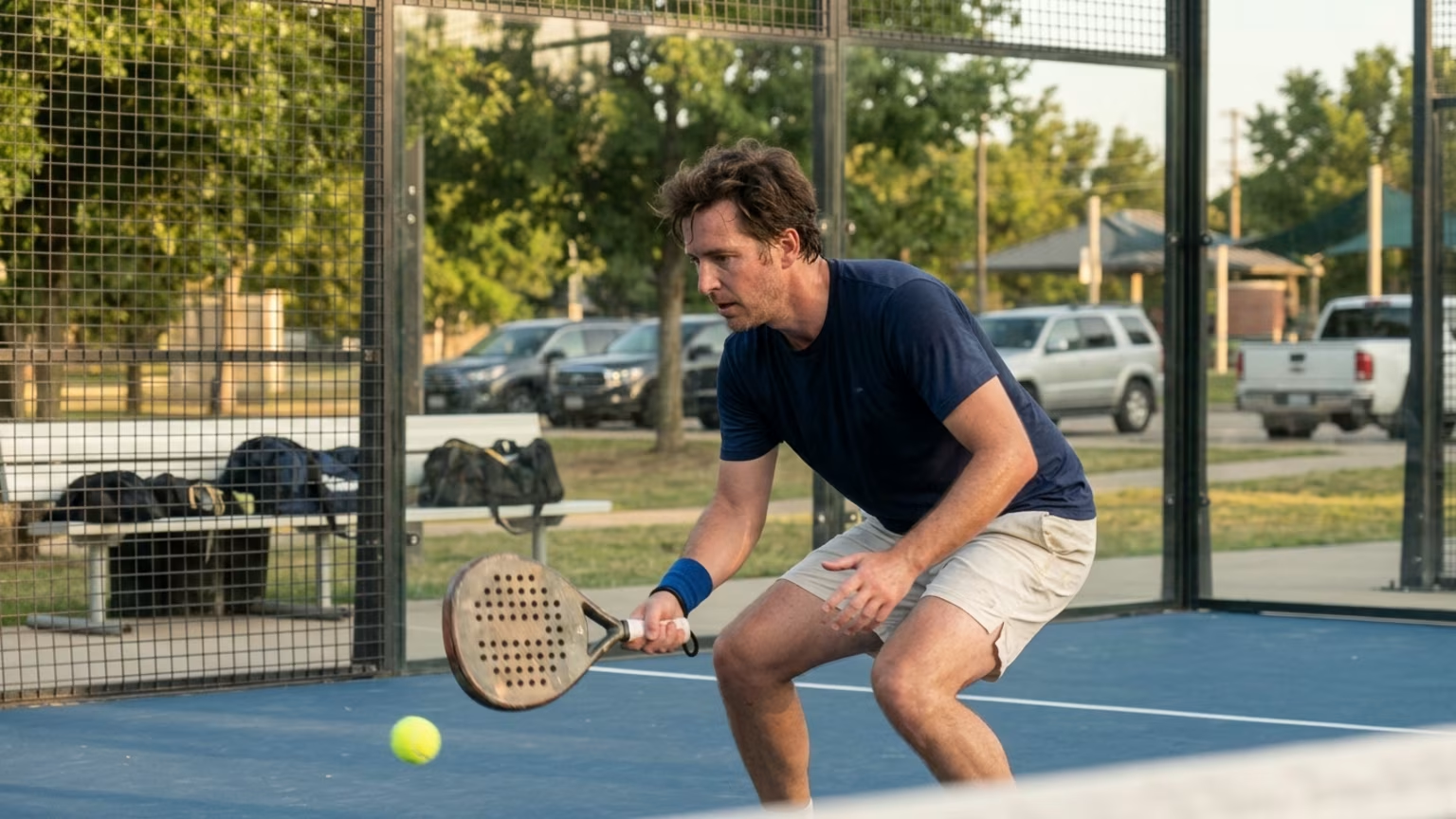

Compare control-first and power-first padel, with evidence-led guidance on choosing reachable targets and recognizing when an attacking shot fits.




Control-first padel means choosing where the ball should go before deciding how hard to hit it. The intention is to select a shot that fits the situation rather than making every ball an attempt to finish the point.
This is a tactical approach rather than a conditioning method. Its physical aim is to work within the balance and preparation time available. When a player is rushed or off balance, keeping a controlled ball in play takes priority over forcing an attacking shot.
LTA Padel’s beginner guidance supports that starting point. It recommends keeping the ball in play with less power and more control. It also notes that beginner points are often won through opponents’ mistakes rather than spectacular winners.
Professional research adds context without turning that guidance into a universal rule. A peer-reviewed analysis examined 2,759 points from golden-point games at six World Padel Tour tournaments in 2021. Errors accounted for 58.7% of point endings in the men’s sample and 63.2% in the women’s sample.
Those findings describe selected professional games rather than a test of recreational tactics. The authors did not account for shots per point, so the results do not prove that extending rallies improves winning chances. The evidence also does not establish injury-prevention or physical conditioning benefits from choosing control over power.
The practical interpretation is narrower: a player does not need to produce a winner on every shot to win a point. That leaves room to judge success by the quality of the decision rather than only by whether the ball ended the rally.
Power-first play, as used in this comparison, means treating extra pace as the first answer. That is different from choosing an attacking shot because the ball and position make it appropriate.
The professional study gives attacking play its due. Its authors reported that trays and smashes were the most characteristic last shots associated with winners. Back-wall shots were the most characteristic shots associated with errors in that sample.
The useful lesson is not to remove attacking shots from the game. It is to separate a suitable attacking opportunity from an attempt to manufacture one. When there is time and a favorable ball, attacking remains a reasonable option.
Control and power are therefore not opposites on every shot. A hard shot can still have a clear target and a sensible purpose. Equally, simply hitting softly does not make a decision well judged.
For a player’s physical capabilities, the distinction is between choosing an action that fits the situation and asking for an attacking stroke regardless of preparation. Neither tactical label should be mistaken for a way to build strength or speed. This comparison concerns how players use the capabilities they bring onto court.
For padel’s multidirectional exchanges, our preference is control-first decision-making with selective attack. The question is not merely whether more pace is available. It is whether the chosen ball serves a useful purpose from the current position.
A contributor writing in The Conversation describes patience and positioning as more valuable than powerful shots in their own padel experience. Anticipating opponents is another part of that perspective. This is an experienced player’s interpretation rather than a controlled comparison.
The same discussion identifies the lob as a way to move opponents away from the net. That gives placement a purpose beyond simply avoiding a miss. A controlled shot can be chosen to change the opponents’ situation rather than finish the point immediately.
A useful practical question is: “What large area can I reach from this position without forcing the shot?” This is a decision prompt, not a research-tested formula for identifying the highest-percentage ball.
The following sequence translates the research’s practical implications into a simple way of thinking:
This avoids treating every open space as an invitation to attempt a winner. The target must be both useful and realistic. Neither condition alone is enough for the decision framework.
For example, the lob discussed in The Conversation has a positional purpose: moving opponents away from the net. Whether it fits a particular ball remains a judgment about the situation. The shot’s name does not replace that decision.
This approach also fits the broader idea of constructing points together as a pair. Placement is part of deciding what the next exchange should look like, rather than judging every contact in isolation.
This padel recommendation should not become a blanket ranking for every racquet sport. The explosive demands of tennis and the stop-start nature of pickleball require their own sport-specific judgments. The evidence discussed here does not establish which approach wins those comparisons.
For players moving between sports or formats, the useful carryover is the question rather than a fixed pace: does the intended shot fit the available position and time? That distinction belongs alongside adjusting movement between singles and doubles, not a rule to play every court in the same way.
A missed ball is worth reviewing without assuming that every error means the player should attack less. The professional study counted point endings; it did not identify the best shot for each recreational situation.
A more useful review separates target choice from execution. Was the intended area reachable without forcing the ball? Was the player trying to attack a suitable opportunity or demanding a finish from an awkward position?
Those questions preserve a place for ambition. The objective is not to become passive, but to make attacking choices more deliberate.
Control-first padel wins as the default for Evercourts’ mission of staying on court for life. It places judgment ahead of a constant demand for more pace. It also leaves attacking shots available when the situation supports them.
That choice respects the capabilities a player brings to each exchange. A rushed ball can receive a controlled response. A favorable ball can receive an attacking one.
The strongest version of consistency is not endless rallying for its own sake. It is selecting a reachable target with a purpose, then matching the shot to the opportunity. Placement comes first; power earns its place.
Follow Evercourts for practical insights on tennis, pickleball and padel performance, movement, recovery and healthy ageing. Stay connected for new articles, research-led guidance and ideas to help you play well and keep playing for years.


Learn how to turn, track and recover for pickleball lobs with a gentle partner drill, plus what fall research says about balance and footwork.

Tennis match data explain why conditioning involves repeated bursts and recovery. Apply the pattern without treating research averages as personal targets.

A flexible pickleball warm-up progressing from easy movement to controlled lunges, side steps, shadow swings and dinking, with readiness-based adjustments.
Read practical guidance for better movement, smarter preparation and a game that keeps working for you.
explore the Blog
