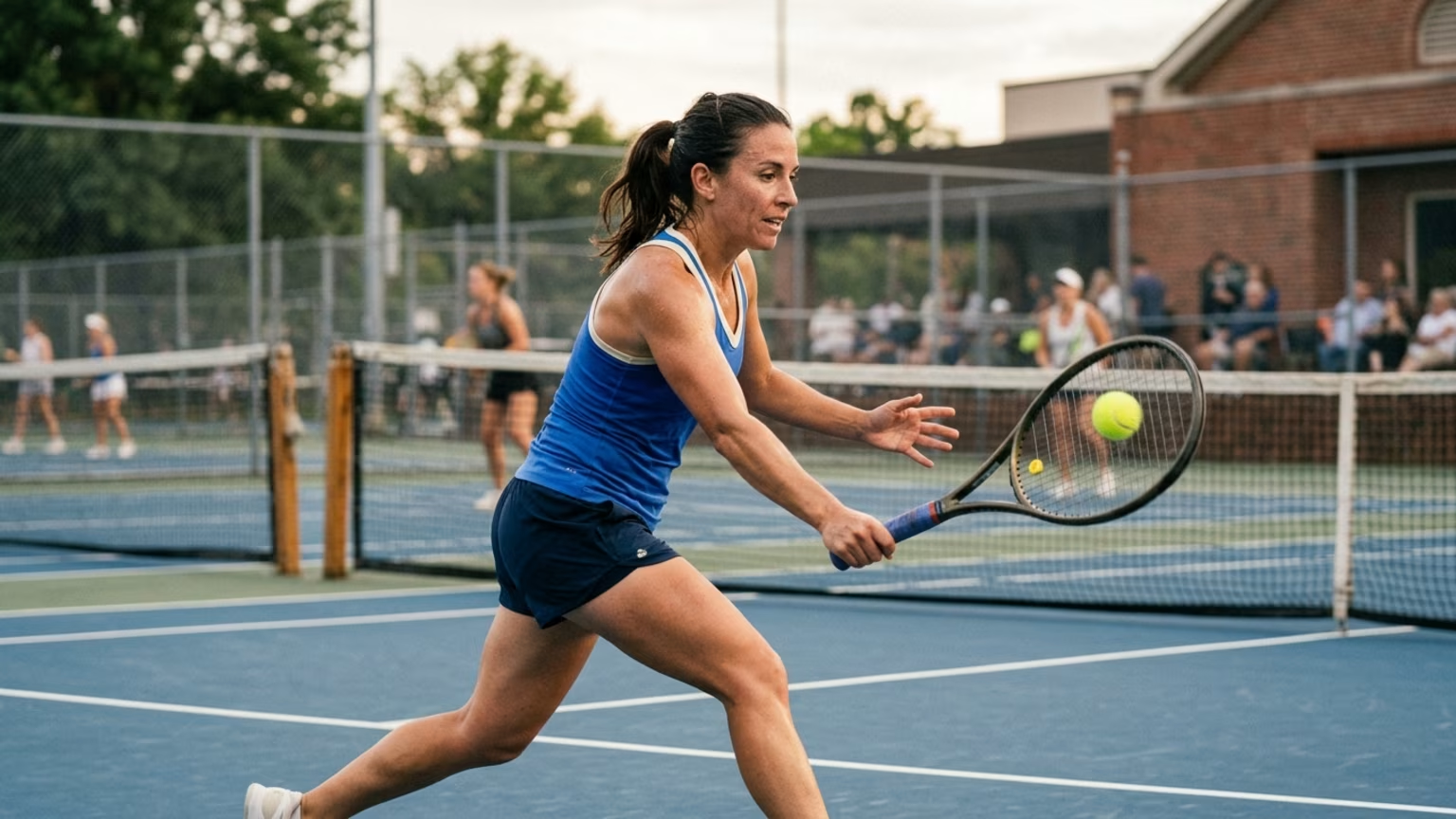

Learn how court geometry alters movement demands across tennis, pickleball and padel formats, and adapt your spacing and ready position for healthy aging.




Singles formats strip away the safety net of a partner. A player must take complete responsibility for every open angle and short ball. Tennis uses a 23.77-metre court with a singles width of 8.23 metres, meaning you must recover toward the centre of the singles court after each shot. The goal is to arrive balanced and ready for both width and depth.
In tennis singles, your ready position must allow for explosive movement in either direction. The wide court requires you to start balanced with enough space to push off your outside foot quickly. If you lean too heavily toward one side, a skilled opponent will easily expose the open court. Remaining planted in the location of your previous contact is a guaranteed way to lose the point.
Playing alone means relying heavily on your physical capacity to decelerate and change direction. You cannot depend on anyone else to cover a defensive lob or track down a precise drop shot. Players must establish solid footwork skills across the court to handle these solo workloads. Good anticipation becomes your only substitute for raw athletic speed.
Pickleball presents a different solo challenge entirely. In singles pickleball, the court remains only 20 feet wide but is still 44 feet long. You might have less distance to the sideline, but you still face relentless individual responsibility. Every shot demands quick individual movement to protect the space, pushing your cardiovascular endurance.
After a tennis singles groundstroke, your immediate priority is reading the opponent's preparation. The court length requires massive baseline stamina and quick vertical adjustments. Adapting to these demands means building a reliable split step and prioritizing consistent court recovery over hitting outright winners.
Adding a partner completely reshapes how you navigate the space. Tennis expands the playing surface to a doubles width of 10.97 metres. This extra width means players must protect the middle and the space between partners. World Tennis Federation coaching guidance recommends that doubles partners cover the middle together, move as a pair and clarify lob responsibilities.
Pickleball keeps the exact same dimensions for doubles, changing how you approach the net. Placing two players on a court that is only 20 feet wide magnifies any spacing errors. Partners must use clear communication to avoid occupying the same lane or leaving tactical gaps. You have to move in relation to your partner rather than reacting independently.
Padel is played on a 20-by-10-metre enclosed court, so wall rebounds form part of the movement problem. The pair must coordinate forward movement while maintaining access to the back area. Effective doubles positioning requires understanding who takes the middle ball and who covers defensive lobs. Moving as a synchronized unit is always more effective than chasing the ball alone.
Before each doubles point, teammates should agree on court roles. Evercourts recommends discussing what commands like 'mine' or 'leave' actually mean to prevent dangerous collisions. A useful doubles rule across all three sports is to move in relation to the partner rather than independently. This coordinated spacing drastically reduces the overall distance you need to sprint.
Different sports punish different movement mistakes. Tennis players transitioning to pickleball must moderate the instinct to rush directly to the net. The non-volley zone extends 7 feet from the net on each side. A player must distinguish between standing near the line and legally volleying inside the zone.
Tennis players moving to pickleball should also expect more compact rallies and must shorten their swing preparation. A full tennis swing is rarely appropriate near the non-volley line. Conversely, pickleball players transitioning to tennis should anticipate more time between contacts and a greater need for full groundstrokes. The tennis court is 23.77 metres long, compared with 13.41 metres for pickleball.
Padel players face an entirely unique environment where patience is highly rewarded. A ball that requires an immediate emergency reaction in tennis might be allowed to reach a wall in padel, forcing players to decide whether to hold position, retreat, turn or let the ball rebound. A 2026 cross-sectional study examined rehabilitation behaviours after ankle sprain among amateur padel players. This highlights the importance of preparing your lower body for unpredictable, multidirectional stops.
Adapting your technique is vital for maintaining joint health across different playing environments. A cutting-biomechanics review summarized by The Dink identifies trunk position, plant width and knee bend as factors associated with knee loading. Using controlled deceleration rather than reaching with an excessively wide plant helps you manage physical stress. Building capacity progressively is always smarter than hoping your body will automatically adapt to a new court.
When evaluating options for athletic longevity, doubles play offers distinct pacing advantages. Singles requires massive individual energy expenditure and continuous solo court coverage. Doubles shifts the burden to shorter, reactive movements while sharing the overall load. A 2026 review of pickleball research found that the literature is divided between health-promotion findings and injury-risk questions, including fractures, sprains and falls.
The shift from singles to doubles is not automatically an easier physical task. A player changing from singles to doubles may reduce individual running but increase short reactive movements and communication demands. Conversely, a player changing from doubles to singles may need more conditioning for repeated solo coverage. Both formats test your endurance differently, requiring thoughtful physical preparation.
While no sport is completely without risk, sharing the court encourages movement habits that promote healthy aging. In one eight-week randomized trial of older adults with pre-frailty, the pickleball group showed reduced sedentary time and increased light physical activity. Adult players who switch to doubles often find they can compete more frequently with less residual fatigue.
Treat your ankles, knees, hips and shoulders as sport-specific preparation targets. You cannot simply apply a tennis conditioning program to padel and expect optimal results. Recognizing these differences is the first step toward long-term athletic health on the court. The mission is to keep moving well for years to come.
Adapting your ready position and spacing to fit the specific court format is the most practical way to protect your body. Building your physical capacity gradually will always yield better results than rushing into intense competition. Ultimately, the best strategy is listening quietly to your physical responses rather than strictly defending one style of play. As you learn to collaborate and read the court geometry, the joy of healthy competition simply becomes a quiet constant in your weekly routine.
Follow Evercourts for practical insights on tennis, pickleball and padel performance, movement, recovery and healthy ageing. Stay connected for new articles, research-led guidance and ideas to help you play well and keep playing for years.


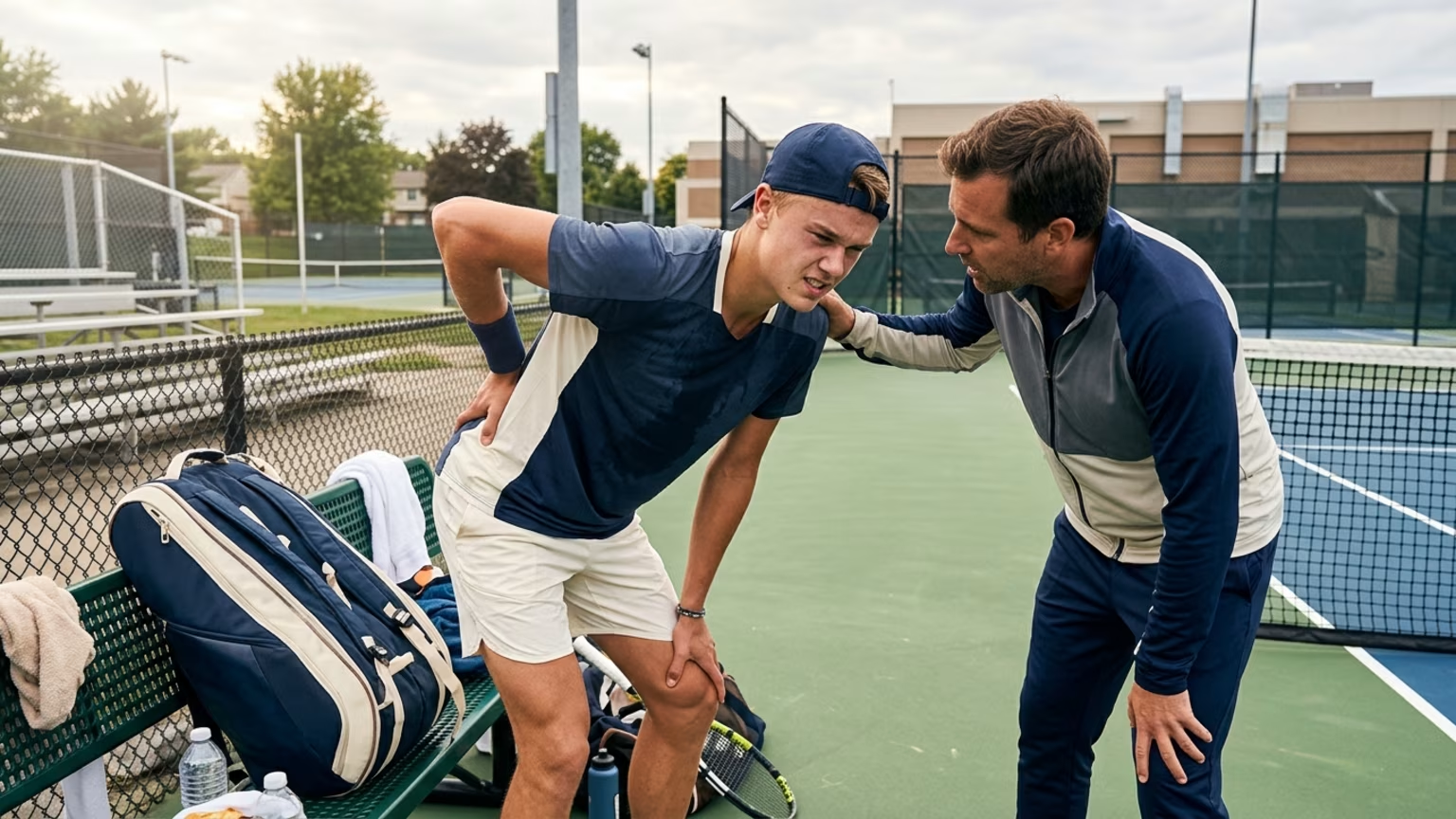
Holger Rune withdrew from the European Open with a back problem. The facts behind his decision and a grounded perspective for recreational players.

The Dink’s October 17 guide emphasizes deep returns, ball-height decisions and positioning against faster pickleball opponents.

A new report outlines padel and tennis gear trends. Learn how to assess adjustable rackets, sensor feedback and smart-court claims.
Read practical guidance for better movement, smarter preparation and a game that keeps working for you.
explore the Blog
