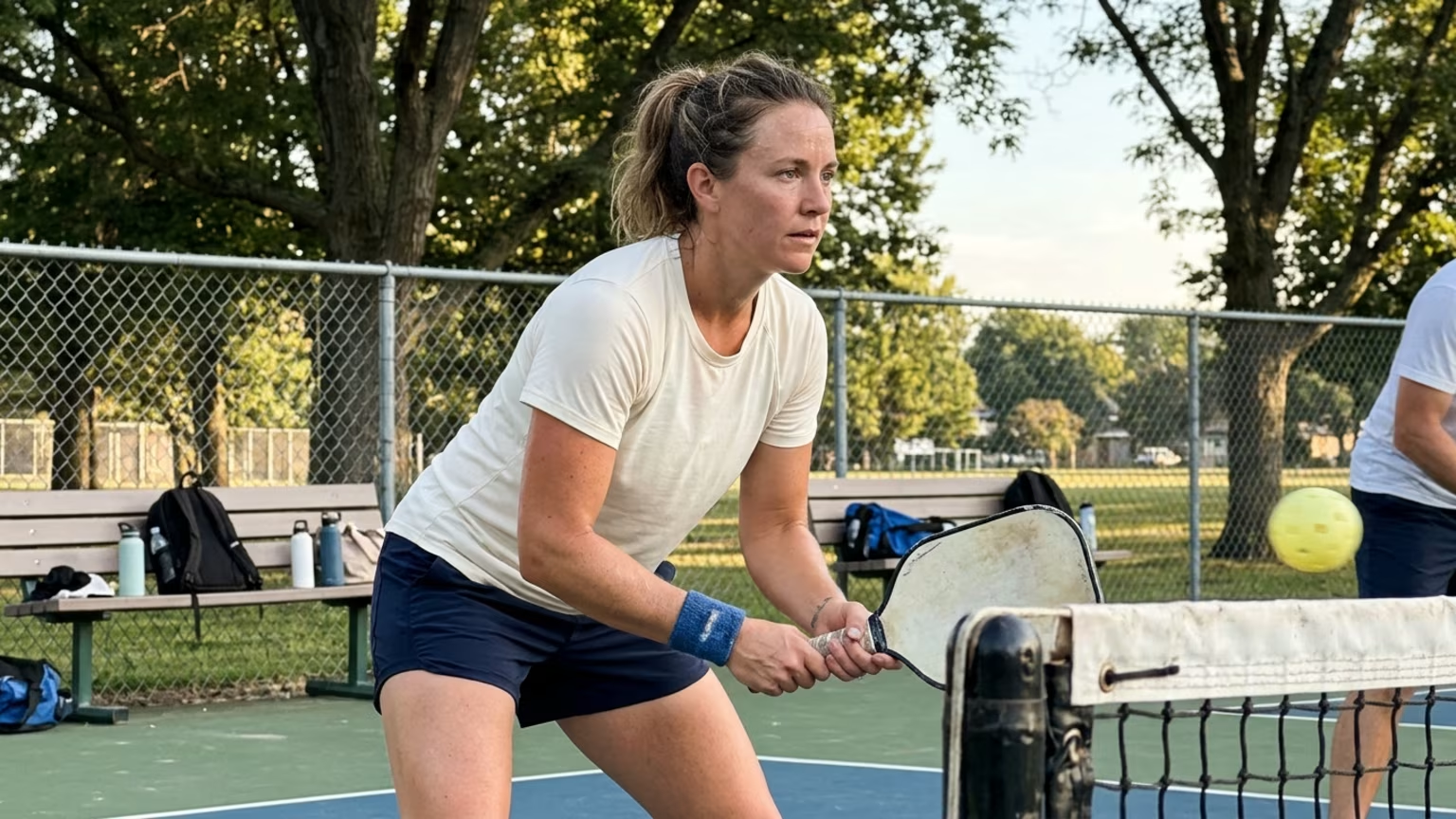

How balance, leg strength and controlled direction changes relate to court confidence, with research context and signs to seek qualified advice.




Dynamic balance is your ability to stay steady while moving or changing direction. In racquet sports, it means controlling your position as you respond to the next ball. Court confidence involves trusting that movement rather than treating every difficult step as a test of courage.
Balance, functional leg strength and controlled footwork describe related aspects of preparation. They are not interchangeable measures of whether someone is ready to play. For players returning after a break or concerned about falling, understanding those distinctions offers a more useful starting point than finding one supposedly protective exercise.
The research gives these qualities a place in the conversation. Its strongest practical message is about thoughtful preparation rather than certainty.
Tennis, pickleball and padel ask players to make repeated explosive efforts and change direction. Moving toward a ball is only part of that task. Stopping and preparing to move again also belong in the picture.
That makes balance a moving skill rather than simply an ability to hold still. A direction change includes the transition between movements, not just the speed of the first step.
Consider the movement question within each sport:
These examples put the emphasis on movement quality rather than speed alone. They also explain why a conversation about confidence should include balance and functional strength alongside footwork. The goal is to understand the movement being asked of the player before judging the preparation.
A pickleball injury guide describes a study of players aged 55 and older who had fallen or were concerned about falling. It tested a 10-week program involving strength, balance and footwork. There were 29 players: 12 in the training group and 17 in the comparison group.
The training group reportedly showed reduced fear of falling. At five-month follow-up, 25% of that group and 44% of the comparison group reported a fall while playing. Those are encouraging findings for a discussion about participation and confidence.
Fear of falling and falls themselves are different outcomes. The first concerns a player's experience of participation. The second records an event during play. Both matter here, but they should remain separate when interpreting a training result.
A balance-training overview summarizes another study involving 92 recreational pickleball players. It reported that 42% had fallen while playing and 30% had fallen more than once. Players who had fallen were slower on a pickleball-specific change-of-direction test.
Broader evidence comes from the World Health Organization's falls fact sheet. It reports that a Cochrane review found exercise reduced the overall rate of falls by approximately 23% in trial populations. It also recommends tailored exercise that challenges balance and improves functional strength for older people living in the community.
The findings have distinct limits. The change-of-direction result shows an association rather than proof that slower movement caused falls. The training study is small and does not establish that its program prevents court injuries. The WHO figure concerns general falls research rather than a measured reduction in racquet-sport injuries.
The evidence also does not establish a universal exercise progression or return-to-play schedule for someone with balance problems, an injury or a medical condition. The practical conclusion is to give balance and functional strength a considered place in preparation while keeping personal exercise decisions individual.
For athletic longevity, the useful question is which physical capabilities a player wants to maintain. A fast movement test may describe one aspect of performance. It should not become a complete judgment about confidence or readiness.
As a practical interpretation of the research, it helps to keep the aims distinct:
These are useful categories for thinking about preparation. They are not a reason to collect increasingly difficult exercises. A drill's difficulty and its relevance to a player's needs are different questions.
For someone returning after time away, a useful starting point is to name the concern. Is it staying steady, moving into position or changing direction? That is more specific than deciding that confidence is simply missing.
This is also the context for considering strength and balance away from the court. The editorial principle is to connect preparation with the movements a player hopes to retain. There is no need to turn every exercise into a test of toughness.
Choosing a balance activity and planning a manageable playing load are separate parts of that conversation. So is thinking through movement confidence after an injury. Keeping those questions distinct makes room for a more individual approach to returning.
Healthy aging on court does not require assuming that every older player has the same concerns. A player worried about falling and a player returning after a break may be asking different questions. Their preparation deserves to reflect that difference rather than being chosen from an age label alone.
The pickleball injury guide specifically advises people with balance problems to seek medical advice before starting its suggested approach. That is an important boundary between general editorial information and decisions about an individual's circumstances.
Repeated falls, an ongoing sense of unsteadiness or fear that is changing participation are reasons for a conversation with a qualified physiotherapist or healthcare provider. An existing injury or medical condition that complicates a return also merits individual guidance rather than borrowing another player's routine.
The purpose of that conversation is to understand the concern and what is appropriate for the person experiencing it. It is not necessary to decide on a diagnosis before asking for help.
Confidence is not the absence of caution. Sometimes it is the quieter feeling that preparation matches the game you want to keep playing.
Follow Evercourts for practical insights on tennis, pickleball and padel performance, movement, recovery and healthy ageing. Stay connected for new articles, research-led guidance and ideas to help you play well and keep playing for years.


Learn how to turn, track and recover for pickleball lobs with a gentle partner drill, plus what fall research says about balance and footwork.

Tennis match data explain why conditioning involves repeated bursts and recovery. Apply the pattern without treating research averages as personal targets.

A flexible pickleball warm-up progressing from easy movement to controlled lunges, side steps, shadow swings and dinking, with readiness-based adjustments.
Read practical guidance for better movement, smarter preparation and a game that keeps working for you.
explore the Blog
