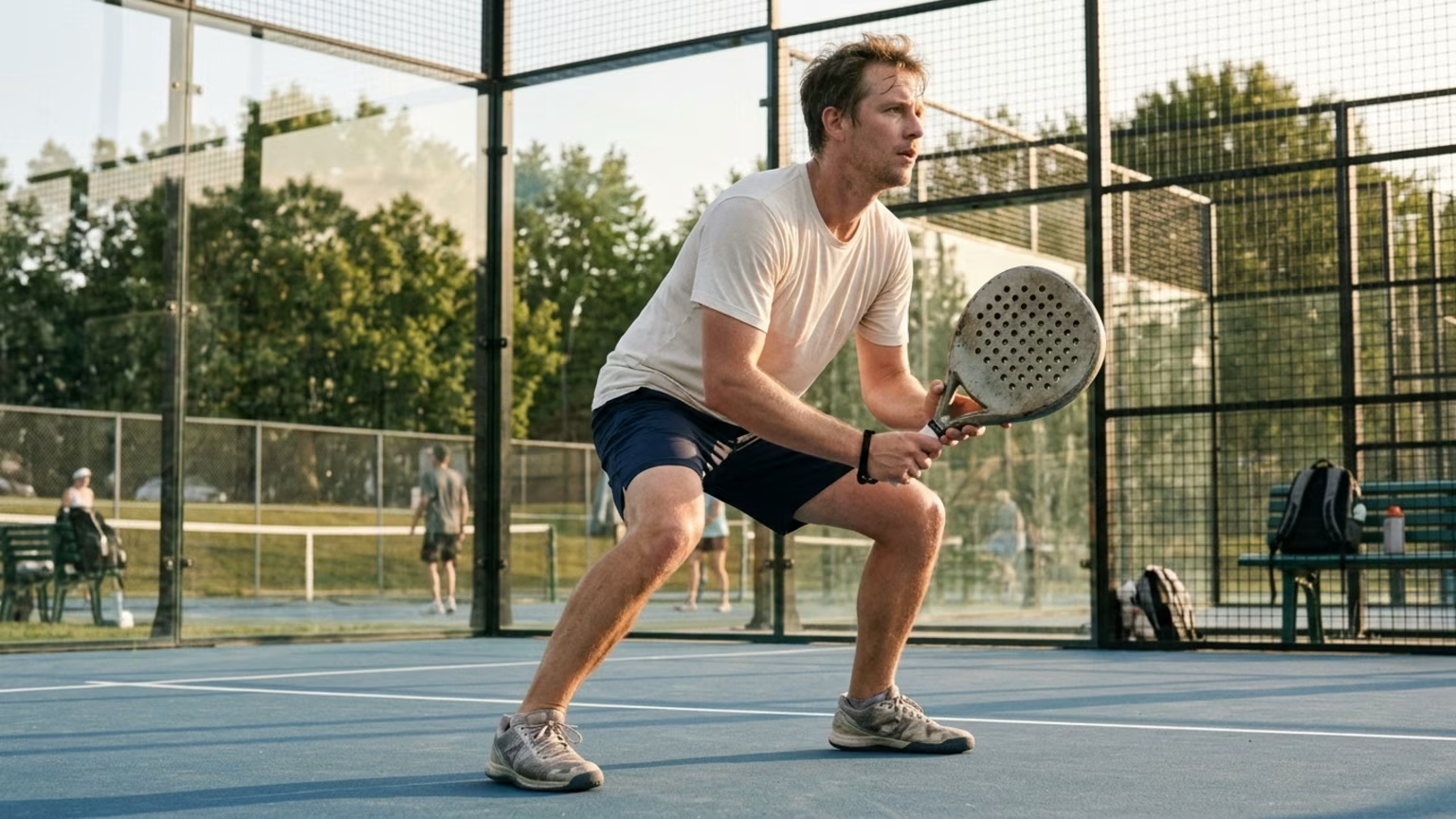

Understand padel footwork through positioning, split steps, controlled arrivals and partner recovery, with clear limits on what the evidence supports.




Balanced footwork is the sequence of preparing, moving, stopping and recovering so you can play the ball and be ready for the next shot. In padel, that means looking beyond how quickly you reach a volley. Your position before moving and your control on arrival belong to the same sequence.
A coaching guide to padel net movement describes short adjustments, lateral coverage and recovery rather than a continuous rush toward the ball. Its central idea is practical: reaching this shot should leave you prepared for the reply.
Padel asks players to repeat short movements within a point. A gym-training guide summarizing a 2022 narrative review of 36 padel studies reports around four to six shots over 10-15 seconds. It describes movement as mostly forward or sideways, with rest periods slightly longer than the periods of play.
That pattern puts the emphasis on repeated starts and changes of direction rather than one uninterrupted run. The coaching guide adds another demand: controlling the arrival well enough to play the shot and recover. The stop is part of the movement task.
For players who also enjoy tennis or pickleball, the useful connection is the question being asked. In tennis practice, consider the arrival and recovery around the stroke. In pickleball practice, consider whether a short adjustment finishes in a ready position. These are ways to examine repeated explosive efforts and direction changes without assuming identical footwork across sports.
Padel's specific framework here includes moving with a partner and retaining options against a lob. That is why movement context matters more than a sport label when thinking about what to practise.
The review summary supplies context about match demands. The coaching guide supplies suggestions for handling them: choose a useful position, prepare at the opponent's contact, cover the distance and control the final steps.
The evidence has clear limits. Much of the match data concerns advanced and professional players rather than recreational adults. The movement recommendations and net-position distance are coaching guidance, not experimentally established rules. Neither source demonstrates that the suggested drills prevent injury or extend playing longevity.
Within that boundary, the guide offers a coherent framework for practice.
The coaching guide suggests roughly 2-2.5 metres from the net as a useful reference for volleying while retaining room to respond to a lob. The underlying coaching priority is keeping more than one direction available.
Rather than treating position as a spot to occupy regardless of play, the guide describes staged advances and small adjustments. A useful practice question is whether the starting position supports both the next volley and a possible retreat. Positioning belongs before the first movement, not just after a late arrival.
The guide describes a split step as a small hop with the landing timed to the opponent's contact. It treats that landing as a brief stop before a push forward, sideways or backward. Landing too early or continuing to drift forward is presented as a source of poor balance.
The practice emphasis is timing rather than jump height. The guide suggests reacting to partner feeds so the preparation happens in relation to an incoming ball. This gives the split step a purpose within the point instead of making it an isolated movement to perform on command.
For a short lateral adjustment, the guide recommends a side shuffle. When more ground needs covering, it recommends a crossover step. It also notes that recovery may be diagonal rather than purely sideways.
These choices give practice a clearer focus than simply asking for quicker feet. The guide suggests shadow shuffles with directional calls as one way to rehearse lateral responses. The question is whether the movement choice suits the distance, not whether every ball can be reached with the same pattern.
Near the ball, the guide favours short adjustment steps rather than one large reaching lunge. Its coaching rationale is that an extended reach can make racket control and recovery harder. The final steps therefore deserve attention alongside the initial push.
One suggested practice format is a volley followed by recovery toward a balanced central position. The repetition includes what happens after contact rather than ending at the hit. This connects with treating braking as part of court movement: the arrival is a transition, not the finish line.
The guide recommends partners shifting in the same direction at the net to preserve middle coverage. If a lob beats one player, it recommends retreating together. Alternating volley and lob feeds is one of its suggested ways to rehearse those responses.
This makes recovery a shared task rather than two separate trips back to position. Practice can include where both players finish after the shot and whether they are prepared for the next feed. The guide also recommends starting with one habit before adding others, keeping the focus manageable.
For adult players, athletic longevity is a reason to value the whole movement sequence rather than the fastest single step. The useful goal is continued capability: being able to prepare, reach the ball and leave that shot ready to move again.
This framework also gives practice a more specific purpose. A player can focus on split-step timing or the final adjustment steps without turning every session into a test of raw speed. Partner recovery offers another focus when individual movement is no longer the main question.
It is worth separating that goal from promises about aging. Better technique should not be presented as a guaranteed replacement for physical capacity. Here, the practical value is having clear movement habits to rehearse and clear questions to bring to a coach.
Evercourts's emphasis is on understanding the demands of play while keeping long-term participation in view. In this case, connecting the shot to the next movement is a useful editorial lens: assess the sequence rather than celebrating an isolated reach.
When discomfort, a sense of instability or difficulty stopping changes how you move, a qualified physiotherapist or healthcare provider is the appropriate person to assess your situation. The same applies when a physical concern keeps interrupting practice or makes you uncertain about changing direction.
A coaching cue can describe a movement. It should not become a self-diagnosis or a treatment plan. Personal decisions about symptoms and physical limitations belong with qualified care rather than a generic footwork drill.
There is more to staying in the game than reaching one more ball.
Follow Evercourts for practical insights on tennis, pickleball and padel performance, movement, recovery and healthy ageing. Stay connected for new articles, research-led guidance and ideas to help you play well and keep playing for years.


Learn how to turn, track and recover for pickleball lobs with a gentle partner drill, plus what fall research says about balance and footwork.

Tennis match data explain why conditioning involves repeated bursts and recovery. Apply the pattern without treating research averages as personal targets.

A flexible pickleball warm-up progressing from easy movement to controlled lunges, side steps, shadow swings and dinking, with readiness-based adjustments.
Read practical guidance for better movement, smarter preparation and a game that keeps working for you.
explore the Blog
