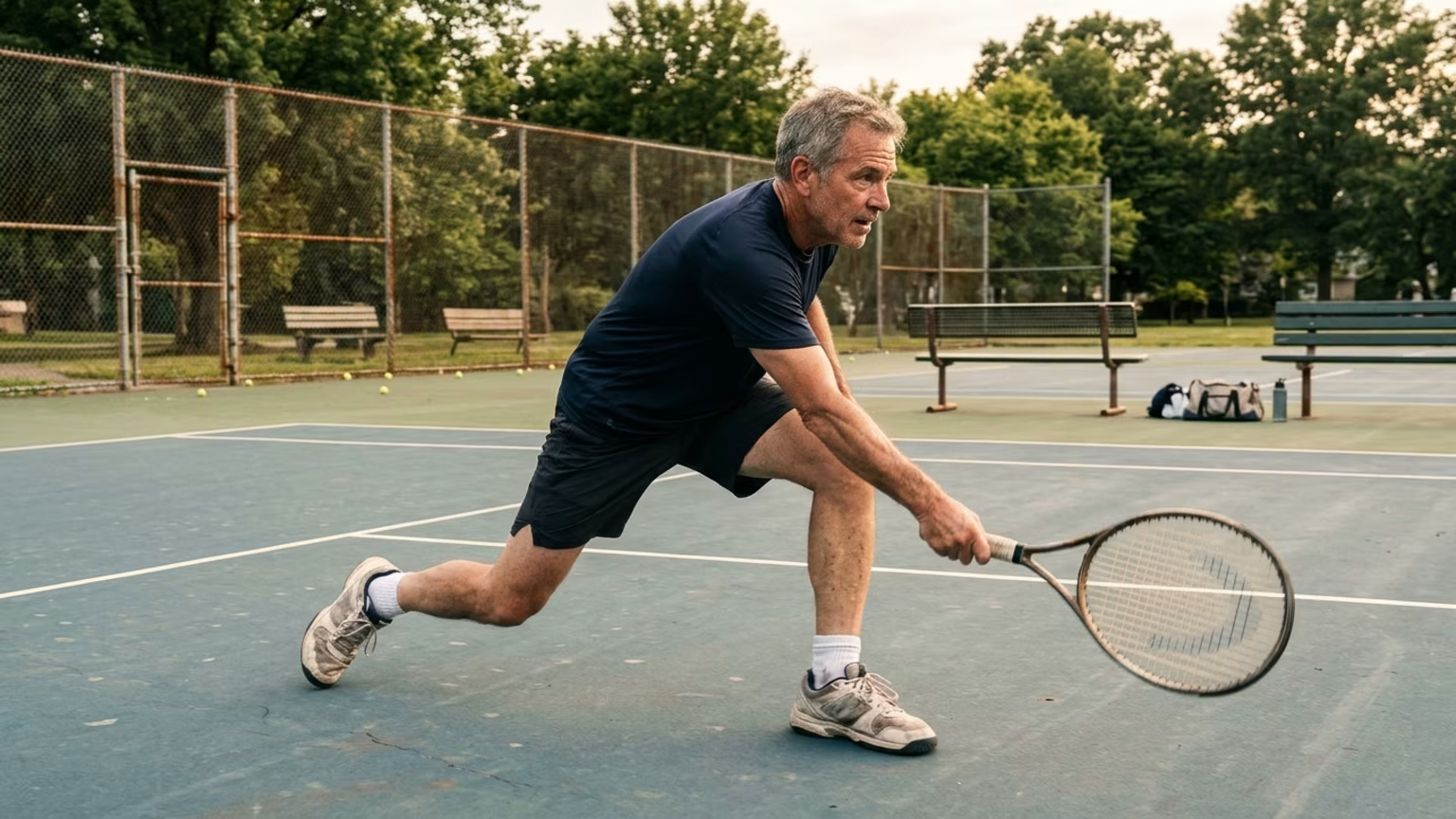

Understand a practical strength foundation for racquet sports, what older-adult studies show and when to seek professional guidance.




A strength foundation is an adaptable approach to preparing your body for the movements you want to keep using on court. For adult racquet players, the useful categories are leg strength, trunk control, shoulder capacity and balance.
The goal is to organize your preparation around the game you play and the capabilities you value. That might mean feeling more confident about movement or making off-court work easier to fit into your week. The starting point is a clear purpose, not a universal workout.
Repeated explosive efforts and changes of direction are useful reference points when thinking about racquet-sport preparation. The practical challenge is not just making one movement. It is being ready to make another effort and regain control as play continues.
An editorial way to connect those demands with training is to keep the whole player in view:
The shared categories help organize the discussion without making the sports interchangeable. For a broader planning perspective, our guide to relating strength work to court demands keeps the focus on the tasks players want to perform.
In a randomized eight-week trial described in a physiotherapy summary, researchers studied 72 community-dwelling older adults with pre-frailty. Their median age was 67. Participants were assigned equally to supervised pickleball or a usual-lifestyle control group.
The researchers reported that 42% of the pickleball group moved from pre-frailty to non-frailty, compared with 8% of controls. The pickleball group also improved on the 30-second chair stand and 30-second arm curl. Improvements were reported for the back-scratch flexibility test and six-minute walk too.
That is an encouraging finding about functional fitness in the population studied. It gives the discussion of healthy aging something more concrete than a broad promise about staying active.
A report on a review of racket-sport interventions described 13 trials across 14 papers involving adults aged 60 and older. The review's primary analysis included 10 randomized trials and 469 participants.
The scope of those findings matters. The pickleball trial tested supervised play, not an off-court strength program. Its eight-week findings do not establish long-term effects or fewer sports injuries. Nor do they establish benefits for every adult player or for tennis and padel players.
The review's tennis evidence came from one trial of 16 men without a non-exercise control group. No included trial directly compared the racket sports. The authors concluded that the available evidence was insufficient to determine whether one sport was superior.
Taken together, these sources do not validate an exact exercise menu or training progression. Leg strength, trunk control, shoulder capacity and balance are practical planning categories here, not a tested sequence.
Understanding these categories gives adult players a clearer language for the capabilities they want to maintain. Instead of treating “stay strong” as one vague goal, the discussion can include lower-body ability and upper-body capacity as well as control and balance.
That is the practical link to athletic longevity. The question becomes how physical preparation can sit alongside the sport you enjoy, rather than whether you can copy somebody else's hardest session.
Use the following areas as an agenda for planning.
Keep lower-body preparation visible in the overall plan. Describe the court movements you want to feel more capable performing, so the discussion starts with your game rather than a favorite gym exercise.
Give control of the body's middle its own place in the discussion. The practical question is how this part of your preparation relates to the positions and movements you use during play.
Include the shoulder rather than letting leg work stand for complete preparation. Identify the court actions you want to keep doing comfortably and bring those priorities into the planning process.
Consider balance alongside strength instead of assuming the terms mean the same thing. Make it an explicit part of the conversation about movement capacity and continued participation.
Consistency is the organizing principle, not a fixed starting standard. An adaptable plan can begin with your current experience and the place training has in your life. Our guide to fitting physical preparation around a busy playing week offers another planning perspective.
For the long view, define success in terms that matter to your participation. That could be maintaining valued movements or having an approach you can keep returning to. Choose goals that describe the player you want to remain, rather than demanding a particular performance result from the research.
Recurring aches or stiffness deserve a conversation with a qualified physiotherapist or healthcare provider when they are changing how you play. Seek that input too if concerns about strength or balance are making exercise choices uncertain. A perceived loss of physical ability is something to discuss, rather than something this article can diagnose.
Bring a description of the movements that concern you and the activities you want to continue. Ask for help relating those concerns to an appropriate starting point. Personal decisions about pain or reduced function belong with qualified care.
Keep the focus on the game you want to keep playing.
Follow Evercourts for practical insights on tennis, pickleball and padel performance, movement, recovery and healthy ageing. Stay connected for new articles, research-led guidance and ideas to help you play well and keep playing for years.


Learn how to turn, track and recover for pickleball lobs with a gentle partner drill, plus what fall research says about balance and footwork.

Tennis match data explain why conditioning involves repeated bursts and recovery. Apply the pattern without treating research averages as personal targets.

A flexible pickleball warm-up progressing from easy movement to controlled lunges, side steps, shadow swings and dinking, with readiness-based adjustments.
Read practical guidance for better movement, smarter preparation and a game that keeps working for you.
explore the Blog
