

Learn how adult tennis, pickleball, and padel players can build a sustainable weekly training schedule balancing court time, strength work, and recovery.




In July 2026, a network meta-analysis of 34 randomized controlled trials involving 1,746 participants examined resistance training strategies for middle-aged and older adults. This extensive review shifts the focus away from rigid fitness protocols toward practical consistency. It highlights a growing consensus that flexible training habits matter more than perfect programming. Adult racquet sports players can use these findings to build a schedule that actually fits their busy lives.
The findings from recent evidence syntheses point toward a pragmatic approach to physical preparation. A large systematic review of resistance training prescriptions found that all studied approaches were superior to no exercise for improving strength. The strongest practical message is that establishing a consistent habit is more important than building a highly elaborate routine. Public health guidance aligns perfectly with this realistic mindset.
The World Health Organization recommends 150 to 300 minutes of moderate aerobic activity per week. Players can alternatively complete 75 to 150 minutes of vigorous activity. Adults are also advised to complete muscle-strengthening work for all major muscle groups on at least two days per week. Hitting these baseline targets provides a solid foundation for tennis, pickleball and padel players.
For adults aged 65 and older, guidelines recommend adding multicomponent activity on three or more days weekly. This specific guidance emphasizes functional balance and strength. The major muscle groups relevant to this standard include the legs, hips, back, abdomen, chest, shoulders and arms.
The 2026 network meta-analysis reinforced that moderate-intensity resistance training three times weekly ranked highest for several skeletal sites in middle-aged and older adults. Meanwhile, high-intensity resistance exercise twice weekly ranked highest for total-body bone mineral density. This variety in outcomes proves that multiple paths lead to better physical resilience. Evercourts recognizes that covering these bases consistently is the key to athletic longevity.
Professional athletes structure their entire week around maximizing their physical output and recovery. They rely on optimal doses of heavy training to build peak power. The adult recreational player faces a completely different physical reality. Work, family obligations and daily stress all compete for the same limited recovery resources.
Attempting to replicate an elite training schedule usually leads to fatigue rather than adaptation. For a busy adult racquet-sport player, the most defensible starting point is two short full-body strength sessions. These sessions should cover a squat or lunge, a hip hinge, an upper-body push and an upper-body pull. A practical strength session can use one challenging work set per movement pattern when time is severely limited.
Evidence from a systematic review in resistance-trained men evaluated low-volume training approaches. It suggests that a single set of six to 12 repetitions can produce significant strength gains over eight to 12 weeks. The load should sit at approximately 70 to 85 percent of a one-repetition maximum. While these gains are suboptimal compared with higher-volume programming, they provide an excellent practical minimum for adults balancing multiple commitments.
Technique and effort must remain high for a minimal volume approach to work. Players should progressively increase the difficulty when the exercise becomes easier. The evidence does not justify presenting one exact set count or weekly frequency as universally optimal for every player. A sensible two-day strength training program covers the essentials without overwhelming a busy schedule.
Recent resistance training research clarifies the difference between an optimal dose and a minimum effective stimulus. Higher-load, multiset training performed three times weekly produced the strongest average strength outcomes in some comparisons. The same evidence synthesis found that multiset training performed twice weekly produced the strongest average hypertrophy outcomes. However, a separate evidence summary described the practical minimum as a broad region of approximately two sets performed twice weekly.
This shows that the minimum effective dose is a range rather than a single fixed number. Flexibility and readiness also depend on specific timing and preparation protocols. A systematic review on stretching found that static stretching increases range of motion. However, long static stretching can temporarily reduce performance immediately before activity.
Dynamic stretching improves readiness with minimal flexibility gains. Players should use dynamic joint movements before court play and save static stretching for post-session recovery. Racquet sports require sharp changes of direction and quick bursts of speed. Low-certainty pooled evidence suggests that neuromuscular training may improve stroke velocity and short-distance sprint performance.
Players should treat balance and functional strength as explicit training categories. Assuming that court play alone covers all these physical qualities is a common mistake. You can learn more about balancing these demands in our guide on how to build a sustainable weekly racquet sports schedule. Proper preparation reduces the risk of aches and stiffness during a long season.
A manageable week requires a deliberate balance between court time and off-court conditioning. A player might schedule two full-body strength sessions and two to four court sessions. The exact number of court hours depends heavily on match intensity and individual recovery capacity. Short mobility exposures can easily attach to warm-ups or daily routines without requiring a separate workout.
Every schedule needs at least one deliberately easy or complete-rest day. Put a demanding strength session on a day separated from the week’s most important match. If strength and court training must occur on the same day, place the higher-priority session first. Avoid stacking a hard lower-body strength session immediately before your most explosive court match.
A competitive match acts as a high-load training day and requires adequate recovery. During a crowded work week, preserve one strength session and the key court match first. A weekly schedule should account for total stress rather than only formal workouts. Poor sleep, heavy work demands and family responsibilities reduce the amount of training a player can recover from.
Players can use a simple traffic-light system to manage their daily readiness. Green means normal energy and good movement quality, allowing you to complete the planned session. Yellow indicates poor sleep or heavy legs, signaling that you should shorten the session or lower the intensity. Red means acute pain, altered mechanics or illness.
When you hit a red light, stop the planned workout and seek appropriate professional advice. Strength training performed through an appropriate range of motion may also contribute to mobility. The safe return to play framework can help guide decisions after a minor setback. Careful scheduling and common sense keep players on the court longer.
The emerging practical distinction is between a minimum dose that produces a meaningful stimulus and a higher dose that maximizes progress. These two concepts should never be conflated when building a weekly routine. A brief program may be sufficient to maintain or improve capacity during a busy period. When schedules open up, players can gradually add volume to drive further adaptation.
Healthy aging guidance is increasingly combining aerobic activity, resistance training, balance and flexibility. The sports science community will likely continue shifting away from rigid fitness prescriptions in the coming seasons. We expect future research to focus heavily on practical dose combinations that busy adults can actually sustain over decades. The conversation is moving from theoretical optimization to realistic consistency.
The sustainable week is not the one with the most sessions or the heaviest weights. It is the smallest repeatable structure that keeps a player exposed to court movement and full-body strength. Recognizing the difference between enough training and too much training requires patience. True progress often looks like a quiet, steady commitment to the basics over many unbroken seasons.
Follow Evercourts for practical insights on tennis, pickleball and padel performance, movement, recovery and healthy ageing. Stay connected for new articles, research-led guidance and ideas to help you play well and keep playing for years.


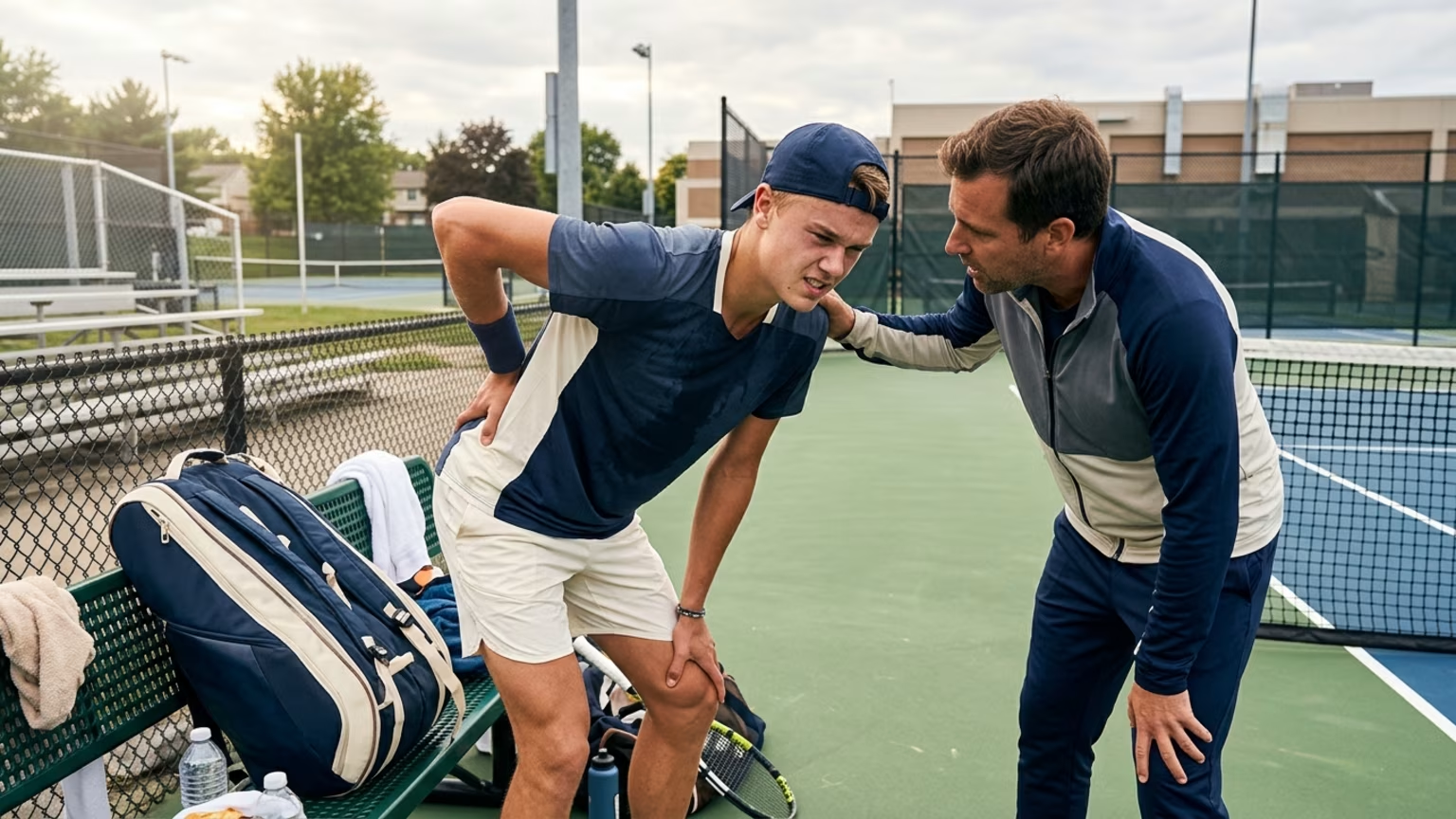
Holger Rune withdrew from the European Open with a back problem. The facts behind his decision and a grounded perspective for recreational players.

The Dink’s October 17 guide emphasizes deep returns, ball-height decisions and positioning against faster pickleball opponents.

A new report outlines padel and tennis gear trends. Learn how to assess adjustable rackets, sensor feedback and smart-court claims.
Read practical guidance for better movement, smarter preparation and a game that keeps working for you.
explore the Blog
