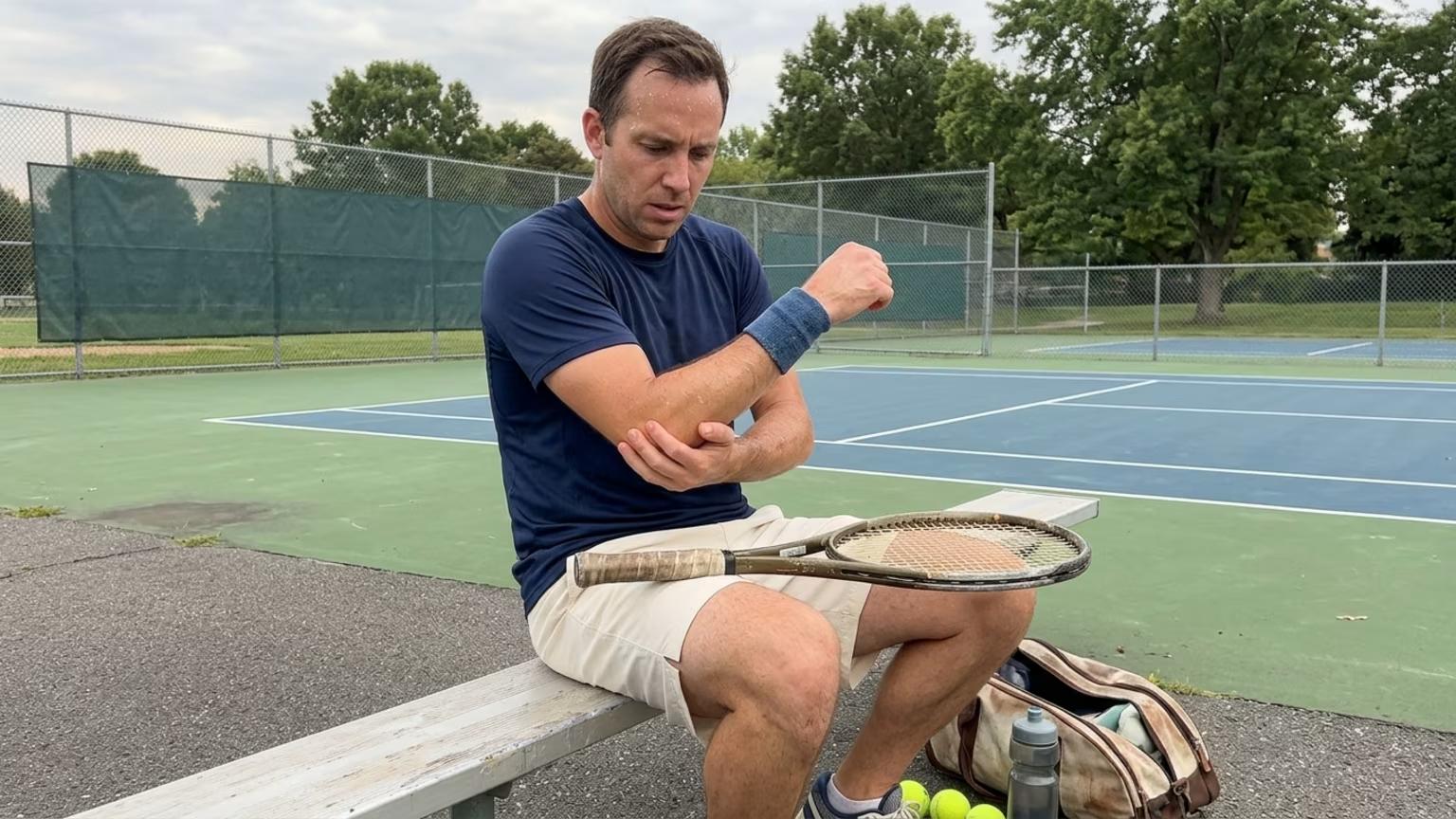

Review playing load, recovery and equipment changes before blaming your racket for elbow pain, plus signs that merit professional assessment.




What should I review before blaming my racket for tennis elbow? Review recent playing exposure and stroke demands alongside recovery and equipment changes instead of treating the racket as the sole explanation.
The racket belongs in the review, but it does not deserve an automatic guilty verdict. NY Bone & Joint describes tennis elbow as pain associated with the tendon attachment on the outside of the elbow. Gripping or lifting may hurt, but pain in that area should not automatically be labelled tennis elbow.
A 2026 narrative review in the International Journal of Sports Physical Therapy proposes that workload and stroke demands may interact with fatigue and recovery. It also considers movement efficiency and equipment. Its central idea is that cumulative mechanical exposure may persistently exceed a player's capacity to adapt.
The same review describes most tennis-related injuries as developing gradually in association with repetitive loading. That makes a look back at recent play more useful than focusing only on the racket in your hand today. The latest equipment change is worth recording alongside the wider pattern.
The authors call their Cumulative Elbow Load Model hypothesis-generating rather than predictive. Much of the underlying research concerns elite and professional players. It does not establish a recreational player's personal risk or a safe playing-volume threshold.
An equipment review notes that studies often measured vibration or forearm activity in healthy players. It describes lower peak elbow vibration at roughly 45 pounds than at roughly 55 pounds in a stationary-racquet test. These are laboratory outcomes, not proof that a setup prevents or treats elbow symptoms.
It also reports greater improvement in a controlled trial's active-damping group than in the group using the same racket with the system switched off. That single trial does not establish which racket will help a particular player.
For a player, the useful distinction is between noticing that equipment feels different and knowing why symptoms developed. Keep that distinction in view when weighing an equipment upgrade. A racket change can be part of the history without becoming the whole explanation.
Build a dated account of what changed around the time symptoms began. The review's workload framework supports looking at the whole playing picture rather than isolating one purchase. The useful question is not just what you use, but what your arm has been asked to do.
If several things changed together, keep them together in the record. A new string setup introduced during a busier stretch of tennis is a different history from a setup change with an otherwise unchanged routine. That distinction keeps the review focused on the sequence of changes.
Alongside those notes, record when symptoms appeared and what activities brought them to your attention. This is a reflection aid for a more informative conversation, not a diagnostic test. A clear account is more useful than trying to make every detail fit the assumption that the racket must be at fault.
A break from play does not establish why your elbow hurts. In the same way, replacing a racket does not establish what caused the symptoms. The practical issue is understanding the pattern rather than treating either choice as an answer in itself.
That is why the history still matters if you have already stopped playing or changed equipment. Include what happened before the change and what you noticed afterward. Describe the sequence without treating improvement or recurrence as proof of a particular cause.
For tennis, include both practice and matches. If you also play padel or pickleball, identify those sessions separately in your account. That is a practical way to describe your activity, not evidence that the tennis review establishes injury risks or safe workloads in those sports.
Whether to pause or adjust play is a personal decision to discuss with a qualified clinician. This evidence does not supply a universal rest period or return-to-play rule. The goal of reviewing your recent activity is to support that discussion rather than make a playing decision from an equipment claim alone.
NY Bone & Joint advises assessment when pain persists or worsens. It also flags pain that repeatedly returns with play or interferes with gripping and everyday lifting.
Other reasons for assessment include:
These changes are reasons to have the symptoms assessed rather than assume that tennis elbow or the racket explains them. A self-review is useful background for that assessment, not a reason to put it off.
The useful goal is a clearer picture of your symptoms, not a guilty verdict for your racket. Confidence and a thoughtful approach to athletic longevity can belong on the same court.
Follow Evercourts for practical insights on tennis, pickleball and padel performance, movement, recovery and healthy ageing. Stay connected for new articles, research-led guidance and ideas to help you play well and keep playing for years.


Learn how to turn, track and recover for pickleball lobs with a gentle partner drill, plus what fall research says about balance and footwork.

Tennis match data explain why conditioning involves repeated bursts and recovery. Apply the pattern without treating research averages as personal targets.

A flexible pickleball warm-up progressing from easy movement to controlled lunges, side steps, shadow swings and dinking, with readiness-based adjustments.
Read practical guidance for better movement, smarter preparation and a game that keeps working for you.
explore the Blog
