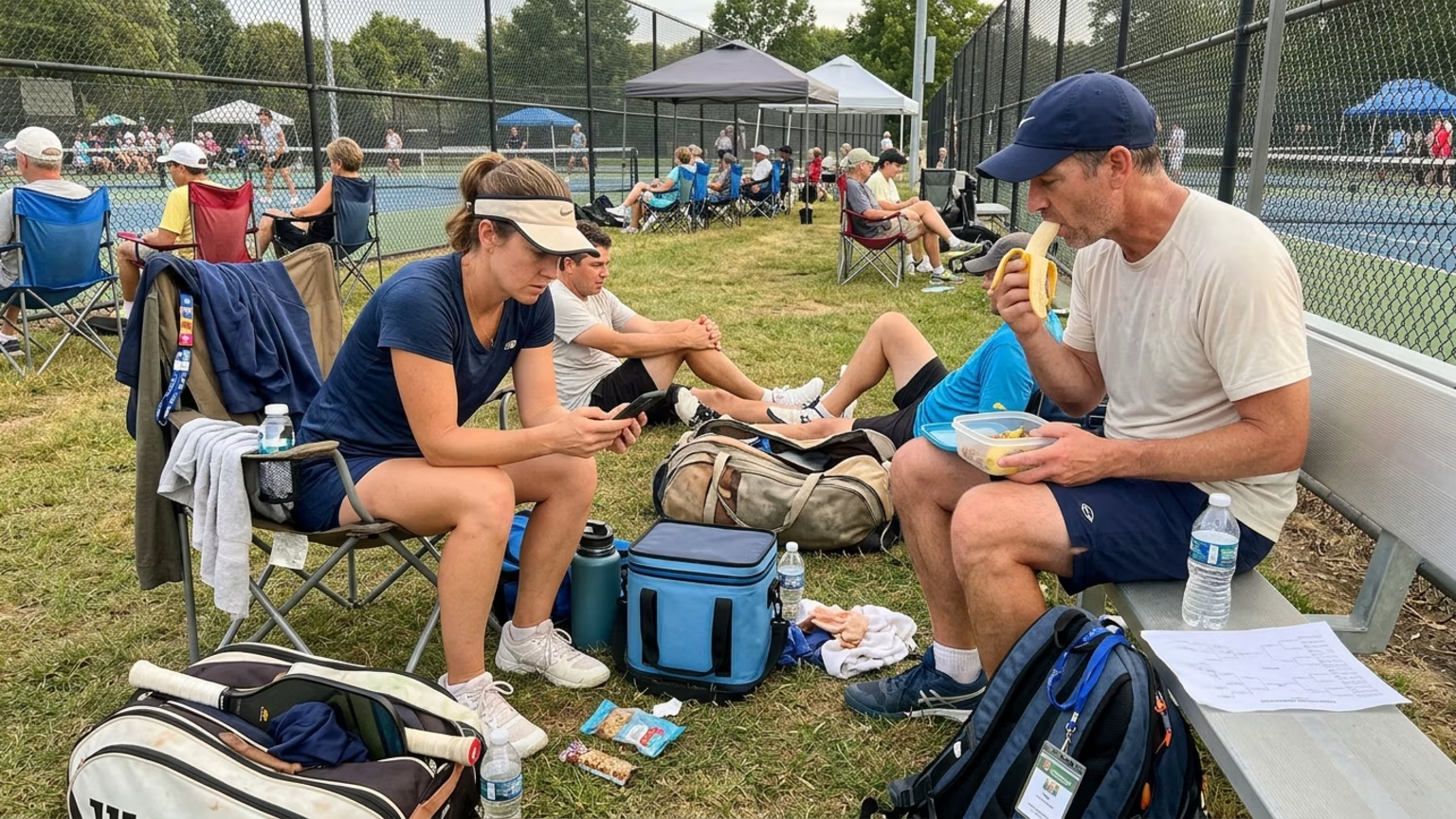

Practical answers on tournament schedules, food, fluids, downtime and travel, with a reusable checklist for tennis, pickleball and padel players.




How do I plan a better tennis, pickleball or padel tournament weekend when the match time on my phone keeps changing? Keep the latest schedule at the centre of a flexible plan for warm-up space, familiar food and fluids, downtime and travel.
This is an editorial planning aid rather than a tested tournament-weekend protocol. The sources do not establish universal warm-up durations, meal schedules, drinking targets or travel buffers. The studies discussed below involve small groups in specific conditions, so they are not predictions for your weekend or a ranking of the sports.
Start with what is currently confirmed: your match schedule, the venue locations and the channel used for updates. Treat everything around those details as adjustable. A meal plan or trip away from the venue should fit the current schedule rather than compete with it.
A pickleball between-match recovery guide recommends checking actual court or bracket updates before leaving the venue or committing to a long meal. That is a useful planning principle across a tournament weekend: check first and make the decision second.
Before the event, establish these basics:
Keep your expected match time separate from any plans built around it. If the schedule changes, revisit the meal or journey attached to that time. Do not assume the rest of the plan still fits simply because it was sensible earlier.
For events involving several locations, include travel and parking in your planning. Leave a buffer rather than treating the journey itself as the entire gap between matches. This is logistical judgement rather than a research-based arrival rule.
It also helps to understand how the competition format shapes the day. Use that context alongside the organizer’s latest information rather than treating the opening schedule as a fixed appointment book.
Pack familiar options and decide what fits once the available break becomes clearer. A tennis-and-pickleball nutrition guide recommends familiar, easy-to-digest food. It advises small snacks for shorter gaps and a light meal when more time is available.
The practical distinction is between having options and following a rigid menu. Packing food does not commit you to eating everything at a particular hour. It gives you a choice when the next court notification arrives.
A flexible food plan can follow this pattern:
The same nutrition guide recommends bringing familiar food and fluids instead of relying entirely on venue access. Tournament day is not the moment to make an unfamiliar product the centre of your plan.
For hydration, plan access to fluids and account for the conditions. The pickleball recovery guide describes needs as varying with temperature and humidity. It also identifies match length, body size and individual sweat rate as relevant considerations.
A tennis injury-prevention article summarizes guidance to arrive hydrated and drink at changeovers. It also discusses cooling during play and allowing longer recovery between same-day matches as heat rises.
The planning implication is to consider heat before the day begins rather than only after a demanding match. Personal medical decisions about food, fluids or competing in heat belong with a qualified health professional.
Give the break a purpose without turning it into another performance task. The pickleball recovery guide recommends light movement during longer breaks and rewarming before the next match. Identify suitable space for both waiting and getting ready again.
The shared planning principle is readiness for the next match. The sport-specific evidence adds context about what deserves attention.
The tennis injury-prevention article summarizes a study in which seven trained men played four-hour matches on four consecutive days. Sprint, jump and serve-accuracy performance declined on days two through four.
For weekend planning, the useful interpretation is to consider the whole event rather than preparing only for the first match. Keep later matches and the following day visible when organizing meals and downtime. A full itinerary between matches is not necessary to make the weekend worthwhile.
The pickleball recovery guide places particular emphasis on checking current court notifications before making plans away from the venue. Use the actual available gap to decide whether there is room for a meal or a trip elsewhere.
For a longer break, its advice combines rest with light movement and a return to warm-up before play. Waiting comfortably and being ready to move again are compatible aims. Neither requires treating every spare moment as training.
A padel sports-science summary reports an average match duration of 57.2 minutes across 13 matches involving 52 amateur players. Those matches averaged about 152 points.
That average describes the matches studied. It should not become the time you automatically allow for your own match or the basis for a tight journey afterwards.
Keep transport and meal plans flexible around the actual finish and next scheduled start. For players moving between sports, understanding their different competition demands provides context without assuming one sport’s timetable transfers neatly to another.
Use the same core checklist for either setting. The difference is which details need more attention, not whether a familiar venue removes the need to check.
For a local event, do not assume that going home fits the gap without checking. For an away event, make the unfamiliar locations part of the same review.
The checklist is complete when it gives you workable options. It does not need to account for every possible delay or turn the weekend into a minute-by-minute exercise.
The match time on your phone may change, but a flexible plan can still make the weekend feel manageable. Good tournament planning is not a promise of perfect performance; it is a way to enjoy competing while keeping your longer playing life in view.
Follow Evercourts for practical insights on tennis, pickleball and padel performance, movement, recovery and healthy ageing. Stay connected for new articles, research-led guidance and ideas to help you play well and keep playing for years.


Learn how to turn, track and recover for pickleball lobs with a gentle partner drill, plus what fall research says about balance and footwork.

Tennis match data explain why conditioning involves repeated bursts and recovery. Apply the pattern without treating research averages as personal targets.

A flexible pickleball warm-up progressing from easy movement to controlled lunges, side steps, shadow swings and dinking, with readiness-based adjustments.
Read practical guidance for better movement, smarter preparation and a game that keeps working for you.
explore the Blog
