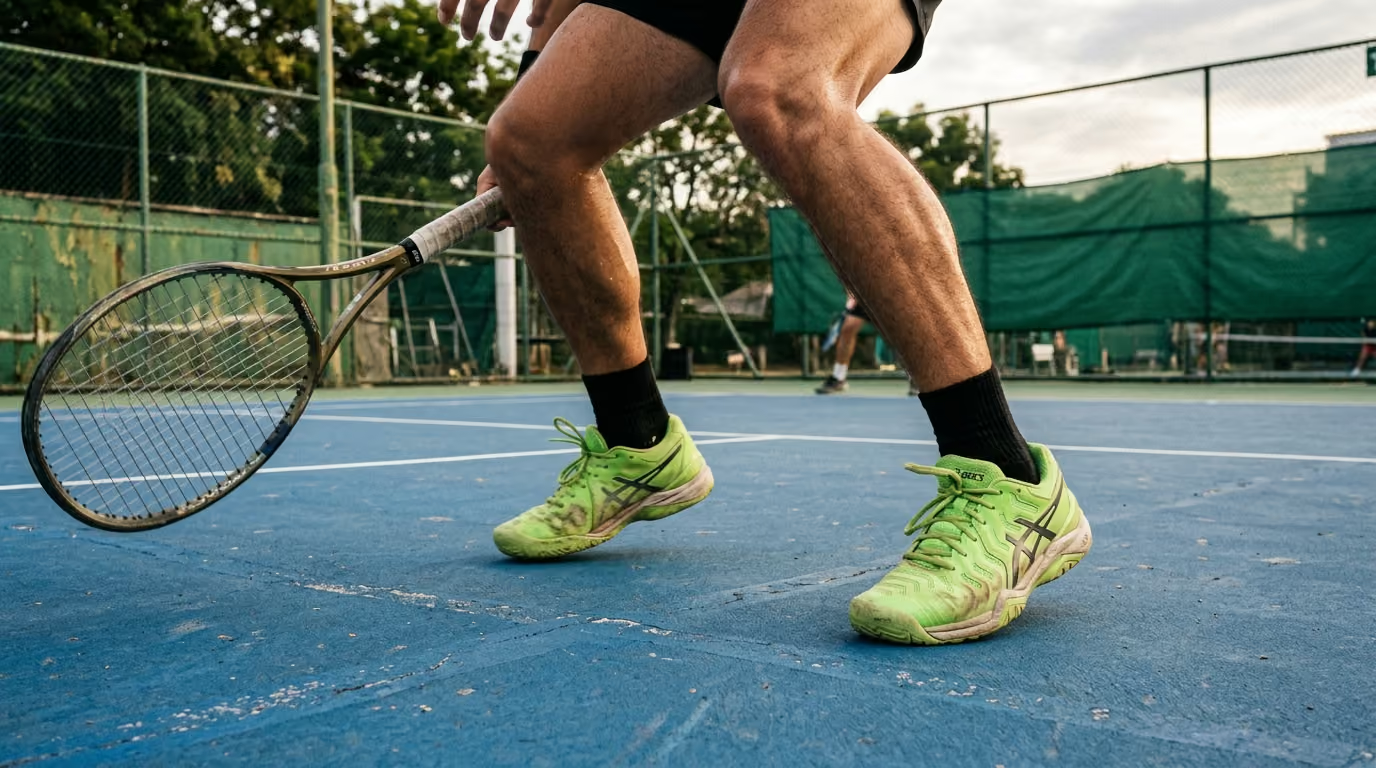
When a ball bounces off the glass in padel or a volley sails out in pickleball, players encounter distinct competitive environments across racquet sports.




Have you ever stepped onto a pickleball court after years of playing tennis, only to watch your first volley sail twenty feet out of bounds? Or perhaps you completed a padel match feeling deeply confused by how a ball could bounce off the glass and still remain active. Many players struggle to transition between these popular racquet sports because they assume a racquet is simply a racquet.
Tennis, pickleball, and padel share fundamental hand-eye coordination but represent entirely different competitive environments. Tennis demands massive court coverage and explosive linear sprinting, pickleball requires rapid close-range reactions with strict spatial rules, and padel emphasizes partner coordination and wall-rebound dynamics. Successful cross-sport play depends on adapting your swing mechanics, movement recovery patterns, and tactical patience to match each court's unique geometry.
Recent biomechanical and match-analysis studies highlight distinct physical demands across these sports. Researchers have examined how ball speed, impact forces, and directional changes vary from the expansive tennis baseline to the restricted pickleball non-volley zone. While the sports share physiological benefits, evidence shows that the specific neuromuscular load differs based on court surface and equipment weight. Understanding these differences allows players to protect their joints and play with greater efficiency.
To move fluidly and compete without injury, you must understand how these sports differ. Let us look at the distinct characteristics of each sport to help you transition smoothly.
Understanding court geometry is the first step toward masterly spatial awareness. The physical size of the court dictates how much ground you must cover and how much time you have to react.
A regulation tennis court is 78 feet long, which equals 23.77 meters. The singles width is 27 feet, while doubles play expands this width to 36 feet. This massive area forces players to cover significant ground. It naturally supports deep baseline exchanges, open-court movement patterns, and large recovery distances.
The vast depth of a tennis court allows players to hit the ball with high clearance over the net. This height creates deep, heavy bounces that push opponents backward. Because the court is open, players must constantly run and slide to recover their position. This dynamic makes lateral and vertical coverage the primary physical challenge of tennis. For more on managing your court time and lifestyle, check out our competition court lifestyle resources page.
A pickleball court measures exactly 20 feet wide by 44 feet long. This footprint remains identical for both singles and doubles match play. The defining feature of this space is the non-volley zone, commonly known as the kitchen. This restricted area extends 7 feet from the net on both sides.
Players cannot hit a volley while standing inside this zone or touching its boundary lines. This spatial rule completely changes how players manage depth and court positioning. It transforms the area near the net into a zone of tactical restraint and delicate placement. Players must learn to balance right on the edge of this line without stepping over during fast exchanges.
A standard padel court is 20 meters long and 10 meters wide. Instead of open boundaries, glass walls and mesh fencing enclose the playing area. This structural enclosure changes how players interpret court depth and ball trajectories.
A ball that passes a player is not necessarily a lost point. Players must wait for the ball to rebound off the wall before striking it. This makes reading the glass a fundamental competitive requirement. The walls turn defensive positions into offensive opportunities, requiring players to stay calm when the ball goes past them.
The tools of each sport alter the physical feedback in your hand. The interaction between the ball and paddle determines how you generate power and spin.
Tennis utilizes a strung racket and a pressurized ball. The large racket head and long handle generate significant leverage and racket-head speed. This configuration allows players to produce heavy topspin and high-velocity serves. The impact forces are distributed through the string bed, which dampens shock but requires a longer swing path.
The tennis ball is pressurized and covered in felt. This felt catches the air and responds dramatically to topspin and slice. Players must use full-body rotation to control this heavy, fast-moving ball. The physical demand on the shoulder and wrist is substantial due to the weight of the racket and the impact of the ball.
In contrast, pickleball uses a solid, noncompressible paddle. The official ball is a perforated plastic sphere with 26 to 40 circular holes. USA Pickleball rules state the ball diameter must be between 2.87 and 2.97 inches. The weight is restricted between 0.78 and 0.935 ounces.
This lightweight plastic ball does not compress like a tennis ball. It has minimal bounce and decelerates rapidly in the air. Players who swing with tennis-like speed will find the ball flying out or sitting up for easy counterattacks. To play well, you must use shorter, more controlled strokes. Check out our pickleball strategy and training section for detailed guides on paddle control.
The padel racket is solid, perforated, and must not exceed 45.5 centimeters in length. A safety wrist strap is mandatory during all matches. The ball is pressurized and closely resembles a tennis ball in size and weight.
FIP regulations require a ball weight between 56.0 and 59.4 grams. When dropped from 2.54 meters, the ball must bounce between 135 and 145 centimeters. This pressurized ball carries substantial momentum compared to a pickleball. It produces high-speed rebounds off the court and the walls. The solid racket requires precise contact to avoid sending vibrations into the elbow.
The scoring system of a sport shapes its psychological rhythm. How points are accumulated determines when and how you should take risks.
Tennis uses a traditional point sequence of love, 15, 30, 40, and game. If players tie at 40-40, they enter deuce, where a player must win two consecutive points. Sets are won by reaching six games with a two-game margin. This scoring system creates immense psychological pressure because service holds are highly valued.
A single poor service game can cost a player an entire set. The scoring also means you can win more total points but still lose the match. This dynamic makes point management and clutch performance essential. Players must learn to focus intensely during break points and deuce games. Discover more about managing match pressure in our technical tennis training articles.
Pickleball relies on side-out scoring in its traditional format. Only the serving team can score points during a rally. Games are typically played to 11 points and must be won by a margin of two. In doubles play, the server announces three numbers before every serve.
These numbers represent the server's score, the receiver's score, and the server number. This structure means that losing a rally when receiving does not hurt your score directly. However, it places a premium on protecting your service turn and managing risk when serving. You must be patient, as rushing to win points on the return can lead to unforced errors.
Padel utilizes tennis-style scoring but adapts it for doubles play. Matches use the standard six-game set structure with a tiebreak at 6-6. However, modern tournaments often use alternative deuce rules. The International Padel Federation allows for classic advantage, star points, or golden points.
The golden point format eliminates deuce entirely, making the next point decisive. This variation alters how players manage risk at 40-40. It heightens the competitive tension and shortens match durations. Teams must coordinate their receiving strategy to handle these high-pressure moments. To learn more about tournament rules, visit our padel articles and guides.
Every court sport has its own unique rhythm. The length of a rally and the type of shots used dictate how you must build each point.
In tennis, points are characterized by short, intense bursts of energy. A match-analysis study of professional players showed average rally durations of 4.3 to 4.6 seconds. During these short exchanges, players cover an average of 5.2 to 7.7 meters per rally. The movement is heavily lateral, with side-to-side shuffling accounting for nearly 79% of displacements.
The tactical sequence follows five distinct phases: initiation, neutralization, construction, conversion, and recovery. Players must look for opportunities to push opponents wide and create short balls. Power and depth are essential to prevent the opponent from taking control of the point.
Padel matches feature longer, more continuous exchanges. Research shows that padel rallies average 6.7 seconds, with some extending past 20 seconds. The effective playing time during a match is roughly 38% to 46% of the total duration. Padel players average about 42.6 shots per minute of active play.
This high shot volume occurs because the walls keep defensive balls in play. The work-to-rest ratio is typically 1 to 3.4. This demands sustained mental focus and repeated partner coordination. You must learn to use lobs to push opponents back and regain the net position.
Analysis of professional matches shows that average play time is around 39% of the total match. Most rallies are settled within 3 to 9 seconds. Over 60% of points involve 3 to 10 shots. The forehand remains the dominant stroke, representing over 40% of all contacts.
Points follow a three-phase structure: the serve-and-return, the transition forward, and the kitchen-line exchange. Players must patiently exchange soft dinks until an opponent lifts the ball too high. Rushing this process usually results in hitting the ball into the net or giving away an easy smash.
Each court demands a different physical movement profile. How you accelerate, decelerate, and rotate impacts your joints and muscles.
Tennis movement requires explosive linear speed and rapid deceleration. Players must sprint to wide balls, plant their feet, and rotate their trunk to strike. This rotational loading places high demand on the hips, core, and lower back. If you lack hip mobility, your lower back will absorb these rotational forces.
The recovery phase in tennis is long and demanding. After hitting a wide ball, you must push off with your outside foot and shuffle back to the center. This requires exceptional eccentric leg strength to absorb the braking forces.
Padel movement is characterized by multidirectional adjustments. Players must shuffle laterally, pivot backward to track lobs, and read the rebound off the walls. This constant turning and crouching can challenge joint mobility.
I remember finishing a tough two hour padel match on a cold Tuesday night and waking up the next morning feeling like my lower back was locked in concrete. For a long time, I just accepted this as the price of playing hard in my forties. But once I started spending just ten minutes on targeted hip mobility before heading to the club, the stiffness almost completely vanished. It taught me that we do not have to accept pain as a default state of aging. To support your own athletic longevity, check out our mobility & movement resources page.
Pickleball movement emphasizes a low, athletic stance and rapid weight shifts. Because the court is small, lateral steps are short but incredibly fast. Players spend a lot of time in a deep squat position at the kitchen line. This puts significant isometric demand on the quadriceps and patellar tendons.
The transition from the baseline to the kitchen requires controlled forward deceleration. Rushing forward too quickly makes it difficult to stop and balance before the opponent strikes. You must learn to split-step as your opponent contacts the ball to maintain balance.
The physical workload of a sport is not determined solely by court size. How your body responds to the demands of play determines your conditioning needs.
External workload refers to physical output, such as distance run and number of sprints. Tennis singles clearly leads in external workload due to the vast court size. Players must cover major distances, often sprinting 10 to 20 meters to save a point.
However, internal workload tells a different story. Internal workload measures physiological responses like heart rate and blood lactate levels. A comparative study of tennis doubles and padel doubles found surprising similarities. Despite tennis requiring greater movement distances and more sprints, average heart rates were comparable.
This physiological response occurs because padel matches have shorter rest intervals and higher rally density. The constant movement, wall tracking, and rapid volleys maintain an elevated heart rate. Padel players spend more of their match time actively moving, even if the sprints are shorter.
This continuous activity demands excellent aerobic conditioning and muscular endurance. Your lower body must be prepared for constant minor adjustments without long breaks. For tailored advice on physical preparation, explore our strength & conditioning articles.
Pickleball presents an intermittent workload profile. The short, explosive rallies are followed by brief rests, creating an interval-training effect. This demands exceptional reaction time and rapid force production rather than long-distance endurance.
The repetitive quick starts and stops place high demands on the Achilles tendons and calves. To maintain athletic longevity and healthy aging, players must build lower-leg strength and flexibility. This helps prevent strains and tendon issues from sudden movements.
Transitioning between these sports is highly achievable if you adjust your habits. Let us look at how you can transfer your skills intelligently.
Tennis players bring excellent hand-eye coordination and solid volley mechanics to the pickleball court. However, their instinct to swing big and hit deep can lead to errors.
Tennis players often transition smoothly to padel due to similar scoring and basic stroke mechanics. The biggest challenge is learning to cooperate with the walls.
Pickleball players possess exceptional touch, quick hands, and superb short-angle awareness. Moving to tennis requires adapting to a massive court and a heavy, fast ball.
Pickleball players already understand the value of patience and short, controlled strokes. Padel introduces a heavier ball and a complex wall system.
Padel players are comfortable in tight spaces and excel at cooperative doubles play. The transition to pickleball requires adjusting to a non-enclosed court.
Many players fall victim to logical errors when switching between these sports. Let us look at two frequent errors and several key misconceptions.
Let us look at how these differences play out in real match situations. These scenarios highlight the unique tactical demands of each sport.
Consider how three different athletes handle a wide serve. The tennis player must sprint laterally, plant, and hit a deep cross-court shot. They must then recover several steps back toward the center of the baseline. This requires explosive leg power and high-speed deceleration.
The pickleball player must step laterally to return the serve deep. They then move forward immediately, preparing to stop and balance before the third shot is struck. Their challenge is entering the kitchen line under perfect balance.
The padel player watches a wide serve strike the side wall. They must pivot, let the ball rebound off the back glass, and hit a lob as it bounces forward. Their challenge is reading the angle of the rebound and coordinating their movement with their partner.
A short ball presents different choices in each sport. In tennis, a short ball is an invitation to attack. The player runs forward, hits an aggressive approach shot, and moves to the net to finish the point. The open court offers plenty of space to find a winner.
In pickleball, a short ball must be handled with care. If the ball is below the net, hitting it hard will only send it into the net or out of bounds. The player must hit a soft dink or a controlled reset to keep the opponent from attacking.
In padel, a short ball requires tactical awareness of the walls. An aggressive shot that hits the back wall too hard will bounce high, giving the opponent an easy reply. The player must choose a spin and angle that keeps the ball low after it hits the glass.
Tournament play demands different recovery strategies. A tennis tournament involves long matches that can last several hours. Players must focus on hydration, electrolyte replacement, and muscle recovery between matches. The high external workload requires substantial rest. For deeper insight into optimal recovery methods, check out our recovery science resources.
A pickleball tournament often requires playing multiple short matches in a single day. Players must maintain mental focus and warm up repeatedly between matches. The challenge is staying warm and loose during frequent breaks.
A padel tournament demands sustained doubles coordination over several matches. Players must communicate constantly with their partner to maintain their tactical shape. The physical load is distributed, but the mental demand remains high.
If you want to play multiple racquet sports without getting hurt or losing your edge, follow this simple checklist:
While cross-training is excellent for healthy aging and athletic longevity, you must listen to your body. If you experience persistent joint pain, swelling, or localized soreness that does not improve after a few days of rest, it is time to consult a qualified healthcare professional. Do not try to push through sharp pain, as this can lead to chronic overuse injuries. A physical therapist or sports medicine specialist can help you build a personalized strength and mobility plan to keep you on the court for years to come. For more health tips, check out our player health articles.
To learn more about our mission and research-led guidelines, visit our about page, or visit our contact page to get in touch with our team of editors.
Follow Evercourts for practical insights on tennis, pickleball and padel performance, movement, recovery and healthy ageing. Stay connected for new articles, research-led guidance and ideas to help you play well and keep playing for years.


Read practical guidance for better movement, smarter preparation and a game that keeps working for you.
explore the Blog