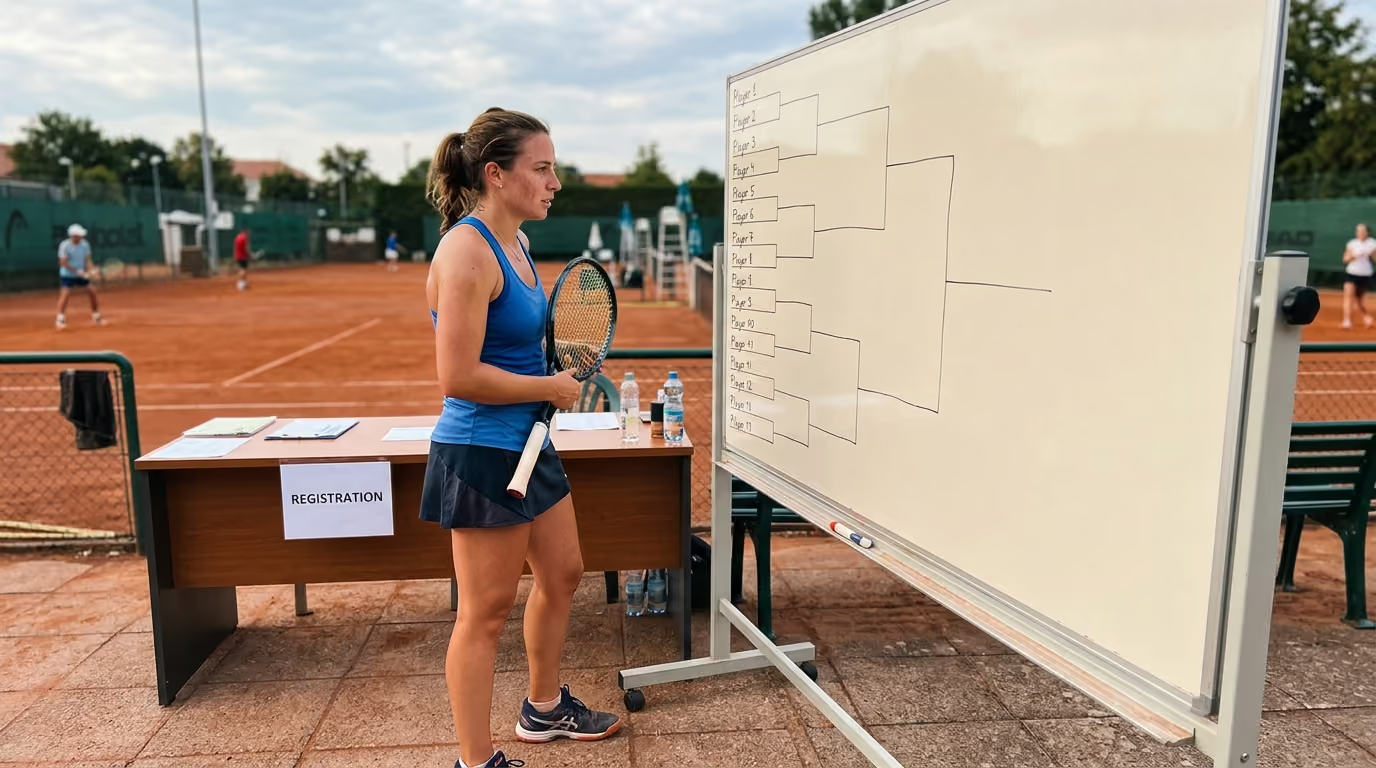

Unlock your full potential in racquet sports tournaments by learning how different formats impact strategy, physical demands, and optimal preparation.




You arrive at the club at 8:00 AM with your gear packed, expecting a standard bracket. Instead, the tournament desk informs you that you are playing in a compass draw with four guaranteed matches, or a timed pool-play format where every single game determines your final standing. Suddenly, your standard warm-up routine and nutrition plan feel inadequate for the day ahead.
Racquet sports tournament formats are structured systems that organize competitive play and determine match volume. They dictate how players advance, how losses affect standing, and what recovery methods are required. Understanding these formats allows players to manage their energy and optimize performance on the court.
To analyze any tournament format, you should ask five key questions. How many matches are guaranteed? What happens after a loss? How many matches will occur in one day? How are ties and advancement decided? Finally, what match length and scoring system will be used?
A tournament has two separate dimensions that players often confuse. The first is the draw structure, which includes round robins, single-elimination brackets, pool play, compass draws, or team events. The second is the match structure, which includes best-of-three sets, short sets, match tiebreaks, or timed games. Knowing both dimensions helps you prepare for the physical and tactical demands of competition.
To perform well across multi-match events, you must understand the physiological stress of racquet sports. Research shows that tournament play imposes substantial neuromuscular and cardiovascular demands. These demands vary based on court surface, match duration, and scheduling density.
Effective playing time during a match is often much lower than the total duration of the event. In tennis, for example, studies show that effective playing time represents only 20% to 30% of total match duration on clay courts. On faster hard courts, this number drops to approximately 10% to 15% of match duration. The rest of the time consists of breaks between points, changeovers, and set rests.
Even with these built-in recovery intervals, the physical load accumulates rapidly. A study of junior tennis players examined the physiological effects of playing three 90-minute singles matches on the same day. The matches were separated by 45 minutes of rest. Researchers found that muscle soreness, physical fatigue, and markers of muscle damage like creatine kinase increased significantly across the sequence.
This research highlights that same-day matches impair physical capacities and increase overall soreness. Fortunately, tennis-induced reductions in sprinting and jumping performance typically recover within 24 to 48 hours. This recovery timeline depends on proper hydration, sleep, nutrition, and training status. It also depends on the format, as single-elimination tournaments offer different recovery windows than dense round robins.
The physical demands also differ significantly by sport. Badminton matches are generally shorter, with reported average durations of 17 to 40 minutes. Tennis matches typically average 60 to 90 minutes, though competitive matches can exceed five hours in professional settings.
To manage these demands, you can use a simple conceptual framework to estimate your tournament workload. This framework calculates tournament load as the number of matches multiplied by match intensity, plus waiting demands, warm-up efforts, and environmental stress. Knowing your expected workload helps you select the right events and plan your recovery. You can read more about managing athletic workloads in our court performance resources.
In a single-elimination draw, also known as a knockout bracket, a player is eliminated immediately after a single loss. This is the most traditional and efficient way to run a tournament. With a field of $N$ players, a complete single-elimination tournament requires exactly $N - 1$ matches, assuming there are no byes or unplayed matches.
Single elimination places a premium on starting quickly and managing pressure in decisive moments. You must be able to perform at a high level on a specific day, as there is no second opportunity to recover from a poor performance. Conversely, a player can win the entire tournament without facing every major rival in the field.
The risk profile in single elimination is highly asymmetric. In a round robin, you might trade an early loss for later wins and still advance. In knockout play, a single bad game or a slow start can end your tournament. This asymmetry often encourages conservative decision-making during critical moments, such as tiebreaks and match points.
If the number of players is not a power of two, some players will receive byes in the first round. A bye changes the physical and mental challenge of the tournament. The rested player receives automatic advancement and more recovery time. However, their first opponent may have already played a match, allowing them to adapt to the court speed, wind, and tournament balls.
Being a top seed does not guarantee an easier tournament. While you may avoid high-ranked players early, you must still manage the pressure of facing opponents who have established their rhythm on the court.
To prevent players from traveling to an event only to play a single match, organizers often use consolation formats. According to United States Tennis Association (USTA) regulations, these include first-match consolation, voluntary consolation, and feed-in championships.
A consolation format is different from a round robin. In a first-match consolation, players who lose their opening match are placed into a secondary bracket. A feed-in championship goes further, placing players who lose in subsequent rounds into later sections of the consolation draw.
These formats are highly valuable for player development because they guarantee match volume. However, they can produce unpredictable schedules. A player might lose early in the morning and then play several afternoon matches against other early-round losers.
When entering an event with a consolation option, always ask the tournament director specific logistical questions. Is entry into the consolation draw automatic, or is a separate sign-in required? Where and when will the consolation brackets be posted? Does withdrawing from the consolation draw affect your ranking or eligibility for future events?
In a round-robin format, every player or team competes against every other competitor in their group. This format is designed to identify the most consistent player over multiple matches rather than the player who peaks for a single afternoon.
The number of matches required for a round robin increases significantly as the field size grows. For $n$ players in a single group, the total number of matches is calculated using this formula:
$$ \frac{n(n-1)}{2} $$
Using this mathematical formula, we can see how the schedule expands:
Because of this rapid expansion, round robins are usually restricted to small groups. USTA guidelines often identify flights of three or four players as the most practical size for amateur tournaments.
Round robins reward physical durability, consistent performance, and psychological resilience. You can survive a poor match and still win the tournament, depending on the group standings. This format favors players who can win matches even when they are not playing at their absolute best.
In a round robin, you must balance your match-winning strategy with a standings-focused strategy. Your match-winning strategy focus is simply to win the current point. Your standings strategy considers games won, sets lost, and point differentials.
If advancement is determined by match wins first and game differential second, you must fight for every game. Even if you are losing a match, winning a few extra games can be the difference between advancing and being eliminated.
Round-robin tournaments require clear, written tiebreak procedures. If two or more players finish with the same win-loss record, organizers must use specific criteria to determine the winner. Common tiebreaker sequences include:
A common issue occurs when three players finish with a 2-1 record. In this scenario, head-to-head results cannot break the tie because Player A beat Player B, Player B beat Player C, and Player C beat Player A. The tournament director must then calculate set or game percentages. You should always obtain a copy of the official tiebreak rules before the first ball is hit.
Pool play divides a large field of players into several smaller round-robin groups. The top finishers from each pool then advance to a single-elimination playoff bracket. USTA and padel regulations frequently use this hybrid format to manage large entry lists.
Pool play is popular because it guarantees multiple matches while keeping the schedule manageable. For example, if a tournament has 16 players, a complete round robin would require 120 matches, which is impossible for a weekend event.
Instead, the organizer can split the 16 players into four pools of four. Each pool plays six matches, resulting in 24 total group-stage matches. The top player from each pool advances to a four-player knockout stage, which requires three matches. This hybrid format produces 27 total matches, offering a balanced compromise between play volume and scheduling limits.
Compass draws and timed formats are modern solutions designed to guarantee matches and create highly predictable schedules. Both formats are popular in recreational leagues and junior events.
A compass draw is a non-elimination format that moves players into different directional brackets based on their match results. All players begin in the center of the draw sheet. As wins and losses occur, players split into eight directional brackets: East, West, North, South, Northeast, Northwest, Southeast, and Southwest.
In a standard 16-player compass draw, the movement pattern follows a specific flow:
This format works best with draw sizes of 8, 16, 32, or 64 players. It guarantees that every player receives at least three or four matches, regardless of whether they win or lose.
Compass draws require rapid psychological recovery. If you lose your first match, you cannot dwell on the defeat. You must immediately reset because you will face an opponent in the West bracket who is also looking to recover.
Players must understand that a loss does not mean the tournament is over. Winning the West or North bracket still represents a strong competitive result. Always check if the tournament director plans to complete all directional brackets, as some events only play selected directions due to court limitations.
Timed formats replace traditional score targets with a strict countdown clock. According to USTA non-elimination guidelines, tournaments may use 10-minute or 15-minute matches. Players play continuous tiebreak points until the buzzer sounds. If a tiebreak is completed before time expires, players simply start a new one.
Timed formats are highly valued by tournament directors because they ensure courts run exactly on schedule. However, they completely alter match tactics.
In a timed format, you must start quickly and minimize your pre-point routine. There is no time to ease into the match or figure out your opponent's weaknesses over several games. If you fall behind early, the clock becomes your opponent.
You must also know the specific rules for when time expires. Does the point in progress count, or is it discarded? What happens if the score is tied when the buzzer sounds? Some events use a sudden-death point to break ties, which places immense pressure on a single exchange.
Team formats aggregate several individual singles and doubles matches into a single team score. This structure shifts the focus from individual glory to collective performance and depth.
A prime example of a structured team format is World TeamTennis (WTT). The traditional WTT format consists of five or six sets of no-ad scoring. A five-set match includes men's singles, women's singles, men's doubles, women's doubles, and one mixed doubles set. A six-set match adds a second mixed doubles set.
Every game won counts toward the team's total score. A team can win three of the five matches but still lose the overall tie if they lose the other two matches by large margins. This system rewards fighting for every game, even when you cannot win the individual set.
The physical demands of team events are influenced by whether the tie is played on one court or two. WTT regulations specify different set sequences depending on court availability:
In a team format, lineup decisions are just as important as individual skill. Captains must manage player fatigue, match transitions, and stylistic matchups.
If you are playing a team event, you must understand your specific role. Are you expected to build a massive game lead in singles, or are you a doubles specialist who must support a partner? Knowing how your performance fits into the team's total score will help you make better tactical decisions.
To fit more matches into a single day, tournament directors often use accelerated scoring systems. The most common of these is FAST4, which was developed to speed up play and make tournaments more dynamic.
Official Lawn Tennis Association (LTA) FAST4 rules utilize a highly compressed scoring structure:
These rules also cap the time allowed between points and during changeovers. To manage tournament density, LTA regulations allow players up to four FAST4 singles matches in a single day, with a mandatory 20-minute rest interval between matches.
Accelerated formats demand a significant shift in your tactical approach. In a standard set, you can afford to lose your opening service game and still recover the break. In a first-to-four set, a single break of serve represents 25% of the set, making recovery extremely difficult.
You must prioritize your opening service game and look for early break opportunities. Additionally, no-ad deuce points require high-percentage decision-making. As the receiver, you should select your strongest return side and play a high-margin shot to force your opponent to play an extra ball.
The compressed scoring also increases the cognitive load. Because every point has higher stakes, players often experience elevated stress levels. You must maintain focus and avoid emotional lapses, as a single bad game can cost you an entire set.
Many players assume that short-format matches are physically easy. While an individual FAST4 match is shorter than a best-of-three set match, the overall tournament load can be much higher. Playing four short matches in a day requires multiple warm-ups, repeated intense efforts, and constant mental adjustments.
This high density can lead to rapid glycogen depletion and joint stiffness. To protect your body during accelerated events, you can consult our recovery science resources for targeted strategies.
To survive a dense tournament format, you must treat recovery as an active part of your competition. Failing to manage your physical resources between matches will lead to premature fatigue and poor performance.
Your recovery window begins the moment your match ends. You must prioritize immediate rehydration and muscle glycogen replenishment, especially during multi-match events.
When playing multiple matches in one day, do not sit down immediately after shaking hands. This causes your blood to pool in your lower extremities and increases muscle stiffness.
Instead, perform a light five-minute walk to gradually lower your heart rate. Follow this with dynamic mobility movements, focusing on your hips, shoulders, and lower back. Avoid long, static stretches immediately after play, as this can temporarily reduce muscle power before your next match.
Before your next round, you must perform a progressive re-warm-up. Since your body is already warm from the previous match, this warm-up should be shorter and more focused. Spend five minutes elevating your heart rate and performing shadow swings to prepare your nervous system for explosive movement. For a deeper understanding of movement prep, explore our mobility and movement resources.
Repetitive sprints and sudden changes of direction place massive stress on your joints, tendons, and muscles. To maintain athletic longevity, you must support your body's natural recovery processes.
Ensure you get adequate sleep the night before and the night after a tournament, as growth hormone release peaks during deep sleep. If you experience mild muscular soreness, use light active recovery, such as cycling or walking, to promote blood flow and tissue healing. You can find more tips on keeping your body resilient in our guide on healthy aging and athletic longevity.
While tournament formats share common structures, their physical and tactical execution varies significantly between tennis, pickleball, and padel.
Tennis features the highest physiological strain per individual point. Matches are longer, court coverage is extensive, and the ball weights are heavier.
In tennis tournaments, recovery times between matches must be longer to prevent acute muscle damage. If you are playing a singles tournament, a standard best-of-three set format requires significant cardiovascular endurance. You must pace your energy, utilize changeovers to lower your heart rate, and ensure you have a robust physical base. Read our tennis articles for more on building court-specific endurance.
Pickleball tournaments are characterized by high match density. Double-elimination draws are incredibly common, meaning you can lose one match and still battle through the consolation bracket to reach the finals.
Because pickleball matches are shorter and courts are smaller, you may play six to eight matches in a single day. This requires exceptional reaction times and repetitive lateral agility.
The primary challenge in pickleball is managing the constant transition between waiting and playing. You must stay warm during long delays and be ready to perform explosive dinks and drives on demand. For specific tournament tips, explore our pickleball articles.
Padel tournaments often combine pool play with knockout stages. The game is played in doubles, which reduces individual court coverage but increases the frequency of overheads and rotational movements.
Padel features high-volume wall-play and rapid transitions from defense to offense. The physical strain is concentrated in the shoulders, knees, and lower back due to the constant bending and explosive jumping required.
Tactically, padel tournament formats require close communication with your partner. Because matches can be played in dense schedules, you must coordinate your court positioning and help each other conserve energy during long rallies. Dive into our padel articles for detailed guidebooks on court positioning.
Even experienced players make critical errors when preparing for tournaments. Avoiding these two common pitfalls will give you a significant competitive advantage.
Many players pack enough nutrition and hydration for a single match, assuming they can buy food at the venue. However, club concession stands are often unreliable, and matches can run ahead of schedule.
If you are playing a compass draw or a round robin, you must pack as if you will be at the courts all day. Bring multiple changes of shirts, extra socks, plenty of water, electrolyte packets, and familiar snacks. Running out of fuel in the third round of a tournament is a completely preventable mistake.
In round-robin or pool-play formats, players often stop competing hard once they realize they cannot win the current match. This is a massive strategic error.
If the tournament uses game or set differential to break ties, every single game you win matters. Losing a match 4-6, 4-6 is vastly superior to losing 0-6, 0-6 in the eyes of the calculator. Always obtain the official tiebreak rules before the event starts, and fight for every point, regardless of the score.
While mild muscle soreness and physical fatigue are normal after a demanding tournament, you must listen to your body's warning signs. Pain is an important indicator of tissue stress or injury.
You should consult a qualified healthcare provider if you experience any of the following symptoms:
Ignoring these warning signs can turn a minor strain into a chronic issue, keeping you off the court for months. For more resources on staying healthy, visit our player health articles.
You can use this simple comparison framework to select the tournament format that best matches your physical capabilities, developmental goals, and recovery needs.
If you want to play as much as possible, choose round robins, pool play, compass draws, or consolation formats. These options guarantee multiple matches, allowing you to test adjustments against different styles of play.
If you prefer a direct, high-stakes competition, look for single-elimination draws or pool-play formats that transition into a knockout bracket. These events reward peak performance under pressure.
If you have a strong physical base and recover quickly, you will excel in round robins, compass draws, and team events. Your durability will become a weapon as your opponents tire in the later rounds.
If you perform best when playing with high intensity from the very first point, select short-set formats, timed formats, or single-elimination draws. Your ability to build early momentum will be highly rewarded.
You should bookmark and review this field guide before your next tournament sign-up deadline. Revisit these sections when planning your physical preparation, packing your court bag, or reviewing the official rules of an upcoming event.
Understanding the structure of your tournament allows you to compete with confidence, protect your physical health, and enjoy the competitive experience for years to come.
Follow Evercourts for practical insights on tennis, pickleball and padel performance, movement, recovery and healthy ageing. Stay connected for new articles, research-led guidance and ideas to help you play well and keep playing for years.


Read practical guidance for better movement, smarter preparation and a game that keeps working for you.
explore the Blog