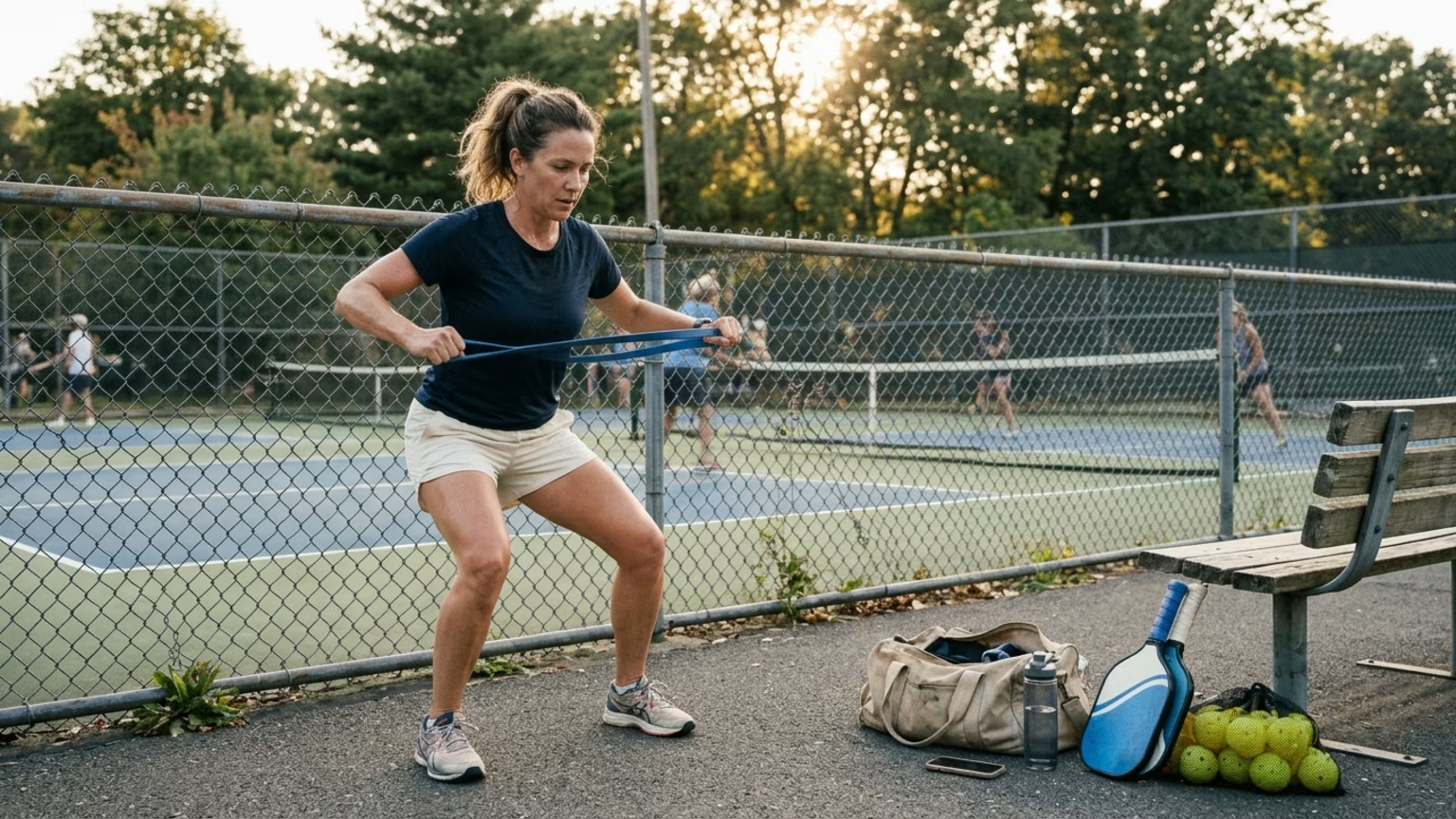

Build a manageable pickleball strength routine for starts, stops and side steps, with exercise options and gradual ways to progress.




A pickleball-ready strength routine is off-court exercise that builds the strength and control you use to push off, stop and get set for the next shot. Picture a short sideways move at the kitchen line: you step toward the ball, slow down enough to play it and get ready to move again. The stroke is only one part of that sequence.
That gives you a better starting point than a generic fitness benchmark. Instead of asking how much you should be able to lift, ask what you want to handle with more control on court. A brief session can work on pieces of that movement without trying to recreate a rally.
Think of a tennis player stopping after a burst toward a wide ball, a padel player checking a backward move before coming forward again or a pickleball player pushing sideways along the kitchen line. Those are different points with a shared demand: a short effort can be followed almost immediately by a stop or a change of direction. Over a match, the sequence repeats.
For pickleball, that makes the end of the step worth as much attention as the start. Your legs and hips have a job when you push off and another when you take your weight as you stop. Your trunk and shoulders are part of the same sequence as you steady yourself and get the paddle into position. Thinking about strength for starts and stops helps explain why a slow squat can belong in a routine for a fast point.
Physical therapy guidance from PlayOn Pickle summarizes research in recreational players that linked greater strength in the muscles on the outside of the hip with faster change-of-direction times. That association does not show that strengthening those muscles will make a player quicker. The guide also describes a 2025 clinical review that proposed combining strength work for the legs and rotator cuff with balance and trunk exercises. The strength recommendations included work that emphasizes the lowering or return phase of an exercise.
A secondary account of a 2025 study described a 10-week program that combined several types of training for older pickleball players who had fallen or feared falling. The trained group improved its change-of-direction performance and reported less fear of falling. At five-month follow-up, 25% of the trained group and 44% of the comparison group reported a fall during play.
The study involved 29 participants and was not randomized. It does not establish which part of the program contributed to the changes or whether the results apply to other groups of players. The exercises below are examples from practitioner guidance, not the tested program or a proven way to prevent falls or injuries.
A useful first version is one you can fit around the pickleball you already play. Practitioner guidance on gradual progression suggests using support, working through a shorter range and keeping early sessions modest. A comfortable starting version gives you something to return to and adjust as the movements become more familiar.
A supported squat or a shallow split squat gives the legs and hips a chance to take weight through a controlled lowering motion. Heel raises give the calves a place in the routine. The split squat does not need to look like a full reach at the kitchen line. Its role here is to work on taking weight in a staggered stance at a pace you can control.
A bridge or plank is an option for working on trunk control. A light-band outward shoulder rotation gives the muscles around the shoulder a different task from swinging the paddle. Neither exercise needs to imitate a shot. The point is to give these areas some attention of their own instead of making the entire session about footwork.
A single-leg stand with support within reach gives balance its own place in the session. It is a quieter task than changing direction in a point, which is useful when the goal is to pay attention to how you take and steady your weight. Support is an option to keep, not something you have to give up for the exercise to count.
When a movement feels manageable and stays controlled, a slightly fuller range is one way to make it more challenging. That can be enough of a change without also making the movement faster or adding resistance. If a busier stretch of pickleball leaves less room for recovery, the familiar version still gives you a routine to come back to.
Brief sessions are one option in the practitioner guidance, which also suggests spacing out work for the legs. A separate pickleball injury-prevention guide recommends increasing court time gradually and allowing rest between sessions. Put those ideas together and a simple scheduling principle emerges: a week with more pickleball does not also have to be a week with harder strength work. It can help to plan around the court sessions that matter most rather than treating strength and play as separate calendars.
Over time, the point is to keep working on abilities you want to use for years: taking a step in either direction, managing the stop and getting set again. Pay attention to which exercise versions you can control and recover from instead of grading your routine by the toughest version you can finish. That gives you a practical way to adjust as your playing schedule or training experience changes.
Persistent pain or a substantial limitation that makes ordinary movement or exercise difficult is a reason to speak with a qualified physiotherapist or healthcare provider. Individual guidance also makes sense if a prior injury or health condition leaves you unsure which movements are suitable. If falls or fear of falling are changing how you play, bring that up too.
Describe the movement that concerns you. That little sideways step at the kitchen line is a useful detail: it brings the conversation back to the move you want to keep making rather than a strength benchmark you feel you have to meet.
Follow Evercourts for practical insights on tennis, pickleball and padel performance, movement, recovery and healthy ageing. Stay connected for new articles, research-led guidance and ideas to help you play well and keep playing for years.


Plan a flexible week of racquet sports, strength work and recovery, with adjustments for hard matches, time away and lingering fatigue.

Compare tennis racquets and pickleball paddles on court with practical tips on grip fit, swing weight and deciding what's worth buying.

Match strength and balance work to the court moves you want to keep doing well, from a controlled reach to the step that gets you ready again.
Read practical guidance for better movement, smarter preparation and a game that keeps working for you.
explore the Blog
