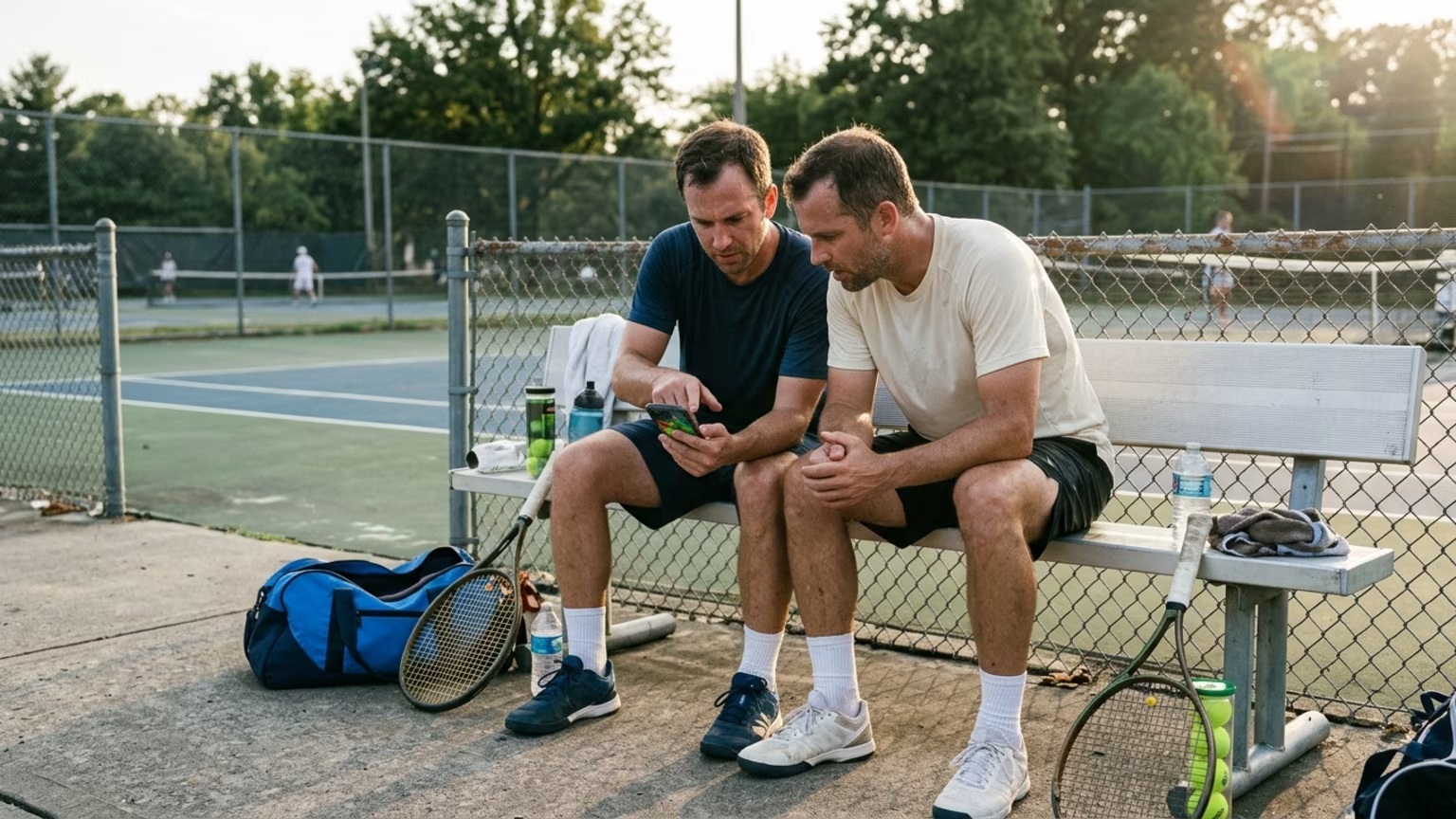

Understand repeated starts, stops and recovery in tennis, pickleball and padel, with research limits and practical context for adult players.




Court movement is the ability to start, slow down, change direction and get into position for the next shot. A fast first step describes only part of that task. Racquet play also asks you to repeat the sequence rather than perform it once.
It helps to separate recovering your court position from recovering between points. One concerns where you are for the next shot. The other concerns the pause before play resumes. Both belong in a discussion of preparation, but they are not the same measure of readiness.
Tennis, pickleball and padel involve repeated bursts of effort alongside lateral movement and changes of direction. That makes court preparation a broader question than how quickly someone can run in a straight line. The useful starting point is the movement that actually occurs during play.
A secondary analysis of tennis and padel conditioning reports that tracking across 182 Australian Open singles matches recorded more than 120,000 medium- and high-intensity changes of direction. The reported average was 1.6 per point.
For a movement-focused reading of tennis, that repetition is the important detail. Getting toward the ball is not the whole task. Braking, turning and repositioning belong in the description too.
The same analysis summarizes tracking of 83 professional male padel players across 23 matches. It reports that 80% of measured accelerations and decelerations occurred within one to two metres.
That finding draws attention to changes in movement over short distances. It is a useful reminder to describe more than the largest or fastest movements when considering what a court session asks of a player.
A physical therapy article about pickleball summarizes a study of recreational players averaging 62 years old. It reports an average heart rate of about 111 beats per minute and more than 70% of court time in moderate-to-vigorous heart-rate zones.
Those figures describe exercise effort rather than the mechanics of an individual stop or turn. Heart rate is not a count of lateral steps, a braking test or a measure of how someone recovers their position.
Across the sports, the format of the session you actually play is a more useful reference for preparation than assuming a sport label describes every player's demands.
The tennis and padel figures describe professional play, with only men in the cited padel study. The pickleball findings are reported through a health-oriented summary of the study rather than the original research. These secondary accounts do not establish a like-for-like movement comparison or a training routine with a proven dose, progression or injury-prevention effect for adult recreational players.
The practical interpretation is straightforward: describe the task before deciding how to prepare for it. A count of turns answers a different question from a description of short accelerations. Heart-rate information answers another question again.
None of those measures needs to become a personal target. The reported tennis average is not a direction-change quota for club players. The padel distances are not stopping-distance targets. The pickleball heart rate is not an exercise prescription.
This distinction keeps useful research useful. It allows match observations to inform the conversation without turning professional tracking data into a test that every adult player should pass.
For an adult player, the value of this broader view is a clearer description of the capabilities worth maintaining. That might mean continuing to move toward a ball, handle a change of direction and return to a useful position. It does not have to mean chasing a top-speed number.
As an editorial starting point, consider the whole movement sequence rather than choosing a routine from a headline. Useful questions include:
These are observation prompts rather than a fitness test. They provide a way to describe your game when discussing preparation with a coach or personal capacity with a qualified clinician.
The same perspective applies to looking at movement between shots. A preparation discussion that includes starts and stops is more specific than a general wish to become faster. The amount and intensity still need to reflect the individual player.
Recovery belongs in that discussion as well. Considering court time and recovery together across the week keeps the focus on the whole playing schedule rather than one demanding rally. The aim is not to add difficulty automatically, but to make preparation relevant to the game you want to keep playing.
This is the longevity value of understanding court movement: a clearer account of what matters to you. It is not a promise of injury-free play or a reason to treat every change in performance as a problem.
Recurring aches or stiffness are reasons to discuss your situation with a qualified physiotherapist or healthcare provider. That conversation is particularly relevant when discomfort changes how you start, stop or turn. Questions about what you can comfortably manage also belong in an individual discussion rather than a comparison with professional match figures.
A useful description includes what you notice, which movements bring it to your attention and how it affects your usual play. This gives the conversation a practical focus without trying to name the problem yourself.
The movement worth preserving is not only the spectacular first step. It is the ordinary ability to get into position and be ready for the next ball.
Follow Evercourts for practical insights on tennis, pickleball and padel performance, movement, recovery and healthy ageing. Stay connected for new articles, research-led guidance and ideas to help you play well and keep playing for years.


Learn how to turn, track and recover for pickleball lobs with a gentle partner drill, plus what fall research says about balance and footwork.

Tennis match data explain why conditioning involves repeated bursts and recovery. Apply the pattern without treating research averages as personal targets.

A flexible pickleball warm-up progressing from easy movement to controlled lunges, side steps, shadow swings and dinking, with readiness-based adjustments.
Read practical guidance for better movement, smarter preparation and a game that keeps working for you.
explore the Blog
