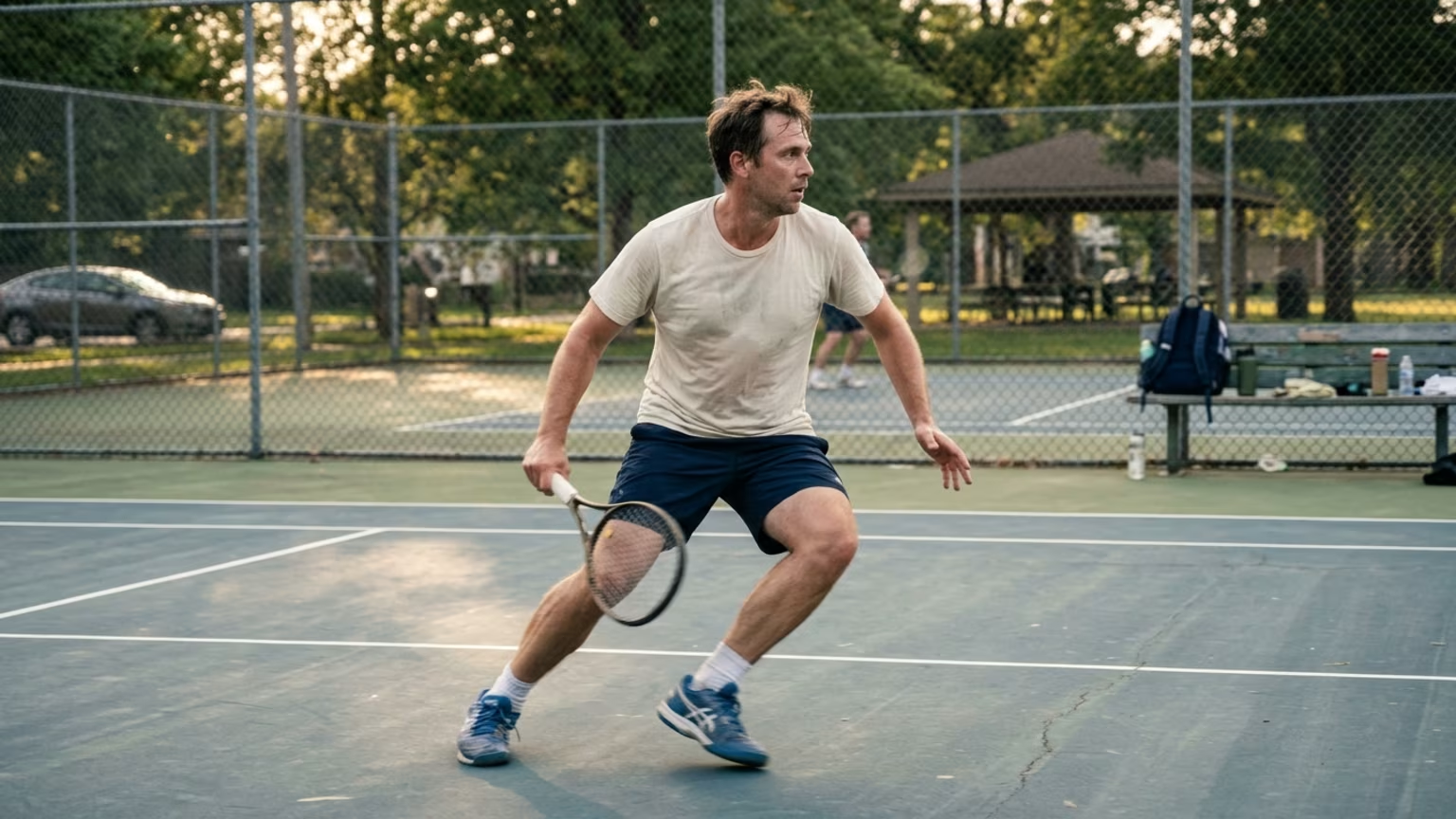

Understand split steps, controlled stops and recovery, with source-based coaching ideas and clear limits for adult racquet-sport players.




Between-shot movement is the sequence of getting ready, moving into position, stopping to hit and recovering for the next ball. It connects one stroke to the next rather than treating each shot as a separate task.
A tennis footwork coaching article describes that sequence through a split step, movement to a marker, a controlled stop and a shadow stroke. Recovery toward the starting position completes the task. The article also describes partner-selected directions to introduce unpredictability.
That provides a useful coaching framework: give the transitions around the stroke a place in practice. The question becomes whether the movement sequence is complete, not simply whether the player reached the ball.
An explosive start is only part of a between-shot movement task. The player still has to stop for the stroke and prepare to move again. Looking at those actions together shifts the focus from speed alone to how the movements connect.
In the tennis sequence described above, reaching the marker is not the finish. A controlled stop leads into a shadow stroke and recovery toward the starting position.
The coaching emphasis is therefore broader than getting somewhere quickly. Practice includes arriving, completing the stroke action and leaving that position for the next movement. Our guide to connecting the first step with braking and recovery considers that same whole-sequence perspective.
The Dink’s pickleball footwork guidance describes the split step as a balance reset between shots. It also cues players to push off the outside leg when moving in the opposite direction.
That coaching description brings the change of direction into focus. Rather than looking only at where the next shot goes, it draws attention to the position from which the next movement begins.
For padel players, the useful starting point is a question about the game itself: where do repeated efforts require a start, a stop or a change of direction? Then consider what happens between the stroke and preparation for another ball.
Keep those observations specific to padel. They provide a starting point for a coaching conversation without assuming that practice should look identical across all three sports.
The available material supports a coaching explainer rather than a scientific training prescription. These are drill descriptions, not clinical trials or a validated progression for adult recreational players. They do not establish injury-prevention effects, long-term physical benefits, a superior drill format or transfer to padel. They also provide no evidence-based speed targets, training volumes or separate off-court progression.
Within that boundary, the tennis article offers a clear sequence worth understanding. Each element gives a different part of the transition a place in practice.
The source begins with a split step and movement toward a marker. This gives the task a defined starting action and destination.
The practical interpretation is straightforward: readiness and travel belong in the same rehearsal. A drill focused only on the destination leaves the preparation outside the task.
The described sequence includes a controlled stop rather than treating arrival as enough. That makes stopping an explicit part of the exercise.
This is a useful distinction when discussing footwork with a coach. “Did I reach the marker?” and “Did I complete the stop?” are different questions. For a closer look at that part of movement practice, read about giving controlled stops their own place in training.
The source then connects the stop with a shadow stroke and recovery toward the starting position. The stroke sits within a movement sequence rather than ending it.
A shadow stroke rehearses the hitting action without striking a ball. Here, its role in the coaching description is to connect arrival with the movement that follows. Recovery remains part of the task rather than an unexamined walk back to the beginning.
The article describes both set marker sequences and partner-selected directions. In the first format, the route is known. In the second, a partner supplies an unpredictable direction cue.
Those are different practice tasks rather than interchangeable labels for footwork. The useful discussion is which task a coach wants to rehearse: following a known sequence or choosing a direction in response to a cue. Adding unpredictability changes the question the drill asks of the player.
For adult players, athletic longevity is a reason to pay attention to the whole movement task. The longer-term goal is to keep the capabilities that make playing enjoyable and manageable in view, rather than judging practice only by the quality of the stroke.
A practical interpretation is to describe those capabilities in clear terms. Can the player identify the starting action? Does practice include the stop? Is recovery part of the sequence being discussed?
These questions make movement practice easier to explain without turning it into a contest over speed. They also give an experienced player something more specific to discuss than “my footwork needs work.”
The source-supported choices are concrete: a known route, a shadow stroke, a recovery movement and a partner-selected direction. A coach can explain which element a task is intended to address. That explanation matters more than giving every drill a performance label.
Current ability should remain part of that conversation. Our resource on adjusting movement work to readiness offers a related editorial perspective on matching practice to the person doing it.
The aim is to keep the discussion grounded in what the player is practising. Starting, stopping and recovering deserve clear attention alongside the shot itself.
Recurring aches or stiffness are reasons to discuss movement practice with a qualified physiotherapist or healthcare provider. Seek individual guidance when discomfort changes how you move, when balance concerns affect your confidence or when you are unsure which movements fit your current capabilities.
Keep that conversation specific. Describe the movement that concerns you and whether the difficulty appears during the start, stop or recovery. A drill description should not substitute for an individual assessment of symptoms or movement concerns.
Today, write down the between-shot movement that feels least manageable to discuss with a qualified coach or, if symptoms are involved, a physiotherapist or healthcare provider.
Follow Evercourts for practical insights on tennis, pickleball and padel performance, movement, recovery and healthy ageing. Stay connected for new articles, research-led guidance and ideas to help you play well and keep playing for years.


A grounded look at lower-body strength and balance for racquet sports, with simple supported examples and clear limits on injury-prevention claims.

The Dink reported a warning about suspected fake Life Time pickleballs. Here’s the practical takeaway for recreational players and bulk buyers.

Understand how coverage, playing format and wall rebounds shape tennis, pickleball and padel movement, with research context for long-term play.
Read practical guidance for better movement, smarter preparation and a game that keeps working for you.
explore the Blog
