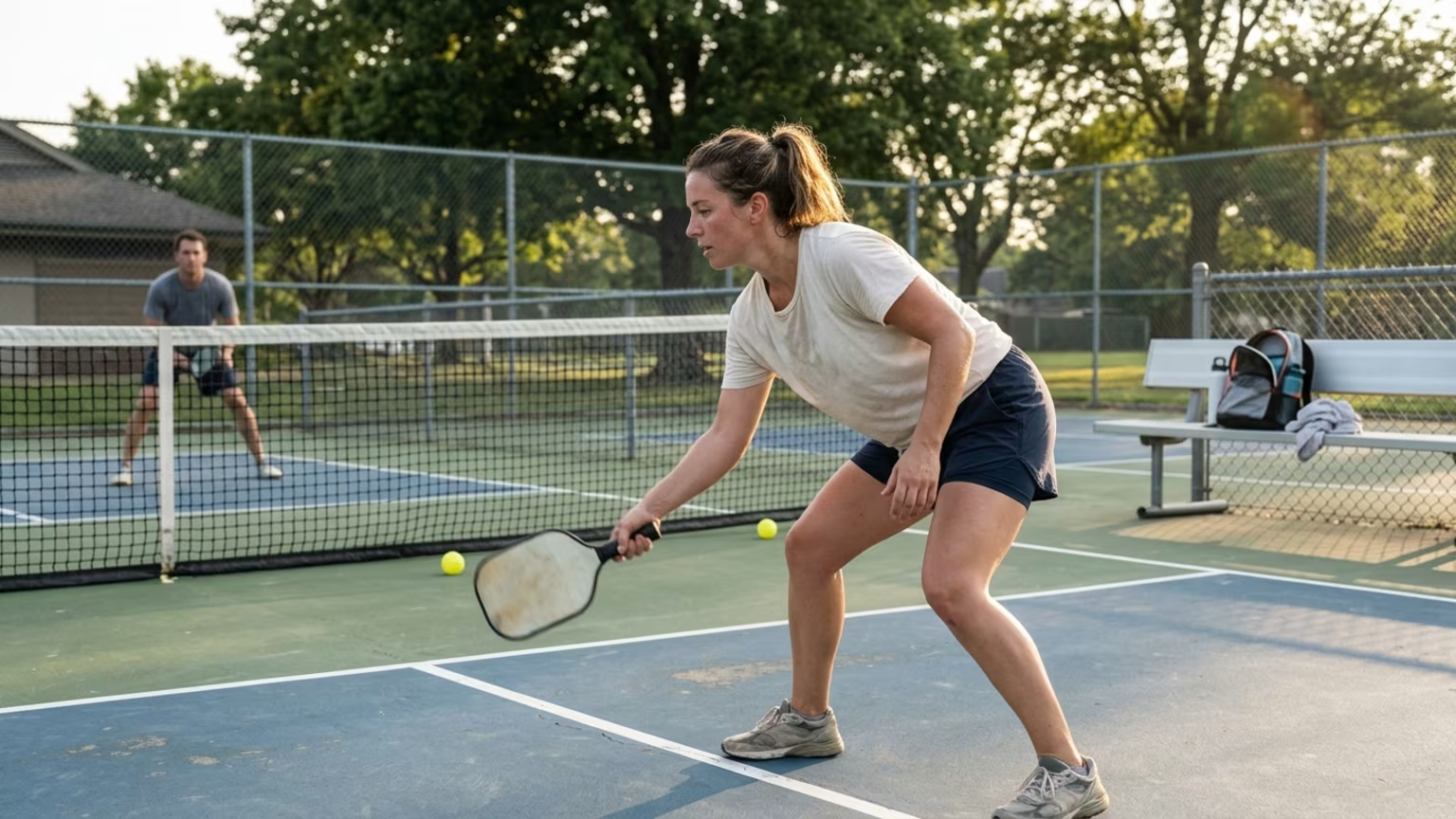

A progressive warm-up for tennis, pickleball and padel, with movement examples, session adaptations and clear limits on injury-prevention claims.




A court-specific warm-up is a gradual rehearsal of the movements and strokes you will use when play begins. It connects easy movement with the quicker steps and harder hitting that follow.
A tennis-focused return-to-play guide describes that progression clearly: start with easy movement, add controlled steps and body preparation, then build from gentle hitting towards greater pace. The useful idea is progression rather than a fixed collection of exercises.
For adult tennis, pickleball and padel players, that gives preparation a clear purpose. The opening rally should follow some rehearsal of what the game will ask of you.
Racquet sports involve repeated explosive efforts and changes of direction. For warm-up planning, the important distinction is between simply moving and rehearsing court movement. Starting, stopping and setting up for a stroke belong in the same picture.
That is why preparation needs to consider the lower body as well as the hitting arm. A practitioner tennis routine includes calf raises and small split-step hops alongside leg swings and lunges. It also includes trunk rotations and arm circles. These examples connect ankle and calf preparation with movement around the hips and shoulders.
The emphasis then changes with the game:
Our discussion of starting, braking and recovering on court offers another way to think about that movement component. The first step is only part of the task.
The research gives good reason to keep injury-prevention claims modest.
A secondary summary of the TennisReady trial reports results from 579 adult recreational tennis players in its main analysis. Average injury prevalence was 37% in the programme group and 38% in the comparison group. The app-delivered programme was unsupervised and lasted 12 weeks. Only 8% of its group adhered closely, according to the summary.
The summary reports that providing the programme did not reduce injury rates. That finding concerns a particular programme and delivery setting. It does not establish that warming up is pointless or that every approach produces the same result.
The practical routines also have clear limits. The tennis examples are practitioner guidance rather than a universally validated sequence. The pickleball guide says it found no published study showing that a particular warm-up reduces injuries. A padel preparation guide likewise reports finding no published trial of a padel-specific warm-up programme and draws on general racquet-sport advice.
The sensible conclusion is to treat warm-ups as preparation for play, not protection promised by a formula. The session variations below are editorial applications of the tennis guidance rather than separately tested protocols.
For athletic longevity, the useful question is not whether a routine promises years without injury. It is whether preparation reflects the movements ahead and leaves room for your current circumstances.
The tennis return-to-play guidance offers a straightforward framework. Its sequence moves from easy activity to controlled movement and then to progressively harder hitting. Applied consistently as a planning principle, that framework keeps attention on present capability rather than what a player remembers managing previously.
The source-supported sequence can be understood in four parts:
This is a framework for organising preparation. The point is the connection between stages, not collecting the largest possible exercise list. Ankles and calves receive attention alongside hips and shoulders, then those movements lead into the strokes of the game.
For another presentation of that transition, see our guide to moving from easy activity into court play.
For a casual hit, the editorial adaptation is to keep the progression brief and comfortable. Easy movement leads into controlled court steps and then gentle strokes before full-effort play.
A relaxed session does not need to become a complicated preparation project. Its warm-up can still have a clear beginning and a gradual rise in effort. The useful distinction is between simplifying the sequence and skipping straight to harder hitting.
For competition, the same framework allows more room to build intensity. Controlled changes of direction and gradually faster hitting connect the early stages with match demands. In tennis, easier serves come before harder ones.
The emphasis is not on making the warm-up exhausting. It is on avoiding a sudden jump from light preparation to the pace expected in the opening points. Competition changes the intended endpoint, not the underlying logic of progression.
The return-to-play guidance places particular value on comfortable ranges and controlled movement. Gentle hitting comes before increasing pace. The warm-up is part of a gradual return rather than permission to resume a previous workload immediately.
For an adult player, that distinction matters. Remembering a former level of play and being prepared for it today are different questions. A return session can be organised around what feels manageable now without turning the first rally into a test of past ability.
Pain, a recent injury or a meaningful movement limitation are reasons to consult a qualified physio or healthcare provider. A general warm-up article cannot determine what those signs mean for an individual player.
That includes pain during easy movement or gentle hitting. It also includes a restriction that changes how you move or prepare a stroke. Questions about rehabilitation and returning after injury belong in an individual assessment rather than a generic sequence.
For long-term participation, preparation and professional assessment have different roles. One organises the transition into play. The other addresses a personal concern that a routine cannot settle.
The first rally is a beginning, not a verdict on what the body ought to manage.
Follow Evercourts for practical insights on tennis, pickleball and padel performance, movement, recovery and healthy ageing. Stay connected for new articles, research-led guidance and ideas to help you play well and keep playing for years.


Learn how to turn, track and recover for pickleball lobs with a gentle partner drill, plus what fall research says about balance and footwork.

Tennis match data explain why conditioning involves repeated bursts and recovery. Apply the pattern without treating research averages as personal targets.

A flexible pickleball warm-up progressing from easy movement to controlled lunges, side steps, shadow swings and dinking, with readiness-based adjustments.
Read practical guidance for better movement, smarter preparation and a game that keeps working for you.
explore the Blog
