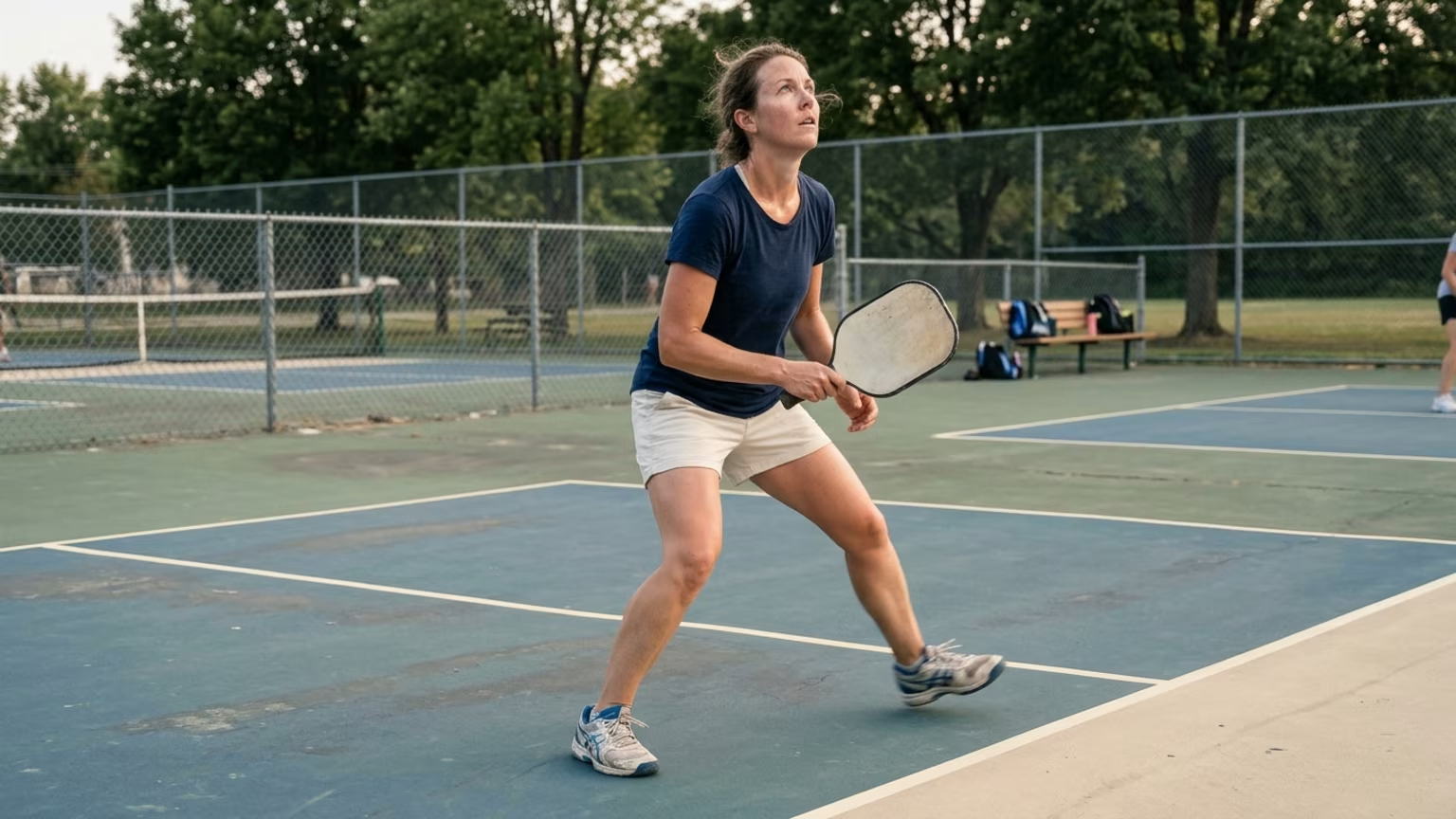

Understand turning and crossover cues for pickleball lobs, the limits of the evidence, and how court awareness and partner coverage shape your choices.




Dynamic balance means staying in control of your body while you move. For a pickleball player tracking a lob, that means judging the ball while deciding how to reposition. The goal is not to ban every backward step. It is to have more than one response when the ball goes over you.
AthleteRX’s recreational pickleball injury-prevention guide describes turning and moving with crossover steps as common coaching advice. It also includes another option: choosing not to chase a deep lob. Together, those choices offer a useful starting point for thinking about movement without treating every high ball as an emergency.
For tennis, pickleball and padel players, the coaching question is how to fit a deep-ball response into repeated bursts of movement and changes of direction. A lob asks for a new decision about where to go. Continuing backward is one response, but it need not be the automatic one.
In tennis, Let’s Play Tennis recommends turning sideways when a lob is recognized. Its guidance includes tracking the ball with the non-racket hand and using shuffles or crossover steps rather than backpedaling. The emphasis is on repositioning for the ball instead of simply retreating from it.
In pickleball, AthleteRX presents turning and crossing over as an option alongside leaving a deep ball. Position and movement capacity belong in that choice. In doubles, partner coverage also belongs in the conversation rather than being left until both players are pursuing the same ball.
For padel players, the useful editorial application is to consider the ball, available space and partner coverage before choosing a response. That is a decision-making principle rather than an instruction to copy a tennis movement pattern unchanged.
This puts lob retrieval within the broader question of how players start, stop and reposition. Getting toward the ball is only part of the decision; whether it can be reached under control matters too.
The turning cue has a straightforward coaching rationale: change your orientation and reposition toward the ball rather than relying on continued backward steps. Let’s Play Tennis recommends that approach for tennis lobs. AthleteRX describes a similar option for recreational pickleball.
AthleteRX also summarizes a small training study involving older players who had fallen or feared falling. After a 10-week strength, balance and footwork program, 25% of the training group and 44% of the comparison group reported a fall during play at five-month follow-up.
The limits belong together. The guide says the specific lob-footwork advice has not been tested in a trial it identified. The small training study does not establish that any single step pattern prevents falls. Neither finding makes turning or crossing over the right answer for every player and every ball.
The practical interpretation is narrower: turning and controlled repositioning are coaching options worth understanding. Strength, balance and footwork are relevant conditioning themes in the training study. Those are related ideas, but they should not be collapsed into a promise that one technique makes lob retrieval safe.
That distinction leaves room for useful practice without overstating the research. A player can work on recognizing a lob and choosing a movement response without treating a coaching cue as a medical rule.
For adult players, the long-term aim is to retain usable options rather than become committed to one footwork rule. Sometimes the available response is a controlled turn and reposition. Sometimes partner coverage changes the decision. Sometimes the sensible choice is to leave the ball.
This is a practical way to approach athletic longevity: build a game around movement you can manage rather than around an obligation to retrieve everything. It also gives practice a clearer purpose. The question becomes whether a movement option fits the situation, not whether it looks like an ideal demonstration.
The tennis coaching guidance begins with recognizing the lob. As an editorial application, that makes ball reading a useful part of rehearsal rather than something separate from footwork.
The questions are simple: How deep does the ball appear to be going? Where are you starting from? Is there a controlled route to it? Those questions keep attention on the whole play instead of reducing the response to “move backward faster.”
A practical interpretation of the coaching advice is to rehearse recognizing the ball and turning to reposition at a manageable pace. Shuffle or crossover steps can be considered within that practice. The aim is to become familiar with an option, not to force the same sequence onto every lob.
Control should remain the reference point. If the rehearsal becomes a rushed attempt to reach every ball, it has moved away from the purpose of expanding movement choices. Choosing to leave a ball can remain part of the practice discussion.
This connects with balance during changing court positions, rather than treating balance only as the ability to hold still.
The research brief’s practical application is to communicate who will take a ball and avoid both players pursuing the same lob. That is coordination guidance, not a claim of measured injury reduction.
A useful partner conversation can cover who appears better placed and what happens when neither player can reach the ball under control. It should leave room for the actual situation rather than create an obligation to chase. Court position and the likely landing point still matter.
AthleteRX explicitly includes not chasing a deep lob within the available coaching advice. That matters because movement decisions need an acceptable stopping point.
Letting a ball go does not require a dramatic explanation about age or ability. It can simply reflect where the player started and whether a controlled response was available. The broader aim is a game with adaptable choices, not a contest to prove that every ball remains reachable.
When difficulty moving under control or worry about falling starts shaping your play, individual guidance is more useful than another general footwork cue. A qualified physiotherapist or healthcare provider is the appropriate person for concerns about your own balance and movement capacity.
Reasons to seek that guidance include repeatedly struggling to stay controlled while repositioning or feeling unsure which movements fit your capabilities. A coach can help discuss ball reading and partner coverage. Health-related questions need qualified healthcare input rather than a universal answer about crossover steps.
A thoughtful lob response includes both movement and judgment. The ball you choose not to chase can be part of a capable game, not a smaller one.
Follow Evercourts for practical insights on tennis, pickleball and padel performance, movement, recovery and healthy ageing. Stay connected for new articles, research-led guidance and ideas to help you play well and keep playing for years.


Learn how to turn, track and recover for pickleball lobs with a gentle partner drill, plus what fall research says about balance and footwork.

Tennis match data explain why conditioning involves repeated bursts and recovery. Apply the pattern without treating research averages as personal targets.

A flexible pickleball warm-up progressing from easy movement to controlled lunges, side steps, shadow swings and dinking, with readiness-based adjustments.
Read practical guidance for better movement, smarter preparation and a game that keeps working for you.
explore the Blog
