

Understand balance during court movement, the limits of current research, everyday exercise examples and when to seek qualified guidance.




Balance is the ability to keep your body steady and controlled while you stand, reach or move. On court, the useful question goes beyond whether you can hold a position. It also concerns how controlled you feel while reaching for a ball and preparing to move again.
That distinction gives adult racquet sport players a practical way to think about steadiness. Standing still is one task. Lunging towards a shot and recovering for the next exchange is another.
Rather than treating balance as a score that defines your fitness, consider it one movement quality worth understanding. The conversation becomes more useful when it connects to a particular task: reaching, stopping or changing direction.
A report describing pickleball’s movement demands identifies repeated squatting and lunging alongside reaching and rotation. It also describes acceleration and deceleration. According to the report, reacting quickly can challenge balance and coordination.
Those descriptions explain why balance belongs in a court-movement discussion. The player is not simply maintaining a comfortable standing position. The task involves moving towards a ball and controlling the transition into another movement.
Repeated explosive efforts and changes of direction are useful ways to frame that challenge. In the report’s terms, acceleration and deceleration put attention on the transitions between movements. For tennis and padel players, that offers a practical lens for examining their own movement rather than a reason to copy a pickleball exercise routine.
The questions can be tied to each sport without turning them into a test:
These are prompts for describing movement, not instructions to manufacture difficult situations during play. They help keep the discussion connected to the court rather than to an isolated exercise score.
Our look at controlled stops before a shot offers a related movement perspective. The emphasis is on what happens between getting to the ball and preparing for the next action.
The pickleball report includes the view of physical therapist Jim Edwards, PT, DPT. He describes the sport as a fast-paced activity that can improve cardiovascular fitness and strength alongside balance and coordination. That is an attributed practitioner view.
A different kind of evidence comes from Jones and Hammig’s 2024 study, available through University of Arkansas ScholarWorks. The researchers used U.S. emergency-room data to examine age-related patterns in pickleball injuries. Their abstract highlighted cardiovascular concerns among players over 50.
A physiotherapy clinic article supplies exercise suggestions. It lists single-leg standing near a counter and heel-to-toe walking alongside sit-to-stands and step-ups. These examples give the balance conversation some concrete everyday movements to consider.
The evidence boundary belongs in one place: these sources describe sport demands, practitioner views and injury patterns. They do not establish that a particular balance drill or progression improves court performance or prevents falls and injuries in adult tennis, pickleball or padel players. The clinic suggestions are not a tested racquet-sport protocol, and the injury study does not establish balance training as the answer to the risks it reports.
The practical response is to separate the questions. What movements does the sport demand? What everyday movement options has a practitioner suggested? What does an individual player need assessed?
Keeping those questions separate avoids giving an exercise more authority than its evidence supports. It also leaves room for useful discussion without attaching a performance promise to every drill.
For athletic longevity, the value of this understanding is a more specific conversation about physical capability. “Balance” is a broad label. Describing uncertainty during a reach or when recovering from a lunge connects that label to an actual playing concern.
That is a useful distinction for adult players who want to keep enjoying their sport. It shifts the discussion away from judging an entire game by one awkward movement. Instead, the focus can remain on the task that feels difficult and the kind of guidance that might be appropriate.
The clinic’s suggested movement options provide examples to discuss with a qualified physiotherapist:
The list is deliberately not presented as a sequence to complete. There is no prescribed duration or requirement to advance to a harder version. A useful conversation is how these everyday options relate to the reaching and recovery tasks a player wants help understanding.
Balance also belongs alongside other aspects of preparation rather than replacing them. The pickleball report cautions that playing should not completely replace strength training when building muscle and strength is the goal. Enjoying regular court time and addressing a particular physical capability are different considerations.
Our discussion of off-court strength and balance work puts those topics beside each other. For the player, the practical aim is to keep questions clear: is the concern about steadiness during a task or about broader preparation for play?
This is where understanding can serve the long game. It gives players a way to describe what they want to maintain without assuming that more playing time or a more difficult balance exercise is automatically the right response.
A history of falls or significant unsteadiness is a reason to seek individualized guidance. Rather than choosing a harder drill to address the concern, bring it to a qualified physiotherapist or healthcare provider. Describe whether it occurs during everyday movement or particular court tasks.
Relevant medical concerns also belong in that conversation. Jones and Hammig recommend age-group-specific interventions and medical approval for players at risk of heart conditions. Their recommendation is about an individual’s health context, not a blanket requirement based solely on age.
If you are concerned about steadiness, the useful starting point is an assessment of your situation. If heart health is the concern, discuss participation with a healthcare provider rather than relying on an exercise article to make that decision.
Keep the long game in view.
Follow Evercourts for practical insights on tennis, pickleball and padel performance, movement, recovery and healthy ageing. Stay connected for new articles, research-led guidance and ideas to help you play well and keep playing for years.


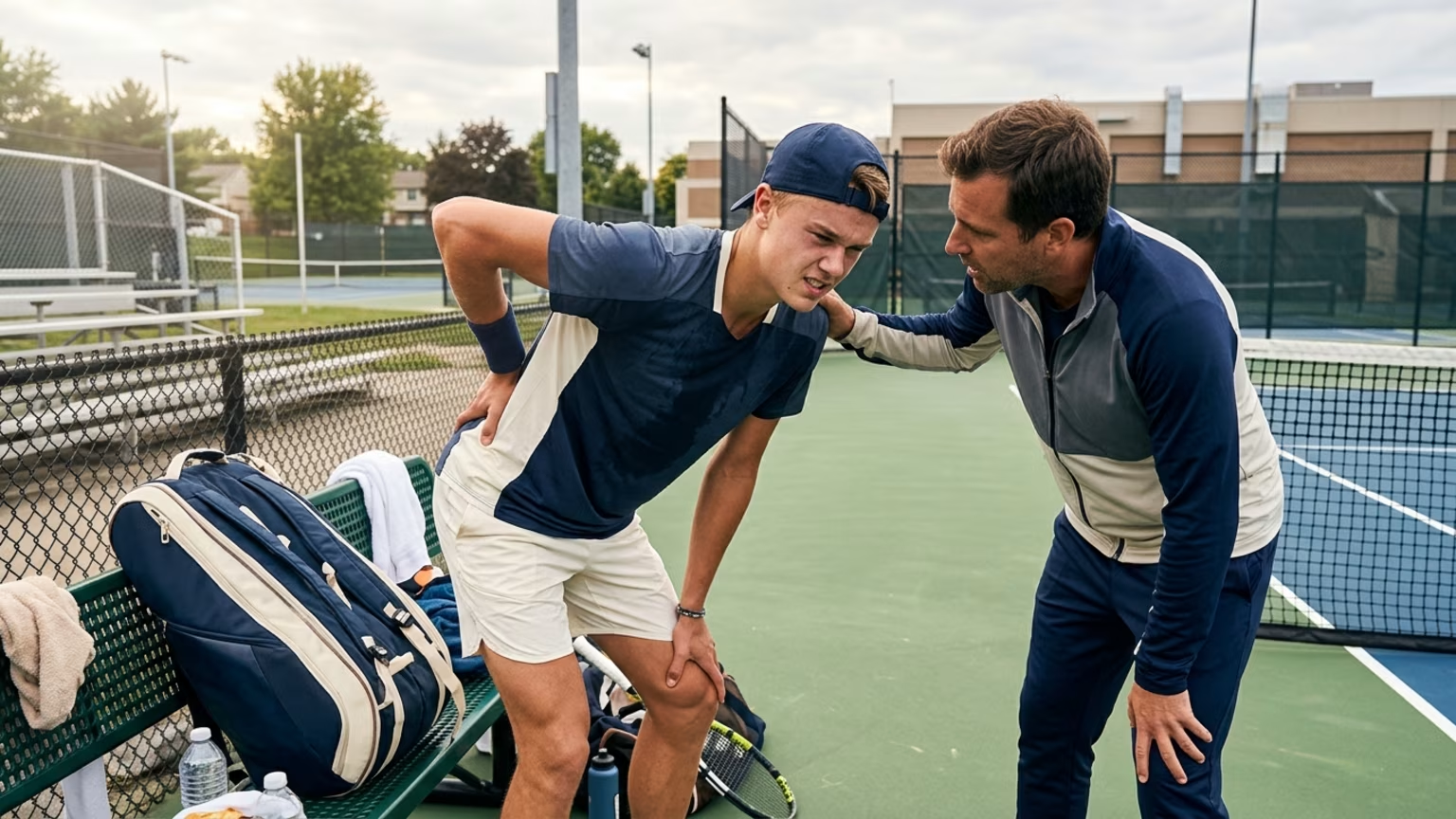
Holger Rune withdrew from the European Open with a back problem. The facts behind his decision and a grounded perspective for recreational players.

The Dink’s October 17 guide emphasizes deep returns, ball-height decisions and positioning against faster pickleball opponents.

A new report outlines padel and tennis gear trends. Learn how to assess adjustable rackets, sensor feedback and smart-court claims.
Read practical guidance for better movement, smarter preparation and a game that keeps working for you.
explore the Blog
