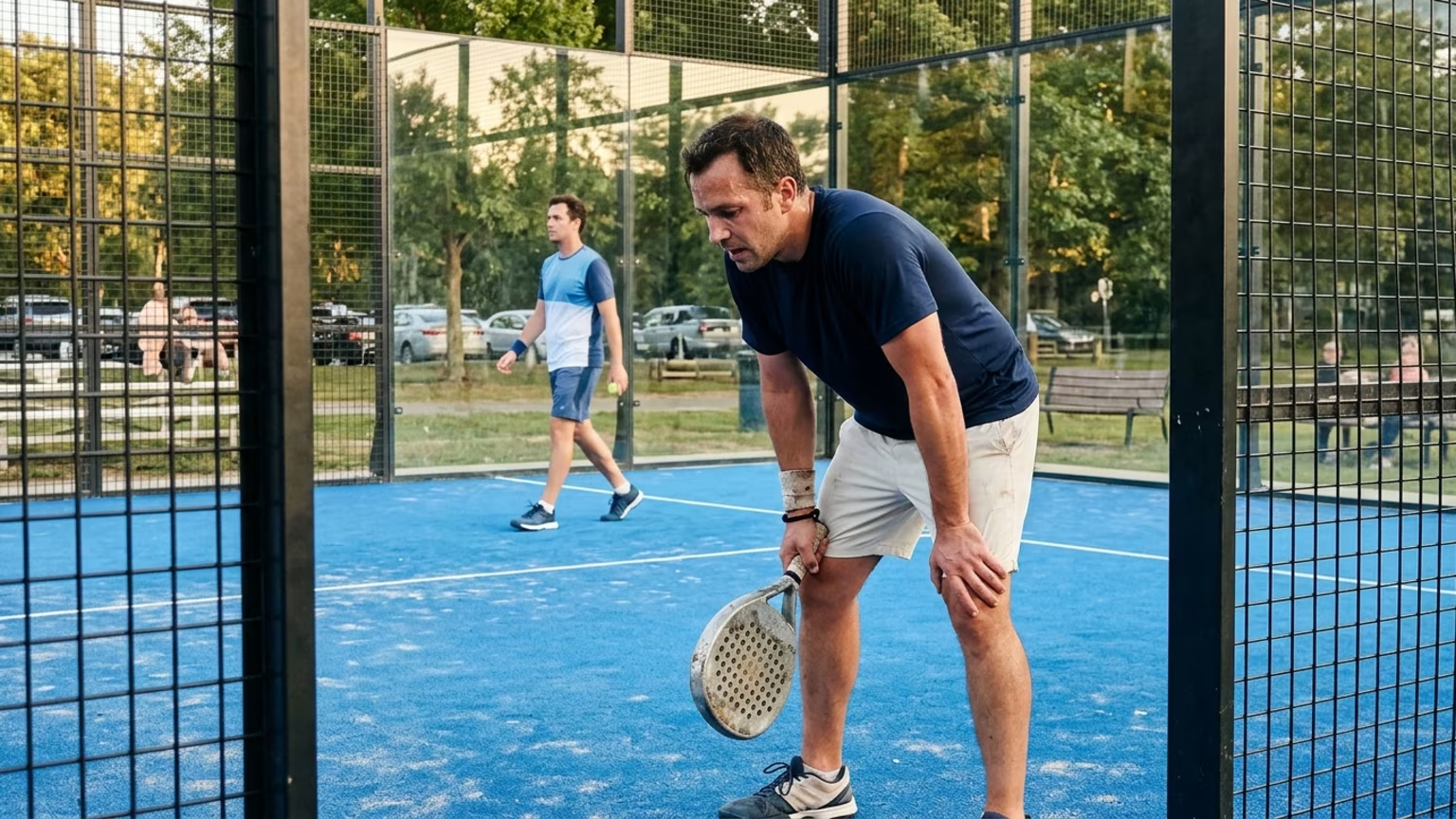

Understand padel’s repeated starts, stops and direction changes, how to interpret the research, and why controlled braking belongs in preparation.




A secondary summary of a 2023 padel injury review reports eight studies covering 2,022 players, but no padel-specific injury-prevention trials.
That finding sets an important boundary for practical advice: describing match demands is not the same as proving that a conditioning routine prevents injuries. The useful starting point is still clear. Padel asks players to repeat short efforts that involve accelerating, braking and changing direction rather than simply running continuously.
Padel is an intermittent whole-body sport. The research summary of its match demands describes repeated strokes combined with short, intense running actions. Players get moving, slow down and reposition before responding again.
The workload sits in that sequence. A quick start is only part of the task because the player must also control the movement already underway. Changing direction adds another demand: the next response may require movement somewhere other than straight ahead.
This is why distance alone would be an incomplete description of a padel session. Covering ground and repeatedly stopping are different aspects of movement. A compact playing area does not remove the need to accelerate or bring movement under control.
The research also separates average match intensity from what happens during individual points. Its summary of a 2022 systematic review describes mostly moderate physiological responses alongside repeated high-intensity actions and moderate-to-high perceived effort. Those findings can sit together without contradiction.
A moderate overall response does not mean every movement is easy. Equally, an intense passage does not describe the entire match. For preparation, the relevant pattern includes both brief efforts and the pauses between them.
Our broader look at padel’s repeated stops and redirection provides further context for thinking about this movement sequence rather than focusing only on running speed.
The available findings answer different questions. Match observations describe what players do during competition. Assessment research asks whether a particular test produces sufficiently consistent measurements.
Keeping those purposes separate makes the numbers more useful.
The systematic review’s moderate physiological responses describe the broad match picture. Its reports of repeated high-intensity actions describe the intermittent efforts within that picture. Perceived effort adds the players’ experience of the demand.
These are complementary observations rather than interchangeable scores. For practical interpretation, keep the overall response beside the movement pattern instead of allowing either to stand for the whole workload. This gives a clearer account of padel than describing it as either uniformly easy or continuously intense.
The same research summary describes a 2026 assessment study in national-level padel players. Its 5-m horizontal deceleration test showed good-to-excellent intrasession reliability. In plain language, the assessment produced relatively consistent results within the testing session.
The study also examined a modified 505 change-of-direction test. Reliability for its split times was poor-to-moderate, so the authors advised careful interpretation of some outcomes.
The distinction matters. Reliability concerns the consistency of a measurement. It does not demonstrate that practising the assessment improves match performance. The 5-m distance belongs to that assessment and is not a prescribed distance for recreational movement practice.
The research includes observations and assessments involving professional or national-level players. Those findings are context rather than expected workloads for recreational players. Match observations also vary with the playing population and measurement method.
Taken together, the studies describe movement demands and aspects of test reliability. They do not establish a best drill, training dose or progression for an individual player. The practical interpretation is to use the movement pattern as a guide while matching the challenge to current capacity.
Padel’s combination of repeated starts, stops and direction changes provides a useful description of its physical demands. It does not establish a ranking of padel, pickleball and tennis by physical toll. That would require comparable measurements across the sports and playing formats.
For players who move between them, keep the comparison specific:
A useful comparison asks what movements repeat and what the session requires. It does not assume that a sport’s name supplies the answer.
For that wider perspective, our guide to comparing sessions across racquet sports offers a way to organise the questions. Keep match observations attached to their original context rather than converting them into universal fitness standards.
Practise the stop, not only the start. Controlled braking is a practical response to the movement pattern described in padel research.
In a safe, clear space, use short and comfortable forward or lateral movements. Practise slowing down under control before changing direction. Keep the initial effort and distance modest. Stop if you feel pain or cannot maintain balance.
Begin with predictable movements rather than rushed reactions. Add speed or more reactive direction changes only when the easier version feels comfortable and controlled. The aim is to rehearse the stopping part of the movement rather than chase an impressive time.
That is the useful translation of the workload: give braking a place in preparation. More speed is not the only feature worth practising when the next action also requires a controlled stop.
Follow Evercourts for practical insights on tennis, pickleball and padel performance, movement, recovery and healthy ageing. Stay connected for new articles, research-led guidance and ideas to help you play well and keep playing for years.


Learn how to turn, track and recover for pickleball lobs with a gentle partner drill, plus what fall research says about balance and footwork.

Tennis match data explain why conditioning involves repeated bursts and recovery. Apply the pattern without treating research averages as personal targets.

A flexible pickleball warm-up progressing from easy movement to controlled lunges, side steps, shadow swings and dinking, with readiness-based adjustments.
Read practical guidance for better movement, smarter preparation and a game that keeps working for you.
explore the Blog
