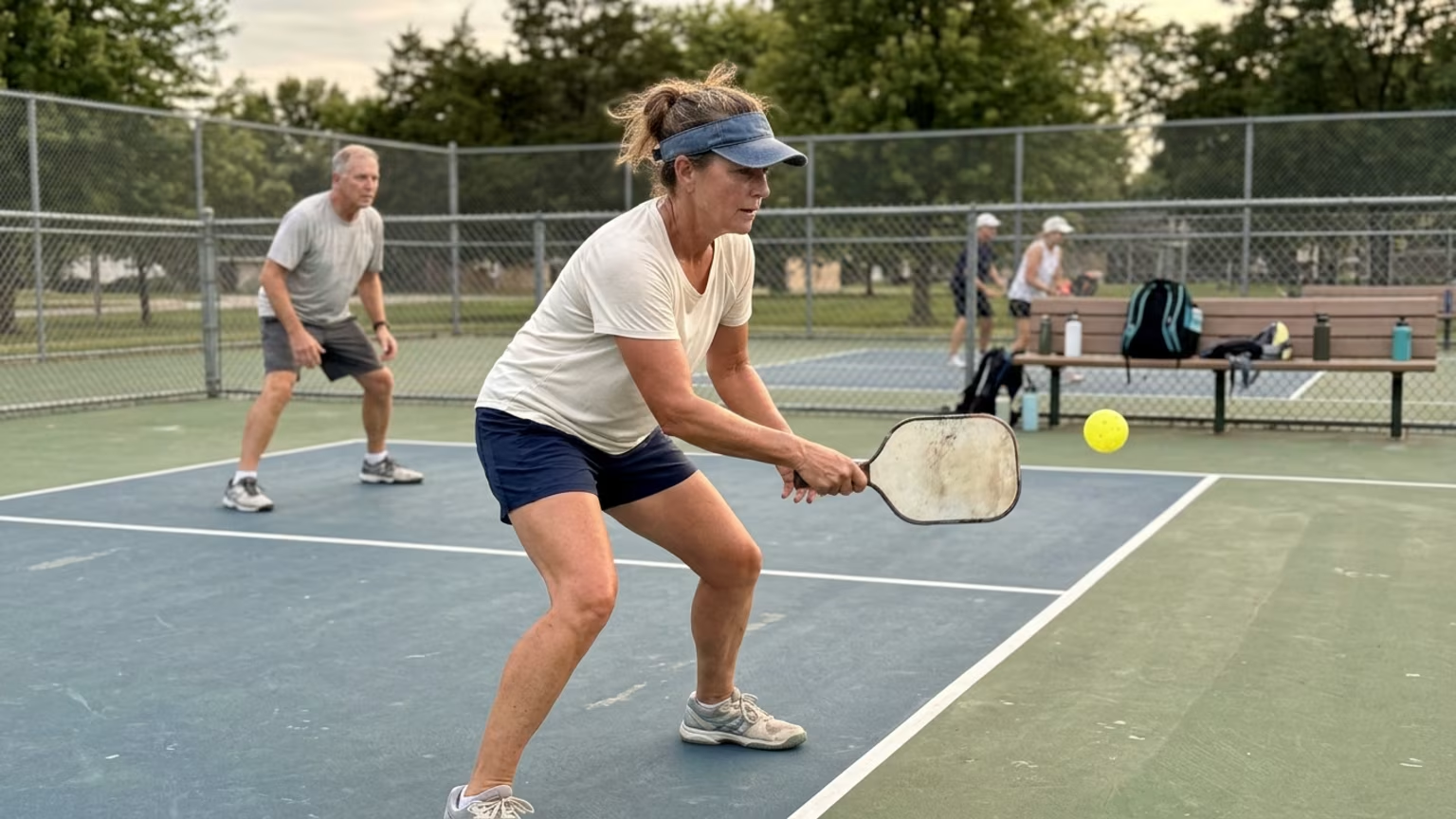

Practice pickleball footwork with a balanced ready position, small adjustment steps and purposeful recovery, plus shadow and partner-feed drills.




Rushed positioning before contact and recovery without considering the next reply are useful targets for pickleball practice. This routine gives you a repeatable sequence for getting set to hit and recovering with purpose, without making maximum speed the goal.
The aim is to practice arriving in balance and regaining a suitable position for the next ball. For an aging or active player, the focus is capability: preparing for contact and completing the movement after the shot.
That fits Evercourts’ emphasis on athletic longevity. The purpose is to keep developing useful playing skills rather than treating every practice session as a test of how quickly you can move.
Love Pickle’s coaching guide describes a sequence built around readiness, a split step and small adjustments before contact. Bracket Ready’s footwork article adds an important recovery principle: move toward the likely reply rather than automatically returning to the same spot.
These are coaching recommendations, not proof that an individual cue makes players faster or prevents injury. Prioritizing repeatability over maximum speed is a practical interpretation of their emphasis on balance and controlled recovery.
Players who feel unsteady or have a history of falls should consider support from a qualified instructor or healthcare professional. The secondary review of pickleball injury research supports that caution rather than treating a drill as universally suitable.
The following sequence follows the coaching guidance above. Each part has a distinct purpose in practice, from the initial ready position through the preparation for another ball.
Love Pickle describes a ready position with feet slightly wider than shoulder width. The knees are bent and weight is on the balls of the feet.
Use that description as the starting reference for the sequence. The practice task does not end with finding a ready position. It continues through movement to the ball and recovery after contact.
The guide recommends a small split step timed to the opponent’s contact. The timing cue belongs to the opponent’s shot rather than an arbitrary moment in your own movement.
For this practice sequence, keep the emphasis on connecting the split step with that contact cue. There is no need to turn the drill into a contest over how much movement you can produce.
Move toward the ball, then use small steps for the final positioning. Both coaching sources emphasize these adjustments before contact.
A useful distinction is to separate reaching the ball’s area from getting set to hit it. The final steps are part of the task, not something to skip because you have already covered the distance.
Bracket Ready’s guidance specifically connects small final steps with settling near the ball rather than reaching for it. Keep that distinction visible during practice.
Bracket Ready recommends settling before contact. Make that a recognizable part of the repetition rather than treating the swing as something to fit into unfinished positioning.
The practice question is straightforward: did the movement include a balanced arrival before the hit? This is the same emphasis behind treating controlled stopping as part of pickleball footwork, rather than judging the repetition only by whether the ball went back.
After contact, recover toward a position suited to the reply you expect. Bracket Ready advises against automatically returning to an identical court location after every shot.
This changes the purpose of recovery. You are preparing for the next ball rather than completing a compulsory trip to a fixed footprint.
A return-to-center pattern can provide a practice structure. It should not become a universal rule for every exchange. The larger emphasis is on organizing the movement between shots, including what happens after your own contact.
Love Pickle describes a shadow drill using a partner’s simulated swing:
The drill rehearses the relationship between the contact cue and your movement. Treat the return to balance as part of the repetition rather than finishing as soon as you have moved.
Bracket Ready suggests alternating manageable feeds to either side. Use the small final adjustments described above and aim to arrive in balance before contact.
The feeder waits for recovery before beginning the next repetition. That waiting period belongs to the drill. It keeps the practice organized around a complete movement sequence rather than a continuous stream of balls.
For the player, the repetition includes moving and getting set. It also includes hitting and recovering. For the feeder, the job includes allowing that sequence to finish.
Keep the practice goal repeatable movement rather than maximum speed. No repetition count or progression threshold is established by the guidance here.
This guidance describes pickleball rather than a comparison of tennis and padel biomechanics. It does not establish the different movement demands needed to prescribe sport-specific changes in stance, step patterns or recovery targets for those sports.
The practical adaptation is therefore to keep the practice questions while seeking sport-specific answers. Copying the entire pickleball routine into another game would go beyond the evidence provided.
For pickleball, the supported routine is the one above: ready position followed by a modest split step and movement to the ball. Small adjustments precede contact, then recovery accounts for the likely reply.
The partner-feed version gives both players a clear practice role. One works through the sequence while the other waits for recovery before feeding again.
For tennis, use the sequence as a discussion framework with a qualified coach rather than as a ready-made prescription. Ask how preparation before contact and recovery toward the next reply should apply to the shots being practiced.
The pickleball stance description should not be presented as a verified tennis requirement.
For padel, take the same coaching-led approach. Ask which position would prepare you for the likely reply instead of importing a fixed starting location from a pickleball drill.
This preserves the practice focus on purposeful recovery without inventing padel-specific movement instructions.
Follow Evercourts for practical insights on tennis, pickleball and padel performance, movement, recovery and healthy ageing. Stay connected for new articles, research-led guidance and ideas to help you play well and keep playing for years.


Learn how to turn, track and recover for pickleball lobs with a gentle partner drill, plus what fall research says about balance and footwork.

Tennis match data explain why conditioning involves repeated bursts and recovery. Apply the pattern without treating research averages as personal targets.

A flexible pickleball warm-up progressing from easy movement to controlled lunges, side steps, shadow swings and dinking, with readiness-based adjustments.
Read practical guidance for better movement, smarter preparation and a game that keeps working for you.
explore the Blog
