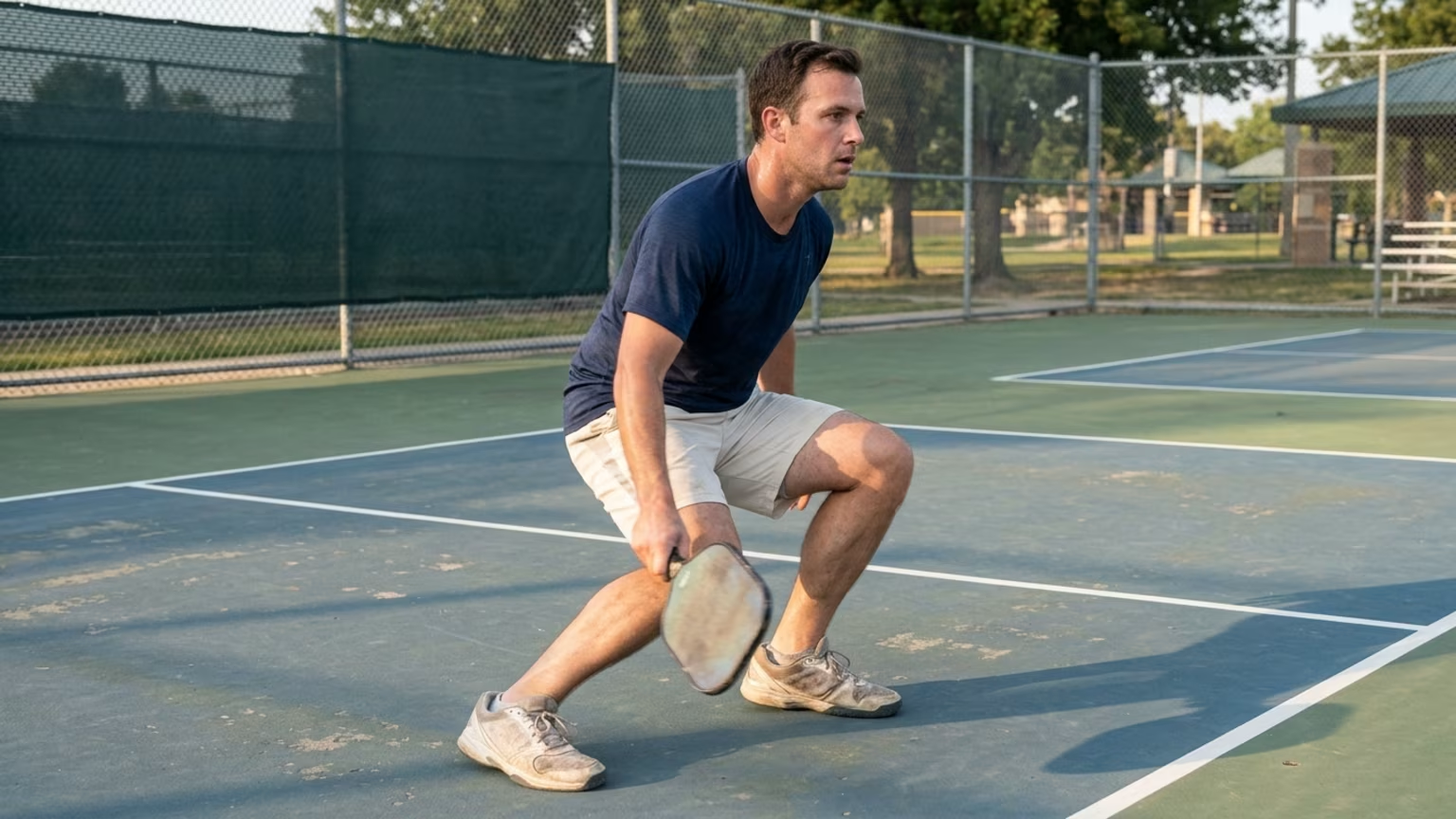

Learn the mechanics of racquet sports movement, from split-step timing to deceleration. Improve your footwork to protect your joints and reach more shots.




Court movement between shots is a continuous physical sequence. It connects your preparation, your initial push toward the ball, your deceleration into a hitting stance, and your tactical recovery. This chain dictates how well a player arrives at the ball and how efficiently they prepare for the next reply. Many players focus obsessively on their racket swing while ignoring the footwork that makes the swing possible. A breakdown in any movement link forces players to hit off balance and waste vital energy. Understanding this physical process helps you reach more shots with less joint strain. Every complete court movement requires you to accelerate cleanly and brake safely.
Racquet sports force the lower body to manage repeated cycles of acceleration and sudden deceleration. A standard rally requires players to completely absorb their own momentum before they can swing effectively. These aggressive changes of direction place significant load on the legs, hips, and core. The quadriceps, hamstrings, and calves must contract rapidly to propel the body and then act as strong brakes to stop it.
Each sport challenges the legs in distinct ways. In tennis, wide baseline rallies demand long lateral sprints followed by heavy braking forces. Pickleball courts compress this action into shorter, sharper, and more frequent stops at the non-volley zone. Padel adds the complexity of unpredictable rebounds off the glass walls, requiring sudden multidirectional shifts. In all three formats, the lower body acts as a shock absorber during every deceleration phase.
Managing these forces requires both muscular strength and technical coordination. If a player cannot brake safely, their joints absorb the impact instead of their muscle tissue. This repeated joint stress often leads to soreness and lingering fatigue. Developing a better movement sequence helps players minimize these physical costs. Better mechanics distribute the load evenly, managing the demands of court footwork across the entire lower body.
The transition between shots relies heavily on precise timing. Tennis coaching guidance commonly recommends timing the split-step landing around the opponent’s contact, with the hop beginning as the opponent prepares to strike. This acts as a practical cue to prime the legs for rapid movement. The small hop ensures both feet are ready to push off in any necessary direction. A specialist summary published by Dominating Tennis reviews a hard-court study of 12 male experts returning serves. The study reported a mean first-foot landing time of 131 milliseconds after server contact.
The researchers noted the second foot landed at 156 milliseconds, and lateral movement began at 177 milliseconds. These averages illustrate the rapid nature of a successful start for expert players. However, these specific millisecond values are not universal targets for recreational athletes. Once the player pushes off, the focus shifts to controlled arrival rather than pure speed. A resource from Analytics for Athletes outlines a practical movement sequence for wide balls.
This drill sequence combines a split-step with a push-off and several fast steps. The player then slows down near the hitting position before executing a recovery step. After the shot, court recovery relies on opponent geometry rather than a fixed center dot. Tennis Congress reports that a 2024 Hawk-Eye analysis examined 5,679 backcourt shots involving 23 top-100 players. The analysis found top players positioned themselves in relation to their opponents’ available angles rather than simply returning to court center. Moving to the bisector of the possible return angles saves vital steps.
Applying these professional insights to your own game requires patience. Recreational players often try to rush their recovery steps before completely finishing their stroke. Rushing the recovery frequently leads to poor balance and weaker subsequent shots. Focus on completing the entire sequence step-by-step rather than blurring the movements together.
Maintaining court speed over the years requires a strict focus on movement efficiency. Adult players often lose the ability to brake cleanly before they lose raw sprinting speed. Training the entire transition sequence helps older adults protect their joints and sustain their match performance. By practicing a balanced split-step and controlled stopping, players reduce the structural wear on their knees and ankles. It is far easier to maintain athletic longevity when you rely on structured footwork instead of desperate lunges. Older adults do not need to mimic the extreme movement ranges of touring professionals to see practical improvements.
Players should scale their movement practice to match their current physical condition and sport format. A partner can point or call a direction, prompting a small split-step and a single controlled step toward the cue. From there, players can gradually add travel distance and movement pace. On a smaller pickleball court, players should emphasize short first steps and highly stable stopping. For wider tennis or padel courts, you can introduce longer crossover movements once you can safely regain balance.
Integrating these measured habits into your routine keeps your legs resilient over time. You can practice stopping under control and shadowing a stroke before resetting your position. Adding these low-speed movement drills into your pre-match warm-up builds confidence without causing unnecessary fatigue. You can refine your timing and first-step movement through consistent, scaled repetition. Consistent practice builds the capacity to handle match intensity without accumulating excessive joint stress.
Refining your footwork is a highly practical goal, but joint pain during rapid direction changes is not a normal part of aging. Players should consult a qualified physical therapist if they experience sharp pain when pushing off or stopping. Lingering joint swelling after a routine match also signals a clear need for professional evaluation. A physical therapist can identify specific muscle imbalances that make braking difficult or painful. Addressing these deficits early prevents minor irritation from becoming a chronic problem. Ignoring joint pain often leads to compensatory movement patterns that create secondary injuries.
You should also seek professional advice if you feel unstable during side-to-side movements. A sense that a knee or ankle might give way indicates a lack of functional control that drills alone cannot fix. A clinician can provide a structured strength program to restore confidence in your lower body stability. They can accurately assess your strength levels and help scale your return to aggressive play appropriately. Working with a professional ensures that your joints can safely handle the forces of racquet sports.
Understanding how to move efficiently is only useful when your body is structurally prepared for the task. Sometimes, the best step you can take for your court movement is stepping away to address an underlying issue. Small adjustments in clinical strength and movement mechanics often dictate how many years you get to keep playing the sport you love.
Follow Evercourts for practical insights on tennis, pickleball and padel performance, movement, recovery and healthy ageing. Stay connected for new articles, research-led guidance and ideas to help you play well and keep playing for years.


Holger Rune withdrew from the European Open with a back problem. The facts behind his decision and a grounded perspective for recreational players.

The Dink’s October 17 guide emphasizes deep returns, ball-height decisions and positioning against faster pickleball opponents.

A new report outlines padel and tennis gear trends. Learn how to assess adjustable rackets, sensor feedback and smart-court claims.
Read practical guidance for better movement, smarter preparation and a game that keeps working for you.
explore the Blog
