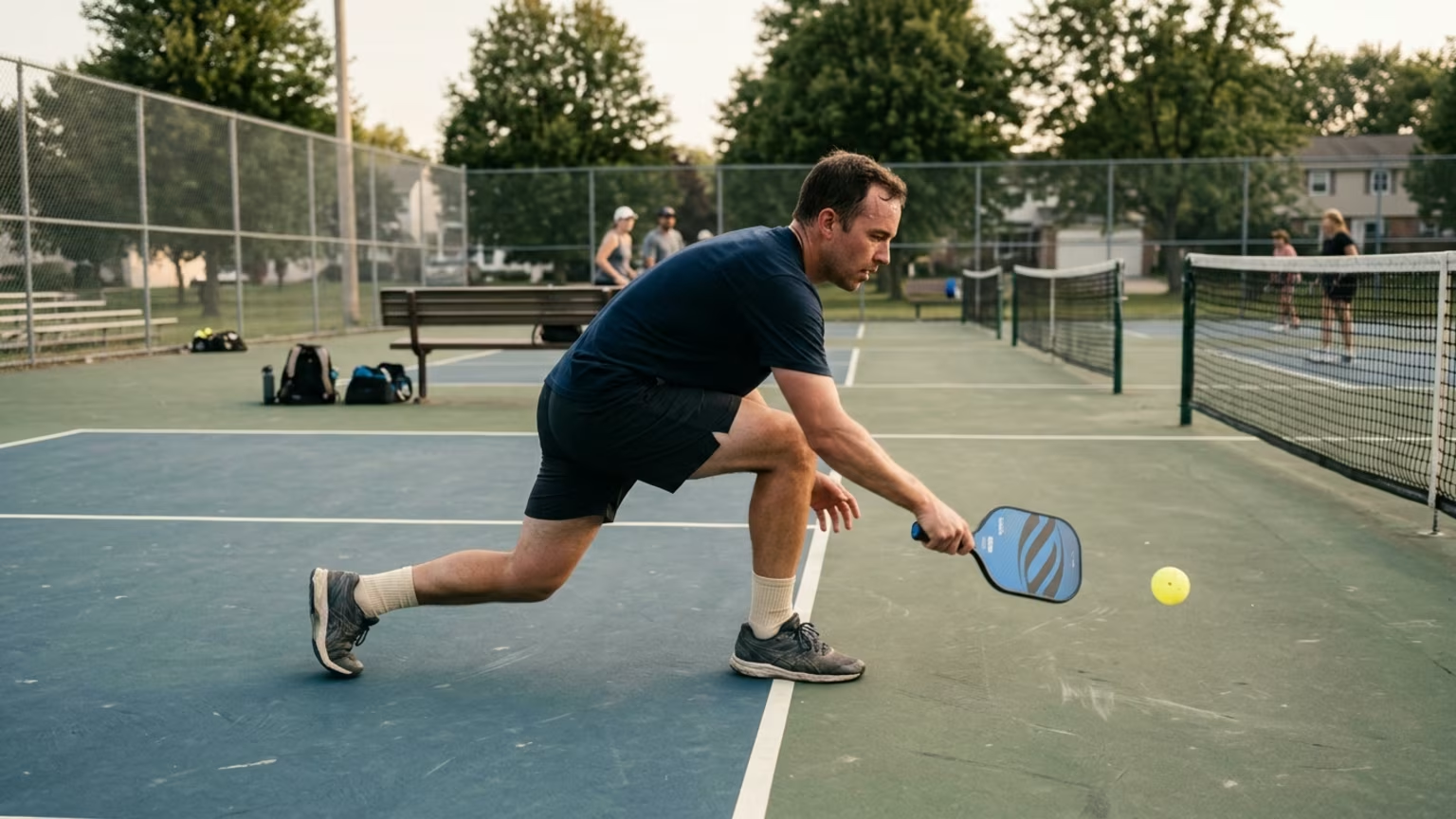

Understand pickleball footwork through controlled arrival, balanced contact and recovery, with coaching-based practice ideas and guidance on seeking care.




Efficient pickleball footwork is the skill of reaching the ball, settling into balance and preparing for the next shot. Braking means slowing your movement enough to arrive under control. Recovery means moving toward a useful position for what comes next rather than automatically returning to the same spot.
A doubles coaching guide organizes these tasks into a simple sequence: move, adjust, set, hit, recover. Larger movements cover the distance to the ball. Smaller steps refine your spacing before contact. The shot then leads into preparation for the opponent's reply.
That sequence gives recreational players something more useful to consider than speed alone: whether each movement leaves them ready for the next part of the point.
Pickleball coaching treats arrival as only part of court coverage. Reaching the ball still leaves the tasks of finding an appropriate contact position and preparing for another movement. An explosive first move does not complete the sequence.
For tennis and padel players thinking about repeated bursts and changes of direction, the same practical question is worth asking: what happens after the initial effort? The emphasis here is on arrival and readiness rather than sprint speed alone. The specific movement recommendations below come from pickleball coaching.
The distinction matters because the guidance does not prescribe one movement for every ball. Nearby balls call for spacing adjustments. Routine lateral coverage calls for shuffling, while greater distances may call for a crossover step or pivot.
Thinking about movement in relation to the court and playing format provides useful context. The practical priority is to match the movement to the situation rather than make every retrieval a full-speed effort.
These recommendations are practitioner guidance rather than findings from a controlled footwork trial. They do not establish that a particular sequence prevents falls, reduces joint loading or extends a playing career. Their role is to provide a framework for practice rather than a clinically validated protocol.
The doubles coaching guide distinguishes getting near the ball from finding the right spacing for contact. That is a useful separation: covering the distance is one task, while making the final adjustment is another.
Its movement priorities are straightforward:
The point is not to make every movement small. It is to avoid asking one oversized movement to handle both travel and precise positioning. A larger move can get you toward the ball, followed by smaller steps that establish a comfortable contact point.
In this framework, setting means establishing balance for contact. It gives controlled arrival and braking a place alongside the more obvious task of reaching the ball.
Recovery then starts a different decision. A recovery-step coaching article advises moving toward a position that covers likely opponent replies. That is not necessarily the center of the court or a familiar spot behind a painted line.
In doubles, the appropriate recovery also depends on your shot placement and your partner's location. A useful question after contact is therefore: where would I be prepared for the likely reply? That is more specific than simply telling yourself to get back.
For a wide ball, the coaching guidance also describes using the final step to help begin movement back toward a useful position. The retrieval and the recovery belong to the same sequence rather than two unrelated efforts.
A pickleball mobility guide describes a simple practice option: shuffle a couple of steps to either side, pause in a balanced stance and shadow a controlled dink. It also describes partner-fed practice that pairs movement to the ball with recovery.
The pause gives the arrival a clear place in the exercise. The task is not finished merely because the player has moved sideways. Balance and a controlled shadow shot are part of the repetition too.
For recreational practice, that creates a useful observation point: does attention end at the shot or continue into readiness for the next ball? Keeping the recovery in the exercise preserves the whole movement sequence. There is no need to turn that observation into another speed contest.
For adult players thinking about years of enjoyable court time, this framework offers a different definition of good movement. A successful chase is not the only thing worth noticing. Balanced arrivals and thoughtful recoveries deserve attention too.
The long-term practice goal can remain grounded: reach appropriate balls, establish a controlled contact position and prepare for the next reply. Those are capabilities worth valuing whether the day's game is competitive or social. They also give footwork practice a purpose beyond proving how fast you can move.
This does not mean avoiding effort. The coaching sources distinguish between movement options because some balls require more ground coverage than others. The judgment lies in choosing the movement that fits rather than applying maximum effort indiscriminately.
An Evanston RoundTable report quoted a sports medicine physician cautioning players against diving for a ball. That is a useful reminder that confidence need not mean attempting every retrieval.
Choosing not to chase a difficult ball can be a considered playing decision rather than a verdict on fitness or commitment. Alongside a court schedule that fits everyday life, that perspective keeps the emphasis on continued participation rather than constant tests of maximum effort.
Footwork coaching addresses movement choices. Personal health concerns belong with a qualified physiotherapist or healthcare provider, especially when discomfort or difficulty moving affects ordinary play.
Reasons to seek individual guidance include:
These concerns deserve an individual assessment rather than an assumption that shorter steps or a different recovery pattern will resolve them. A coaching sequence is not a diagnosis or a treatment plan.
Moving well need not look dramatic. Sometimes it is simply arriving with enough control to play the shot and enough composure to be ready for another.
Follow Evercourts for practical insights on tennis, pickleball and padel performance, movement, recovery and healthy ageing. Stay connected for new articles, research-led guidance and ideas to help you play well and keep playing for years.


Learn how to turn, track and recover for pickleball lobs with a gentle partner drill, plus what fall research says about balance and footwork.

Tennis match data explain why conditioning involves repeated bursts and recovery. Apply the pattern without treating research averages as personal targets.

A flexible pickleball warm-up progressing from easy movement to controlled lunges, side steps, shadow swings and dinking, with readiness-based adjustments.
Read practical guidance for better movement, smarter preparation and a game that keeps working for you.
explore the Blog
