

Learn why controlled deceleration and balanced footwork are essential for tennis players. This guide breaks down movement phases to support athletic longevity.




Controlled deceleration is the physical ability to slow down, stabilize your body, and establish a balanced position before striking the ball. In racquet sports, movement is rarely about sprinting in a straight line at maximum speed. Instead, players must constantly accelerate toward a shot and then manage the heavy braking forces required to stop cleanly. This critical transition from moving fast to standing firm forms the foundation of reliable stroke execution.
Without the capacity to brake effectively, players lose control over their contact point and struggle to recover for the next rally. To play well, athletes have to coordinate their body weight against the ground and halt their momentum on demand. The entire lower body acts as a shock absorber during this process. Muscles lengthen under tension to absorb the energy generated by the initial sprint, ensuring the kinetic chain is aligned.
Tennis, pickleball, and padel force players into repeated, explosive changes of direction across relatively short distances. Every wide forehand or sprint to the net requires a sudden burst of energy followed by an immediate demand to stop. This continuous cycle of starting and stopping places significant mechanical stress on the lower body. The muscles, tendons, and joints must repeatedly absorb the force of your body weight moving at high speeds.
When players lack the necessary braking mechanics, their momentum carries them past the ideal striking zone. Each of these sports demands a slightly different spatial awareness, but the physical requirement to halt momentum remains consistent. In tennis, players might cover ten or fifteen feet at a sprint before needing to plant a foot and brake. Pickleball involves shorter, more frequent bursts where players must abruptly stop near the kitchen line.
Padel requires dynamic adjustments as players track rebounds off the glass walls, forcing them to brake and pivot constantly. In all these scenarios, failing to control deceleration forces awkward reaches, compromised balance, and delayed recovery movements. Players who cannot stop cleanly often find themselves leaning heavily into their shots, which diminishes power and accuracy. Ultimately, understanding movement demands across these sports highlights why braking is just as important as the first step.
Coaching guidance treats court movement as a connected sequence rather than a series of isolated steps. According to a tennis-coaching article by Mattspoint, a typical change of direction involves four linked phases. First, a player must respond and accelerate toward the ball. Next, they brake as they approach the hitting zone. The third phase requires them to maintain balance through the stroke itself. Finally, the player must push off and recover for the next shot.
This framework shows that footwork practice should address the whole change-of-direction sequence. Mattspoint notes that these phases place different physical demands on the body. Specifically, the braking phase requires eccentric strength for deceleration, while planting and transitioning require isometric strength. Breaking down the sequence this way helps athletes focus on the quality of their movement rather than just their raw sprinting speed.
A tennis-footwork article from Analytics for Athletes supports this practical, phase-based approach. The publication recommends using smaller adjustment steps while approaching the ball to create a stable base for contact. It presents movement as a progression where players read the ball, move into position, control their body for the hit, and finally recover.
To develop these specific footwork skills, Analytics for Athletes suggests practical, cue-based drills. One recommended exercise involves a simple partner-cue format. A player performs a split step, moves a few steps toward a called side, stops under control, and then resets. Another drill focuses on practicing the whole point pattern, moving from a split step to a wide-ball shadow stroke, and finishing with a recovery back toward the starting position.
Understanding and practicing controlled deceleration directly supports a player's athletic longevity. Adult recreational players often focus their training time on building top speed, increasing cardiovascular endurance, or hitting with more power. However, prioritizing movement control over pure pace allows older players to protect their joints from unnecessary structural strain. When athletes arrive at the ball under control, they reduce the sudden, jarring impact on their knees, ankles, and hips.
Practicing the entire movement pattern deliberately helps players build resilience for longer, more grueling matches. By starting from a baseline position and responding to simple cues, players can add direction changes gradually. The focus should remain on approaching an imagined contact point with manageable, measured steps. Staying balanced through a shadow stroke and finishing in a controlled manner reinforces good habits without demanding maximum physical output.
Evercourts emphasizes that pacing and movement quality are central to enjoying racquet sports over the long term. A player should only increase the pace of their drills if their stopping movement remains completely clean and controlled. Pushing past the point of fatigue often leads to sloppy footwork, which in turn increases the load on unprepared joints. Prioritizing balance over exhaustion keeps players healthy, capable, and ready for their next session on the court.
While shadow drills and controlled stopping exercises are highly useful for technique, they are not a substitute for individualized medical advice. Players experiencing sharp joint pain, recurring swelling, or ongoing balance concerns during these movements should consult a qualified physiotherapist. A healthcare professional can accurately assess whether a lack of deceleration control stems from a specific muscular deficit, a joint limitation, or a prior injury. Treating on-court practice drills as a personal rehabilitation protocol without professional input is an unwise approach.
If footwork quality consistently drops during basic shadow drills, or if halting momentum feels distinctly unstable, it is a clear sign to seek an expert evaluation. Sometimes, the inability to stop cleanly is rooted in a lack of eccentric strength or a minor proprioceptive issue that requires targeted clinical attention. An expert can provide the right foundational exercises to ensure the body is truly ready for the court.
Movement on the court is merely a reflection of the structural strength and stability underneath it. Recognizing personal physical limits and seeking the right help ensures that the foundation remains sound.
Follow Evercourts for practical insights on tennis, pickleball and padel performance, movement, recovery and healthy ageing. Stay connected for new articles, research-led guidance and ideas to help you play well and keep playing for years.


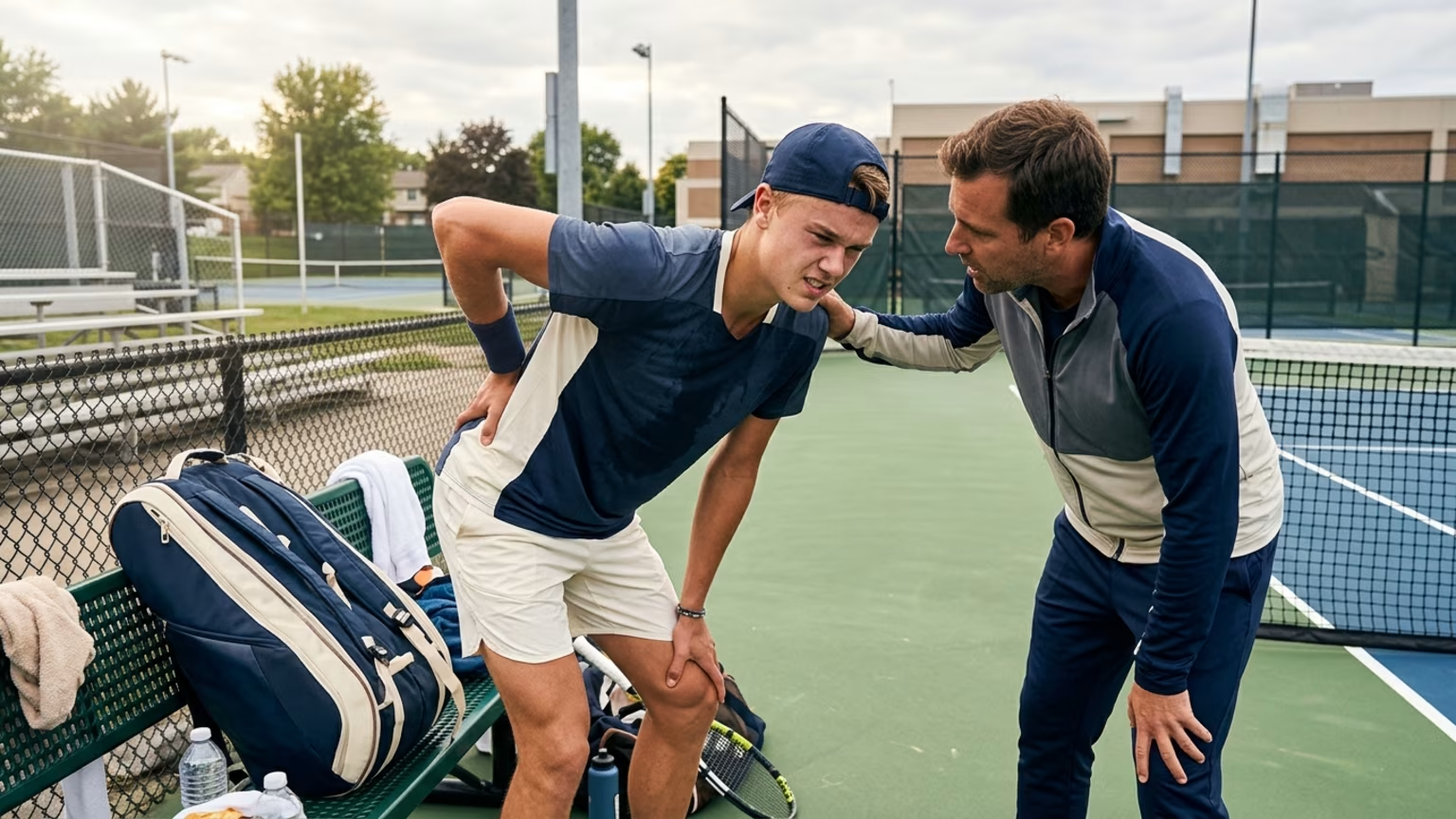
Holger Rune withdrew from the European Open with a back problem. The facts behind his decision and a grounded perspective for recreational players.

The Dink’s October 17 guide emphasizes deep returns, ball-height decisions and positioning against faster pickleball opponents.

A new report outlines padel and tennis gear trends. Learn how to assess adjustable rackets, sensor feedback and smart-court claims.
Read practical guidance for better movement, smarter preparation and a game that keeps working for you.
explore the Blog
