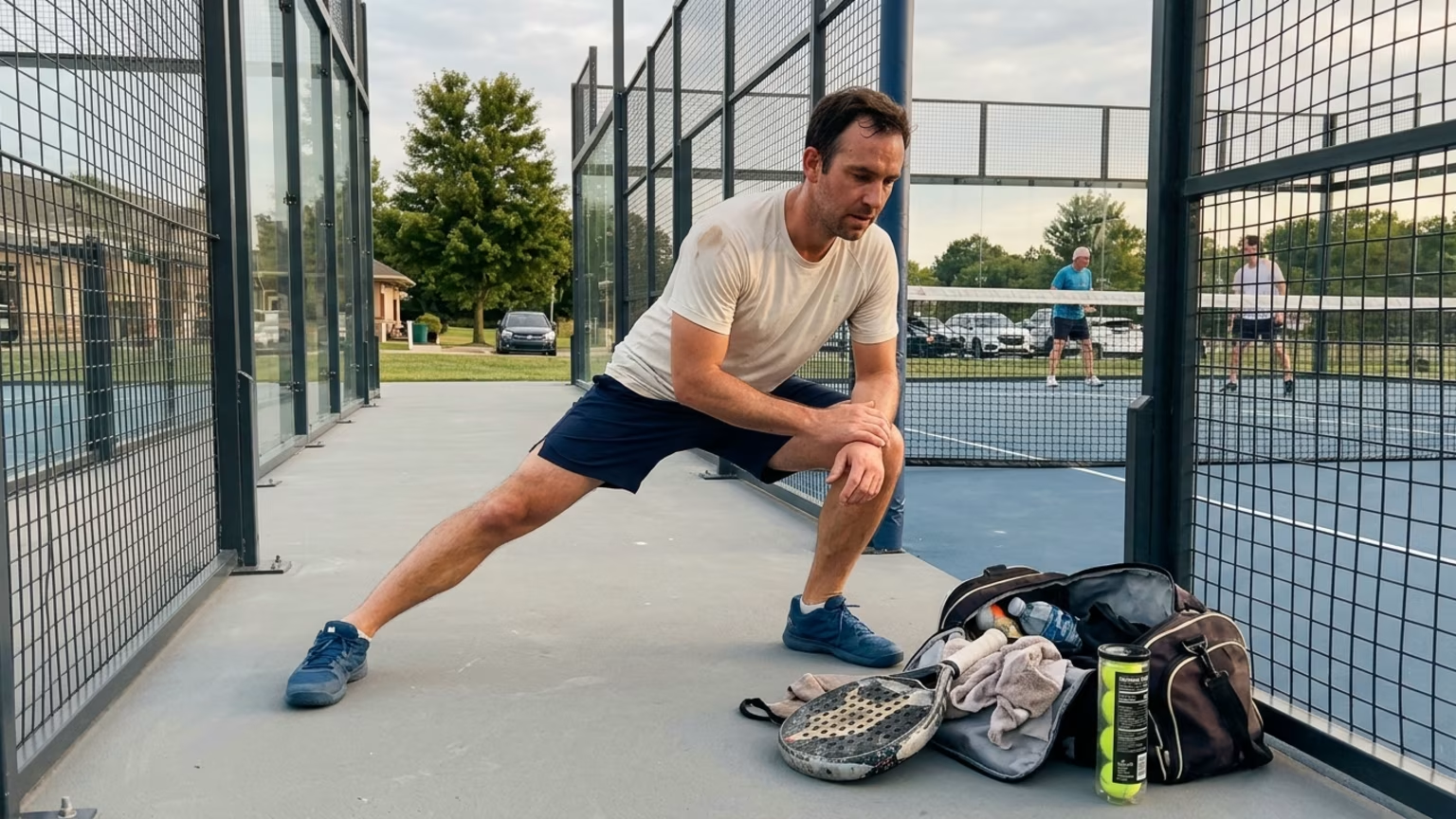

Prepare for padel with a progressive warm-up, gradual increases in play and clear guidance on when persistent pain needs professional advice.




Movement readiness means preparing your body for the starts, stops and changes of direction that play demands. For padel, the practical approach is to build from easy movement toward quicker efforts and increasingly demanding hitting.
Think of the first rally as the end of that preparation rather than the beginning. A progressive warm-up creates a sequence between arriving at the court and playing harder points. Beyond the individual session, padel injury guidance also recommends a gradual approach when returning after a break or increasing playing frequency.
A summary of padel match analysis describes an intermittent sport: short periods of movement separated by brief rests, with frequent changes of direction. One Italian sub-elite men’s sample reported rallies averaging 6.7 seconds and recovery periods averaging 14.8 seconds.
Those observations give preparation a clear movement focus. Starting and stopping belong in the picture alongside lateral movement and changes of pace. Preparing only through strokes would leave those other demands outside the warm-up.
The same summary reports that rally durations differed across studies and player groups. The useful takeaway is the pattern of effort and recovery, rather than a stopwatch target for every point.
For adults who also play tennis or pickleball, this offers a practical question to bring to court preparation: does the warm-up address movement between shots as well as the shots themselves? Here, the evidence describes padel rather than a measured comparison between the three sports. The emphasis is on preparing for its repeated short efforts and direction changes.
The available material combines match descriptions with practical warm-up and workload guidance. A summary of a 2023 systematic review reports that the review covered eight studies and 2,022 players.
The review summary cautions that the injury studies often relied on players’ recollections and used different injury definitions. They were also concentrated in Spain. It reported no studies testing padel-specific injury-prevention programs. Taken together, these limitations mean the guidance is a practical framework rather than a proven prevention program or a universal schedule for increasing play.
Within that framework, a padel-focused warm-up guide describes a progression from easy movement through mobility and activation to short sport-specific efforts and progressive hitting. Its examples provide a sensible way to organise preparation without turning the warm-up into a separate workout.
The guide begins with easy activity such as brisk walking or jogging. The practical point is the starting pace: preparation begins below the demands of hard rallies rather than immediately matching them.
That gives the warm-up a recognisable beginning. It also keeps hitting from becoming the only form of preparation before play.
The guide includes dynamic movements such as lunges and arm circles alongside side shuffles. These examples move the preparation beyond travelling straight ahead.
For padel, that is a useful connection between the warm-up and the movement pattern described in match analysis. Lateral movement belongs in the preparation because changes of direction are part of the game, not because any particular exercise has been shown here to prevent injury.
Short accelerations and stops appear later in the guide’s sequence. Shadow swings and increasingly demanding hitting then bring preparation closer to play.
The organising principle is progression. Easy movement comes before quicker efforts, while controlled hitting builds toward harder rallies. This provides a useful lens for organising a padel-specific warm-up without treating its duration as the main measure of quality.
A practical interpretation is to look at what the warm-up contains and how it develops. Walking followed immediately by hard points leaves a different preparation sequence from one that also includes lateral movement, stopping and progressive hitting. The latter more closely reflects the activities described in the padel guidance.
Athletic longevity gives preparation a broader purpose: maintaining the physical capabilities needed to keep enjoying the sport. For adult players, that means looking beyond whether today’s warm-up felt complete and considering how the amount of play is changing.
The padel injury guidance recommends increasing sessions gradually rather than making a sudden jump in frequency. It gives the example of adding sessions one at a time. That is a general direction for planning, not a reason to attach a fixed weekly timetable to every player.
A useful distinction is between preparation within a session and progression across sessions. The warm-up builds toward the demands of the next rally. Gradual workload progression concerns how much playing time or playing frequency is being added across a return to the sport.
These are related planning questions, but they are not interchangeable. Completing a progressive warm-up does not answer the separate question of how much additional play belongs in a return after time away.
For practical planning, the source-supported questions are straightforward:
The long-term perspective is not about making every court visit more demanding. It is about giving preparation and changes in playing amount a deliberate place in the plan. That is a grounded way to approach continued participation without making promises about future performance or injury.
The padel injury guidance advises players not to ignore pain that continues. Persistent pain or concern about an injury is a reason to consult a qualified physiotherapist or healthcare provider.
This matters when deciding whether to continue with the current amount of play or increase it. General warm-up guidance does not provide an individual assessment of an existing problem. Personal decisions about an injury or return to play belong with a professional who can assess the situation.
Understanding how to respond to pain and warning signs on court is part of responsible preparation, alongside movement and workload planning.
Return to the picture of that first rally. A good build-up considers more than whether the shots are finding the court. If persistent pain is part of the picture, taking it seriously and seeking qualified advice belongs in the preparation too.
Follow Evercourts for practical insights on tennis, pickleball and padel performance, movement, recovery and healthy ageing. Stay connected for new articles, research-led guidance and ideas to help you play well and keep playing for years.


Learn how to turn, track and recover for pickleball lobs with a gentle partner drill, plus what fall research says about balance and footwork.

Tennis match data explain why conditioning involves repeated bursts and recovery. Apply the pattern without treating research averages as personal targets.

A flexible pickleball warm-up progressing from easy movement to controlled lunges, side steps, shadow swings and dinking, with readiness-based adjustments.
Read practical guidance for better movement, smarter preparation and a game that keeps working for you.
explore the Blog
