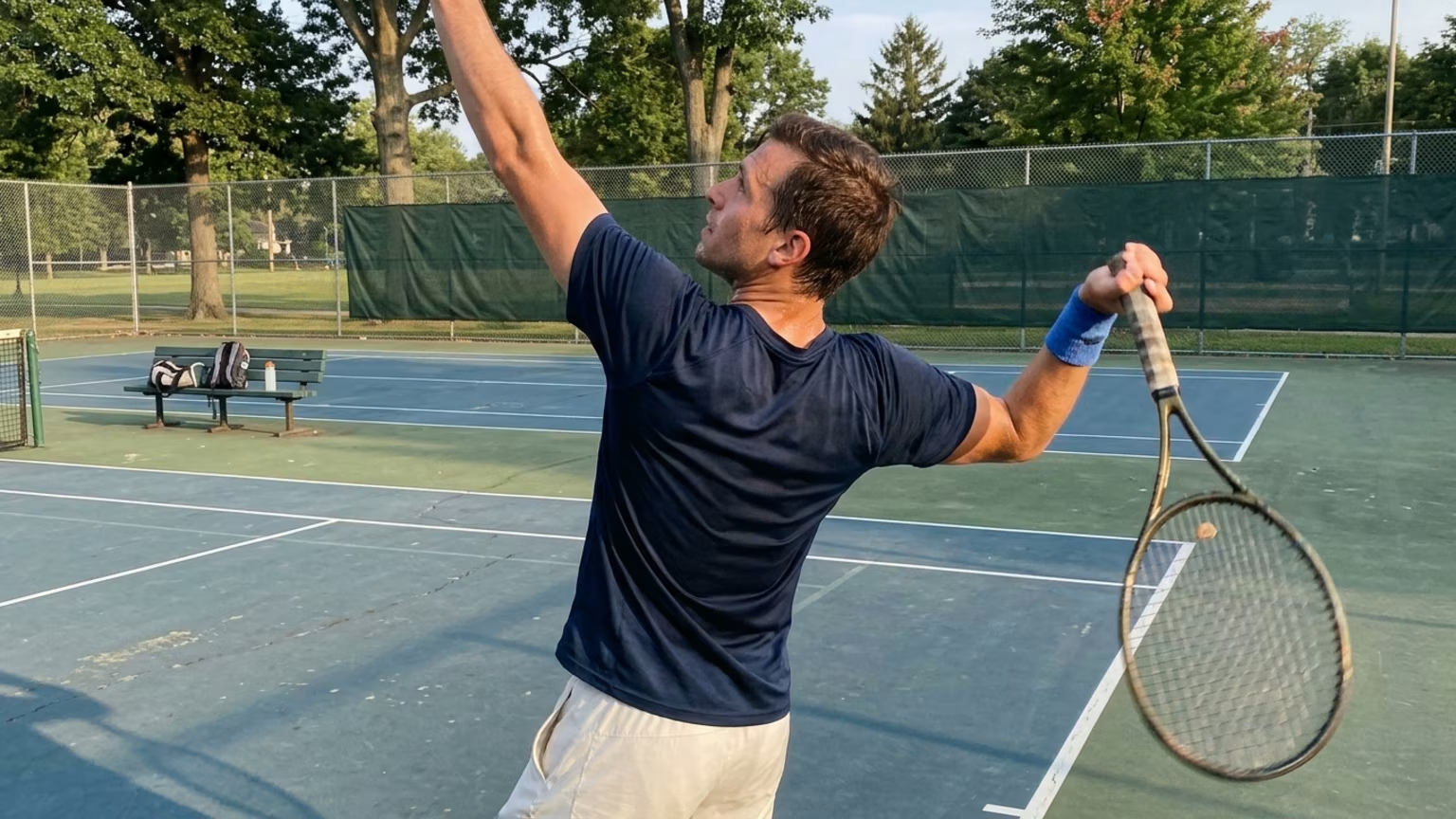

A research-led look at serving load, whole-body technique and shoulder preparation, with evidence limits and signs that merit professional assessment.




Shoulder capacity is the ability to handle the work asked of the shoulder during play. In tennis, that includes repeating serves and other overhead shots. Preparing for that work means considering serving volume and technique alongside shoulder conditioning.
That wider view runs through tennis-specific practitioner guidance on returning to play. It treats the shoulder as part of a whole-body action rather than an isolated joint to stretch before serving. The practical focus is preparation that fits the player and the session, not a routine that promises protection.
Serving combines an overhead action with contributions from elsewhere in the body. The practitioner article recommends that coaches consider whether leg drive, trunk contribution or the ball toss is making the arm compensate. That makes technique review a whole-movement question rather than a search for one perfect shoulder position.
The same article's warm-up advice includes easy movement, controlled side steps and lunges, plus trunk and shoulder preparation. Gentle hitting comes before faster play, with easier serves introduced before harder ones. These recommendations connect the overhead action to the moving session around it.
For tennis, pickleball and padel players, the useful questions are similar: how much overhead work is involved, and how does it fit around explosive efforts and changes of direction? As a practical planning approach, describe each sport's sessions separately rather than assuming they ask the same of the shoulder.
Our discussion of the whole-body side of serving provides related context for that broader view.
The most directly relevant adult evidence here comes from the TennisReady randomized trial, summarized by PEDro. It tested a 12-week unsupervised online prevention program in adult tennis players of all levels. Injuries were followed over 16 weeks, with 579 participants included in the main analysis.
Average injury prevalence was 37% in the program group and 38% in the control group. The difference was not statistically significant. Substantial injury prevalence was 11% versus 12%, also without a statistically significant difference.
A separate tennis workload summary reports that sharp increases in weekly tennis and fitness hours were associated with more shoulder and back problems in competitive adolescents. Steadier loading was associated with the lowest risk in that population.
The evidence boundaries matter. The trial tested one unsupervised program rather than all conditioning or individualized rehabilitation. The workload findings concern adolescents rather than adult recreational players, and the summary's serve-count return program is preliminary and not yet validated. These sources establish neither a universal safe serve count nor direct shoulder-load comparisons with pickleball and padel.
The practical ideas below therefore reflect practitioner recommendations and editorial interpretation, not a proven injury-prevention routine. Preparation deserves attention without being sold as insurance against every shoulder problem.
For athletic longevity, the useful aim is repeatable participation rather than proving previous capacity in the first session back. This shifts the discussion away from finding a single protective exercise. It puts the emphasis on how serving practice, conditioning and technique fit together over time.
The practitioner article recommends that players returning after a break begin below their previous workload and rebuild gradually. It specifically advises against making the first practice a prolonged session of maximum-effort serving.
Its proposed sequence moves from easier movement and controlled hitting toward faster play. Easy serves precede harder serves. This is a general preparation principle rather than a personal return-to-play schedule.
A practical interpretation is to distinguish returning to the court from immediately recreating the hardest session previously completed. That distinction keeps the focus on the work being resumed, rather than treating attendance alone as the measure of readiness. Previous playing experience remains useful context, but it does not supply an individualized progression by itself.
The tennis workload summary identifies serve and groundstroke counts as possible ways to monitor tennis activity during return to play. Counts describe exposure. They can make a conversation about practice more concrete than simply saying a session felt busy.
For ordinary practice planning, the useful question is what changed: the amount of serving, the effort involved or the wider tennis workload. This is an editorial application of the source's emphasis on monitoring activity. It is not an adult injury-risk calculation.
Our article on keeping track of serving workload offers a related way to think about practice exposure. The purpose is awareness of the session, not chasing a particular number.
The practitioner guidance emphasizes shoulder endurance and control, with exercises selected for the individual. It also places technique review alongside conditioning. A coach may consider the ball toss and contributions from the legs and trunk rather than looking only at the arm.
For an adult player, this creates a useful distinction between physical preparation and stroke review. They are related conversations with different purposes. Neither needs to become a search for a dramatic technical fault or a fashionable exercise.
The longer-term planning question is how court time sits alongside conditioning and recovery. Our guide to fitting tennis around strength work and recovery considers that broader schedule. The editorial priority is keeping preparation connected to the game a player wants to continue enjoying.
The tennis practitioner article advises assessment when movement is painful rather than increasingly forceful stretching. It also notes that pain during serving does not identify its cause. Persistent or worsening symptoms therefore belong in a conversation with a qualified physiotherapist or healthcare provider, not a self-diagnosis based on the stroke that hurts.
Reasons to seek that assessment include:
A coach can review the serve, while a healthcare professional assesses the symptoms. When returning after an injury, the rehabilitation team should determine the order of activities and any restrictions. A generic progression should not replace that individual decision.
The serve is one moment in a match. Being able to keep enjoying the game is the longer view.
Follow Evercourts for practical insights on tennis, pickleball and padel performance, movement, recovery and healthy ageing. Stay connected for new articles, research-led guidance and ideas to help you play well and keep playing for years.


Learn how to turn, track and recover for pickleball lobs with a gentle partner drill, plus what fall research says about balance and footwork.

Tennis match data explain why conditioning involves repeated bursts and recovery. Apply the pattern without treating research averages as personal targets.

A flexible pickleball warm-up progressing from easy movement to controlled lunges, side steps, shadow swings and dinking, with readiness-based adjustments.
Read practical guidance for better movement, smarter preparation and a game that keeps working for you.
explore the Blog
