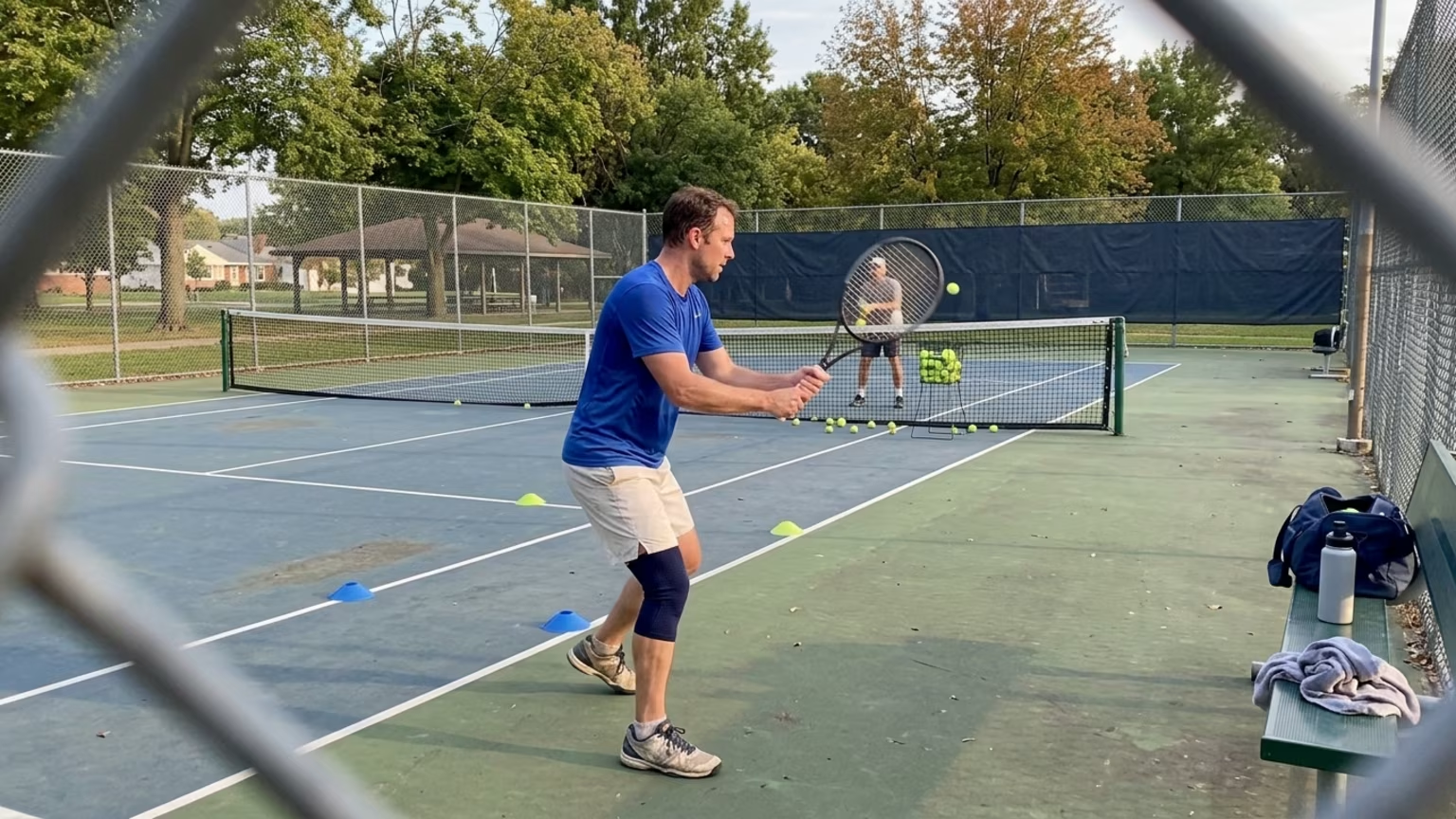

Practical answers on rebuilding tennis court time, separating rallying from match play, reintroducing serves and reviewing next-morning symptoms.




How should I return to tennis after time away? Start below your previous workload and gradually rebuild court time, movement and serving rather than trying to make up missed sessions at once, as tennis-focused practitioner guidance recommends.
The starting point is your previous workload, not the amount of tennis you wish you had played. The practitioner guidance recommends coming back below that workload after a holiday, illness or injury. It specifically cautions against trying to recover missed sessions in one weekend.
The evidence has an important boundary. The detailed progressions discussed here come from practitioner resources and injury-focused guidance rather than a validated timetable for every adult returning from a break. A return-to-sport review summary reports five eligible studies from 1,164 screened and describes its suggested progression as guidance rather than a proven protocol. An ordinary recreational break is not automatically an injury rehabilitation case.
With that distinction in place, the practical question is not “What is the correct session length for everyone?” It is “Does this session start below my previous workload and give me room to rebuild?” That keeps the focus on a manageable return rather than a test of your former schedule.
For planning purposes, separate what the session will contain:
These categories translate the practitioner advice into a clearer description of a session. “A hit with a friend” leaves plenty unspecified; describing the intended time and type of work gives the plan more substance. Evercourts covers this distinction in its guide to tracking court work beyond minutes.
A sports-physiotherapy summary of tennis demands describes singles as repeated short movements with accelerations, braking and changes of direction. It also notes that matches can be long and that play on consecutive days can leave limited recovery.
A controlled hitting session is therefore a different exposure from match play. Points introduce less predictable movement alongside those accelerations and changes of direction. The distinction is not simply between a short session and a long one: what happens during the session matters too.
That is worth remembering when a comfortable cooperative rally becomes the reference point for a whole match. Enjoying the rhythm of hitting is a positive part of being back. It does not make cooperative practice and competition equivalent workloads.
The progression in an injury-focused tennis guide makes those differences visible. It starts with pain-free daily activity and strength work before moving into shadow swings and short-court hitting. Graded baseline rallying and point play follow, with serves and overheads later in the sequence.
For everyday planning, the useful lesson is to name the task rather than calling everything “tennis.” Controlled hitting, baseline rallying and point play are separate items in that guide. Giving them separate entries in a return plan makes the intended session easier to describe.
A match need not be the first measure of a successful return. The practical aim is to rebuild court time and intensity through manageable work rather than compress every demand into the first outing. Evercourts' guide to organising a gradual return to court offers related planning context.
Serving deserves its own part of the plan. The tennis-focused practitioner resource advises treating serve volume separately from rally volume and cautions against a long session of maximum-effort serves on the first day back. It recommends introducing easier serves before harder ones while movement and hitting pace are rebuilt progressively.
That is a different question from whether your groundstrokes feel comfortable. A plan that says only “easy hitting” can leave the serving part undefined. As a practical interpretation of the guidance, describe the intended serving effort and volume separately rather than assuming they are covered by the rally plan.
The injury-focused tennis guide takes a similar staged view by placing serves and overheads after controlled hitting and point play. Its sequence reinforces the distinction between restoring rally work and restoring full serving. Serving is a separate item to consider rather than an automatic addition to a comfortable baseline session.
For a tennis player, the useful planning questions are straightforward:
Those questions make the plan more specific without turning the first practice into a serving test. A good rally is a welcome part of the return; it does not have to settle every question about the rest of the session.
The same injury-focused tennis guide includes checking how symptoms respond by the following morning. In practical terms, reviewing a session extends beyond how the final rally felt.
That makes the next-morning response another piece of information when considering the work completed. It belongs alongside the type of hitting and movement involved, rather than being separated from the session that preceded it.
For an injury-related return, questions about symptoms and progression belong with the treating clinician or rehabilitation team. Evercourts' guide to putting movement and next-morning symptoms in context provides related reading.
A return to tennis is a rebuilding process, not a repayment plan for missed court time. There is room for patience and good tennis in the same comeback.
Follow Evercourts for practical insights on tennis, pickleball and padel performance, movement, recovery and healthy ageing. Stay connected for new articles, research-led guidance and ideas to help you play well and keep playing for years.


Learn how to turn, track and recover for pickleball lobs with a gentle partner drill, plus what fall research says about balance and footwork.

Tennis match data explain why conditioning involves repeated bursts and recovery. Apply the pattern without treating research averages as personal targets.

A flexible pickleball warm-up progressing from easy movement to controlled lunges, side steps, shadow swings and dinking, with readiness-based adjustments.
Read practical guidance for better movement, smarter preparation and a game that keeps working for you.
explore the Blog
