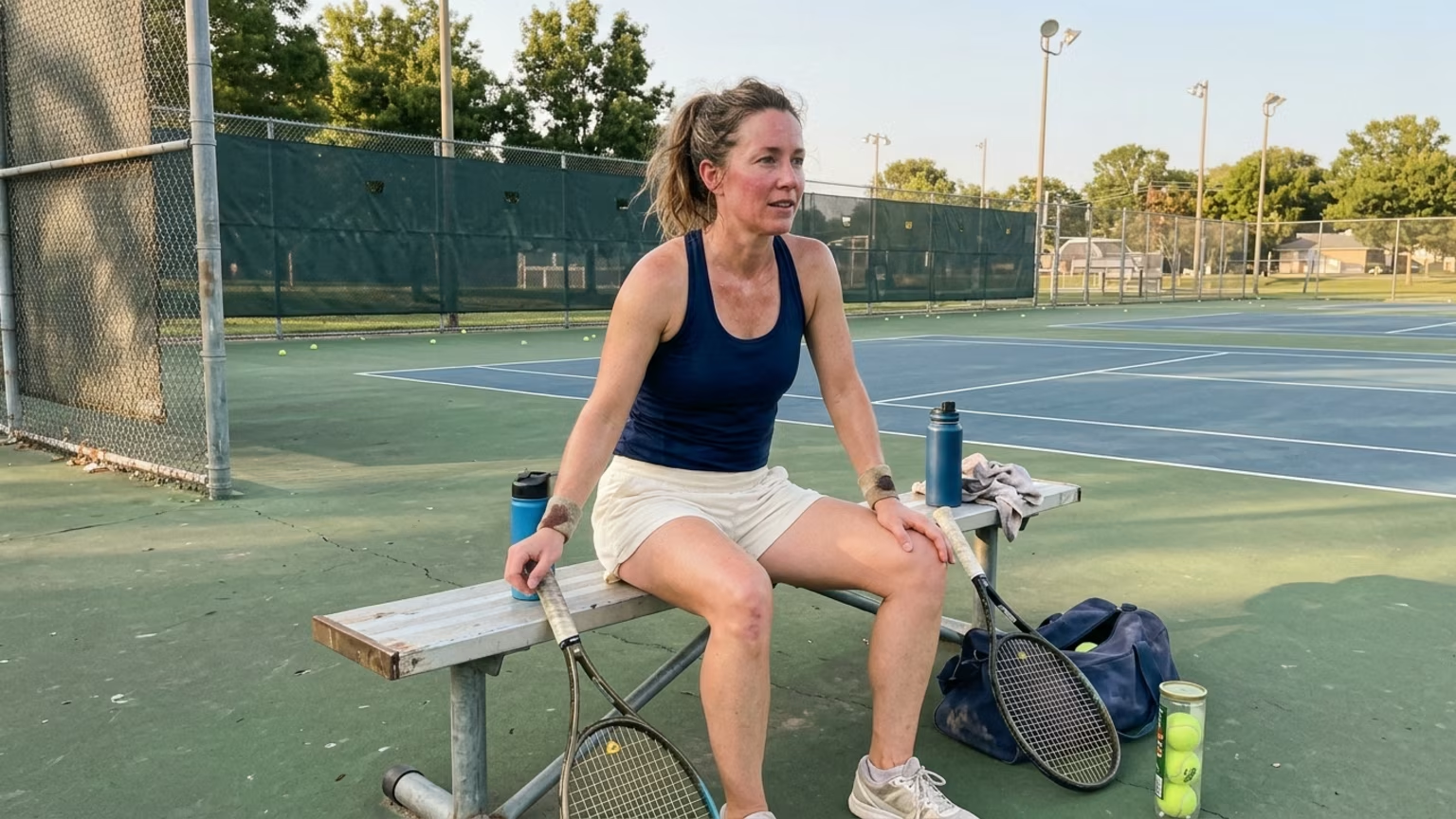

Practical answers on rebuilding tennis workload after a break, balancing matches with recovery and using session notes to guide a flexible week.




How do I build my tennis workload after a break without doing too much too soon? Start below your previous workload, rebuild gradually and arrange the week around its most demanding session while paying attention to how you respond between outings.
Your previous routine is a reference point, not the starting requirement. A tennis workload article recommends returning below the workload you managed before the break and increasing activity progressively. It specifically advises against trying to make up missed sessions all at once.
The practical distinction is between rebuilding your routine and catching up with your calendar. An empty stretch in your playing history does not create a debt of court hours. The useful question is what belongs in your current week, not how quickly you can recreate your busiest one.
A six-week coaching example illustrates a progression from easy rallies toward more demanding strokes and practice points before match play. Its useful feature is the sequence: returning to court does not have to mean returning immediately to your most demanding tennis.
The evidence has important boundaries. The workload article states that no percentage increase is universally safe for every athlete, while the coaching timetable is an example rather than a validated individual prescription. A narrative review in the International Journal of Sports Physical Therapy also cautions that much of the elbow-load literature comes from elite and professional tennis rather than recreational players.
For weekly planning, that points toward a flexible starting point rather than a fixed calculation. Thinking in terms of rebuilding from your current baseline keeps the emphasis on what you are doing now. Your former routine can remain a goal without becoming this week's obligation.
Start by identifying the week's most demanding tennis session. The workload article recommends arranging the rest of the week around preparation for and recovery from that session. That gives the calendar a clear priority before other court bookings fill the gaps.
A match or demanding practice can be that priority. An easier technical session can serve a different purpose. The planning task is to keep those roles distinct rather than treating every available court booking as equally important.
The following is an editorial planning example, not a schedule tested by the cited sources:
This arrangement makes the weekly question more useful. Instead of asking how much tennis will fit, ask which sessions matter most and what room they need around them.
The same workload source advises adjusting plans when symptoms or sleep make the original schedule unrealistic. Work stress also belongs in that decision. A plan written earlier in the week is not an obligation to ignore what has changed since.
For players also fitting in strength work, considering court time and recovery together keeps the planning discussion connected. The point is not to fill every category perfectly. It is to make the week's priorities visible before adding more commitments.
Record the court time, but give the session some context as well. The narrative review of cumulative elbow load describes several potentially interacting contributors. These include stroke volume and intensity alongside fatigue and recovery capacity.
The practical interpretation is that a calendar entry alone does not describe everything discussed in that review. It tells you when you played and for how long. It does not tell you what the session involved or how demanding it felt.
A simple editorial approach is to keep a brief note alongside the booking:
This is a planning record, not a diagnostic score. Its purpose is to make your own observations available when you decide whether to keep the next session as planned or adjust it. There is no need to turn the note into a complicated performance project.
For example, the planned session and the completed session may deserve different descriptions. If an intended easy practice became demanding match play, record what actually happened. Otherwise the next planning decision starts from the wrong account of the week.
That is the useful connection between court minutes and perceived effort: duration is part of the record, not its entire meaning. A short note also gives a coach or qualified health professional a clearer account of your recent tennis if you need individual guidance.
Treat that response as information rather than an inconvenience to the schedule. The coaching-site return plan advises stopping for joint pain rather than treating it as ordinary muscle soreness. The workload article recommends reducing activity when symptoms persist or when movement or recovery worsens.
For planning purposes, the next session is a decision point rather than an automatic step upward. Persistent symptoms are not a reason to keep increasing the workload simply because the calendar says another progression is due.
Where symptoms persist or worsen, decisions about your individual situation belong with a qualified health professional. A session log can describe what happened, but it cannot establish why you hurt or determine the right return plan for an injury.
Adjusting a week's tennis is compatible with a long-term playing goal. It does not need to become a judgment about your commitment or your future on court.
A useful tennis week respects your current starting point and leaves room to adapt, keeping the focus on enjoying the game for years rather than catching up in a hurry. Today's practical takeaway is a calendar with the hardest tennis session identified and recovery space protected around it.
Follow Evercourts for practical insights on tennis, pickleball and padel performance, movement, recovery and healthy ageing. Stay connected for new articles, research-led guidance and ideas to help you play well and keep playing for years.


Learn how to turn, track and recover for pickleball lobs with a gentle partner drill, plus what fall research says about balance and footwork.

Tennis match data explain why conditioning involves repeated bursts and recovery. Apply the pattern without treating research averages as personal targets.

A flexible pickleball warm-up progressing from easy movement to controlled lunges, side steps, shadow swings and dinking, with readiness-based adjustments.
Read practical guidance for better movement, smarter preparation and a game that keeps working for you.
explore the Blog
