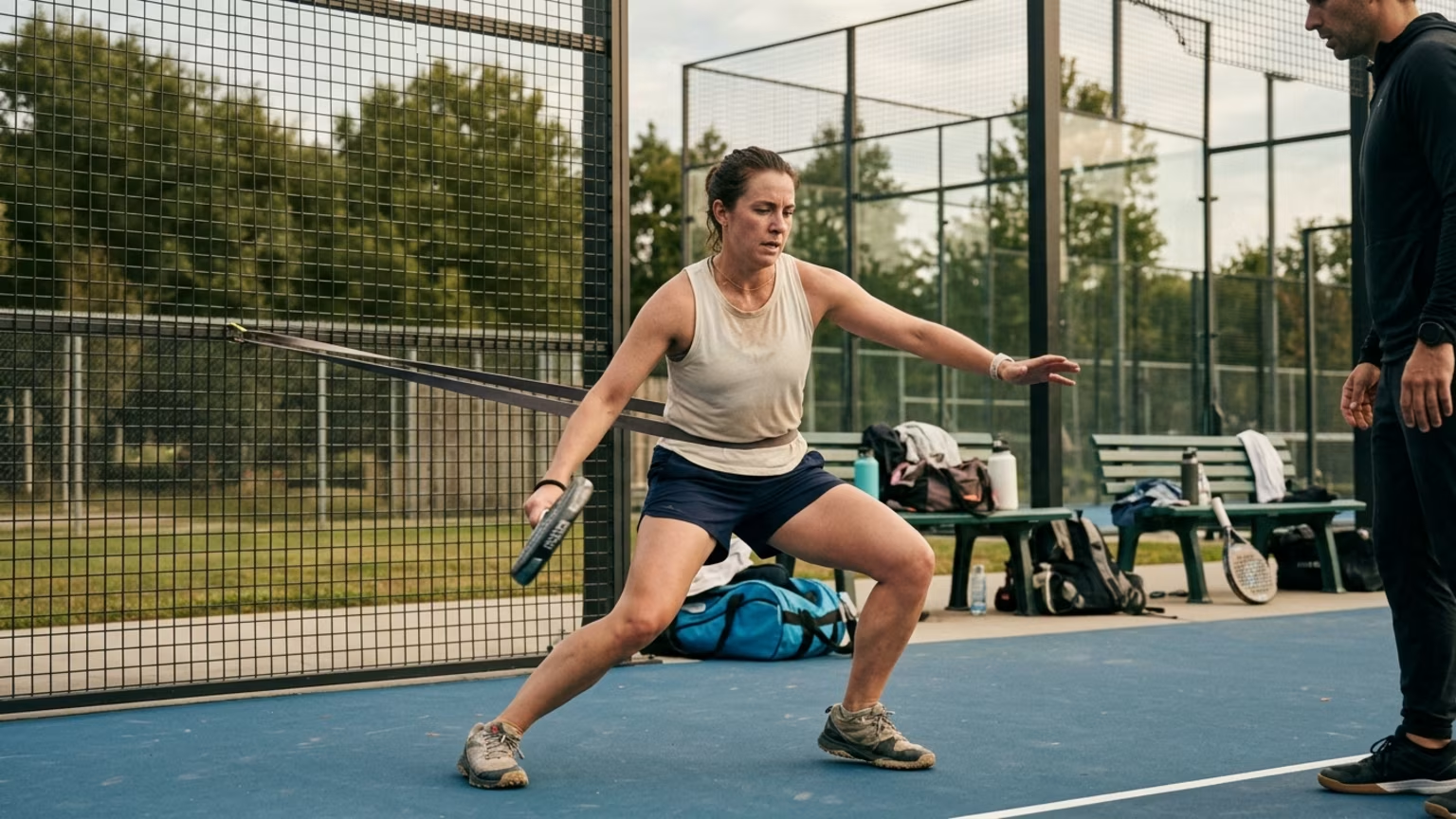

Understand padel’s starts, stops and turns through leg strength, balance and trunk control, with a clear look at the evidence and its limits.




Strength training for padel is planned work to develop the force and control involved in starting, stopping and moving again on court. That includes leg strength alongside balance and control of the trunk. The useful question is not simply how much weight a player can lift. It is which physical capacities the training is intended to develop.
For adult players, this gives strength work a clear purpose without making it a promise of injury-free play. Getting moving matters. So does managing the stop and being ready for the next movement.
Thinking in terms of capacities also changes how exercises are discussed. An exercise is a way to practise or develop a quality, rather than a requirement that every padel player must complete.
Padel involves frequent braking and changes of direction. The practical connection to strength training is the repeated need to produce force, manage movement and then move again. These are related tasks, but they are not interchangeable.
Starting asks a player to get moving. Braking asks the player to slow that movement. Turning adds the challenge of organising the body for a different direction rather than continuing along the same path.
For tennis and pickleball players, the same questions help interpret repeated explosive efforts and direction changes: how does the player get moving, slow down and prepare for another effort? This is a shared movement lens rather than a claim that the sports have identical demands. Padel remains the focus of the evidence discussed here.
Consider the difference between reaching a ball and being ready after reaching it. The first task draws attention to the initial movement. The second brings balance and body control into the picture. As a practical interpretation of court demands, both deserve space in a discussion of physical preparation.
That is why looking at starts and stops together is more useful than treating court strength as a single quality.
A secondary summary of a 2023 systematic review describes eight studies involving 2,022 padel players. It reports that the review found no studies testing padel-specific injury-prevention programmes. That finding describes the research included in that review, not proof that preparation has no value.
The evidence assembled for this topic does not establish an optimal padel strength programme. It also does not provide a trial-validated progression for different experience levels or show that a particular exercise prevents injury. Professional movement demands do not establish an appropriate training dose for recreational players or older adults.
The useful response is to separate the task from the training choice. Repeated stopping and turning provide a reason to think about physical capacities. Choosing a particular exercise or progression remains a coaching decision rather than a result directly established by this evidence.
The research supports the following practical translations of padel’s movement demands:
These descriptions are a framework for understanding training aims. They are not a ranking of which quality matters most for every player.
A useful exercise discussion therefore begins with its purpose. Is the emphasis on producing force? Is it on controlling position? Or is it on connecting a stop with the next movement? Naming the aim makes the choice easier to understand without attaching an exaggerated promise to it.
An accessible coaching progression can move from easier, controlled movements toward more demanding single-leg work or faster court-like actions. This sequence is practical guidance, not a tested padel protocol.
The important distinction is what changes between versions. A controlled movement puts the emphasis on managing the action. A single-leg variation changes the balance demand. A faster action changes the speed at which the movement must be organised.
Those are different challenges rather than automatic markers of a better exercise. More demanding does not mean more appropriate for every person. An experienced player and someone returning after a break may need different choices even when their broad training aim is the same.
For more context on the controlled end of that spectrum, our guide to movement tempo and strength work looks at how exercise pace fits into the wider discussion of capacity.
For an adult player, athletic longevity is a more useful goal than completing an impressive exercise progression. The aim is to maintain physical capabilities that matter to the game and keep enjoying participation over time.
A capacity-based approach provides a vocabulary for that goal. Instead of saying only that a player needs to get fitter, it allows a more focused conversation about force or balance. Instead of treating every difficult movement as a strength problem, it leaves room to consider control and the transition into the next action.
That distinction also respects experience. A player may understand positioning and shot selection very well while still wanting to develop a physical quality. Physical preparation does not replace court knowledge. It addresses a different part of the task.
The same perspective can make training discussions less dependent on exercise novelty. A familiar movement with a clear purpose has a place in the conversation. So does a more demanding variation when it serves the intended aim. Difficulty alone is not the objective.
For players thinking about the bigger picture, placing strength work within the court week is a useful next topic. The editorial priority is a coherent approach to playing and physical preparation, rather than a collection of exercises disconnected from the game.
Understanding the mechanics offers a grounded way to think about the years ahead: retain useful capacities, recognise personal concerns and keep the purpose of training clear.
Recurring aches or stiffness are reasons to discuss personal training choices with a qualified physiotherapist or healthcare provider. The same applies when discomfort changes how a player moves or leaves them uncertain about continuing to play.
Difficulty deciding which exercise level is appropriate also belongs in that conversation, especially when symptoms are involved. General coaching progressions cannot resolve an individual health concern. A return after a break should not be judged solely by whether someone can complete a harder variation.
These are situations for individual assessment rather than a diagnosis from an article. For the long game, an honest understanding of present capacity matters more than an impressive-looking exercise.
Follow Evercourts for practical insights on tennis, pickleball and padel performance, movement, recovery and healthy ageing. Stay connected for new articles, research-led guidance and ideas to help you play well and keep playing for years.


Learn how to turn, track and recover for pickleball lobs with a gentle partner drill, plus what fall research says about balance and footwork.

Tennis match data explain why conditioning involves repeated bursts and recovery. Apply the pattern without treating research averages as personal targets.

A flexible pickleball warm-up progressing from easy movement to controlled lunges, side steps, shadow swings and dinking, with readiness-based adjustments.
Read practical guidance for better movement, smarter preparation and a game that keeps working for you.
explore the Blog
