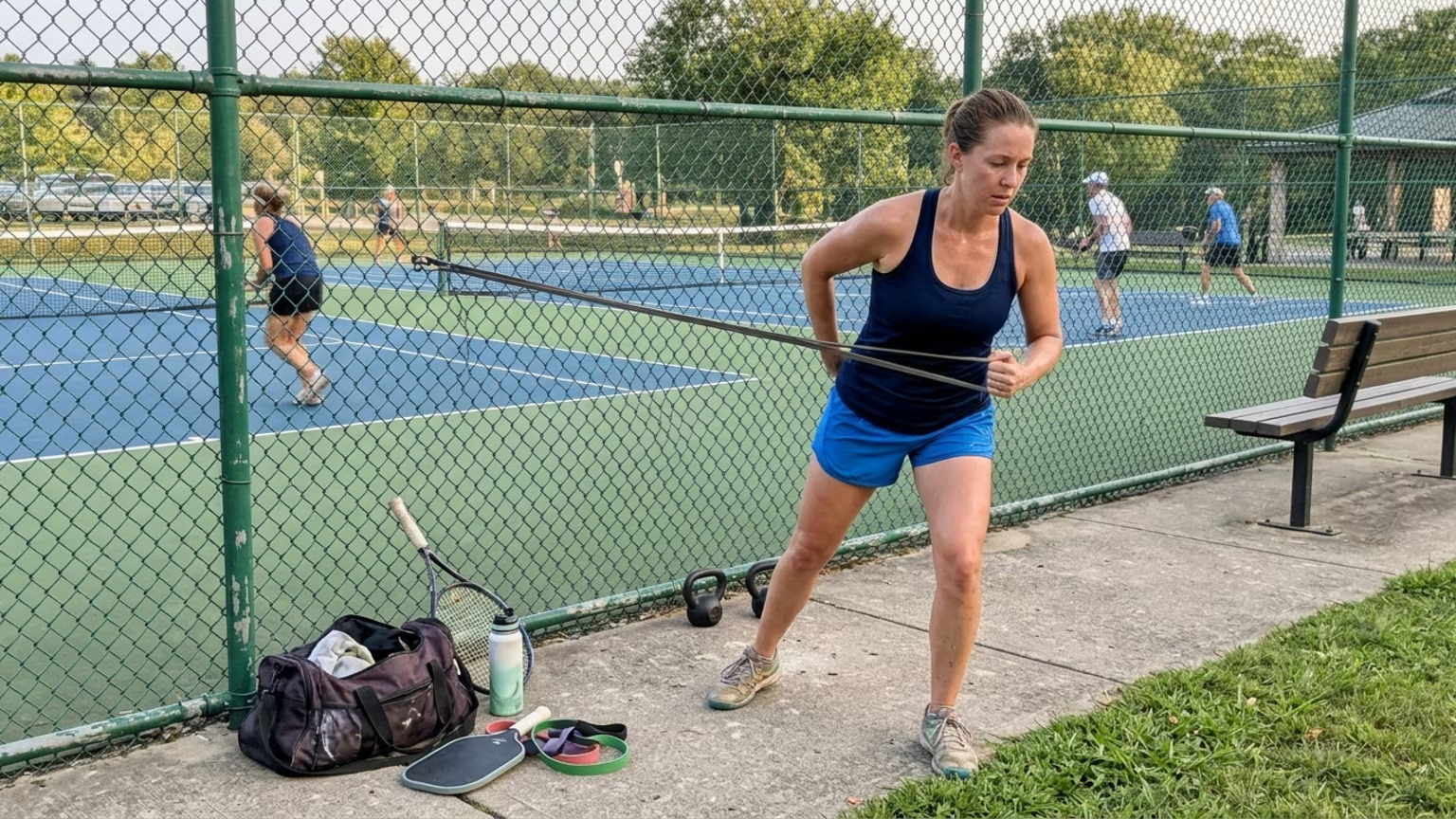

Plan court time alongside strength, balance and lighter movement, with a clear look at the evidence and when to seek individual advice.




Physical capacity is your ability to handle the effort and movement involved in playing and training. For an adult racquet-sport player, planning around that capacity means considering more than whether another match fits in the calendar.
Court play belongs in the same picture as strength work, balance practice and easier movement. These are complementary priorities rather than unrelated activities competing for whatever time remains.
A useful starting point is the court time you most want to preserve. Build the planning discussion around that priority, then consider where the other activities belong. The aim is a week that makes sense as a whole rather than a collection of individually worthwhile sessions.
For tennis, pickleball and padel, a useful planning question is how repeated explosive efforts and changes of direction fit alongside everything else you do. Count those demands as part of training rather than treating court time as separate from physical work.
That shifts attention from available calendar space to the demands of the actual session. An open evening does not automatically need another demanding activity.
Keep the sports distinct in your planning without assuming that the sport name tells the whole story. Describe the tennis session you intend to play. Do the same for pickleball and padel, rather than giving every court booking an identical place in the week.
The practical question is not which sport deserves a blanket label of easy or hard. It is which sessions matter most to you and how their demands fit with strength and balance work. That is the foundation of thinking about strength alongside court commitments.
A review in European Review of Aging and Physical Activity examined racquet-sport interventions in adults aged 60 and older. It included 13 trials across 14 reports. Its primary analysis used 10 randomized trials involving 469 participants.
The authors reported favorable findings for some outcomes, but the evidence was uneven. The review covered table tennis, badminton and tennis. It did not include pickleball or padel.
Table tennis supplied the most evidence. Badminton evidence was sparse, while the tennis evidence came from a single trial of 16 men without a non-exercise comparison group. The authors concluded that the available research could not establish whether one racquet sport was superior to another.
A separate pickleball injury article reports that no randomized trial has tested a pickleball-specific injury-prevention measure. It describes off-court balance work as a plausible idea drawn from broader older-adult fall-prevention research. It also states that balance training has not been tested directly in pickleball players.
These limits belong together: the evidence does not establish a single ideal weekly schedule or prove that a particular arrangement prevents injury. It also does not establish that court play replaces dedicated strength or balance training.
The practical interpretation is to consider these activities together while keeping their purposes separate. Playing a sport and deliberately making room for other physical training are different planning decisions.
For athletic longevity, the useful shift is from collecting sessions to choosing priorities. The planning task is to preserve meaningful court time while giving strength, balance and lighter movement a deliberate place.
This is not a reason to make every week identical. It is a way to see what the week contains before adding more.
Start with the sessions that matter most to your enjoyment or competitive goals. An important match may deserve different planning attention from an optional extra booking.
Then look at the whole week rather than considering each activity in isolation. If adding court time leaves no space for strength or balance, acknowledge that trade-off. Neither activity needs to disappear from consideration simply because the court booking happened first.
For a broader planning framework, consider how court commitments and off-court priorities fit together. Use that discussion to organize choices rather than to search for a timetable everyone must follow.
Treat strength and balance as separate priorities in the plan. Writing down both makes it easier to notice when court play has crowded one out.
That distinction matters editorially as well as practically. The racquet-sport review should not be read as permission to replace every kind of physical training with more matches. Likewise, the rationale for balance practice should not become a claim that it guarantees safety on court.
A useful planning question is straightforward: does the week reflect the activities you intend to maintain? If strength or balance repeatedly disappears, revisit the allocation of time rather than assuming an increasingly crowded calendar will resolve itself.
The emphasis is consistency of attention, not perfect attendance at a prescribed set of sessions. Personal decisions about exercise selection or progression belong with someone qualified to assess your circumstances.
Lighter movement days can be included as an adaptable planning option. They do not need to be filled with extra training merely because time is available.
The choice between easier movement and complete rest is also worth considering deliberately. Evercourts discusses how to think about lighter activity and rest as part of the wider training picture.
Keep the purpose clear: you are deciding how the week fits together. You are not trying to turn every free slot into another workout or treating a lighter day as a failure to train.
Over the longer term, this approach keeps the planning conversation connected to the court time you value. Getting older need not become an automatic instruction to abandon that priority or copy someone else's routine.
Persistent symptoms are a reason to consult a qualified physiotherapist or healthcare provider rather than repeatedly rearranging the calendar around them. Ongoing aches or stiffness deserve an individual discussion when they remain a concern.
Questions about increasing training are another reason to seek advice, particularly when you are unsure what your current capacity allows. A general article can help organize the questions. It cannot decide which changes suit your symptoms or circumstances.
If the main planning problem has become how to keep playing despite persistent symptoms, move that decision beyond the calendar. Seek qualified assessment instead of relying on someone else's weekly routine.
Your court time deserves care, not guesswork.
Follow Evercourts for practical insights on tennis, pickleball and padel performance, movement, recovery and healthy ageing. Stay connected for new articles, research-led guidance and ideas to help you play well and keep playing for years.


Cronometer's recovery article puts nutrition alongside sleep, workload and rehabilitation, with practical context for recreational racquet-sport players.

Use minutes and perceived effort to track tennis workload, notice changes between sessions and keep wearable recovery findings in perspective.

Zhen Yan recommends strength and endurance exercise for healthy aging. Here is a practical reading for racquet players, with mitoAMPK research in context.
Read practical guidance for better movement, smarter preparation and a game that keeps working for you.
explore the Blog
