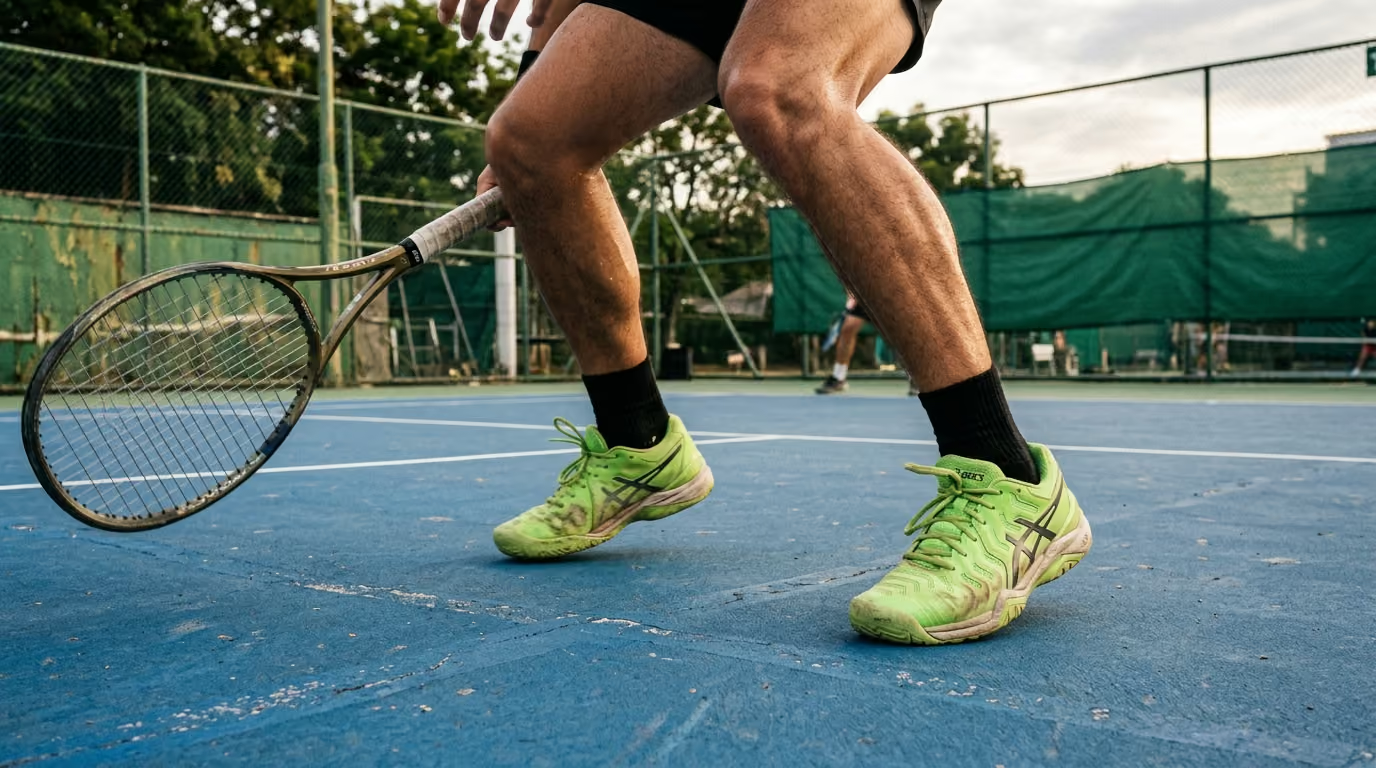

Slow strength training for racquet sports uses controlled tempos, deliberate pauses, and isometric holds to build capacity, coordination, and joint robustness.




You are deep into a competitive second set when you feel your legs begin to grow heavy. The wide lunges that felt effortless during warmups now require a noticeable mental struggle. Your recovery steps feel slow, and you struggle to push back to the center mark of the court.
Slow strength training is a targeted load-modification strategy that uses controlled tempos, deliberate pauses, and isometric holds to build capacity. It helps players increase time under tension, improve coordination, and develop joint robustness without relying solely on heavy weights or specialized gym equipment. This method allows you to build strength when heavy loading is unavailable, impractical, or poorly tolerated by your joints.
Whether you are looking to support your joints for athletic longevity, training in a hotel room with minimal equipment, or returning to play after a layoff, managing your movement speed is a highly effective tool. By shifting your focus from how much weight you lift to how you control that weight, you can build a more resilient physical foundation.
To use slow strength training effectively, you must understand how to measure and control your movement speed. We use a standardized four-digit tempo notation system to structure every exercise. This notation represents the exact seconds spent in each phase of a single repetition. It provides a clear blueprint for consistency in your training.
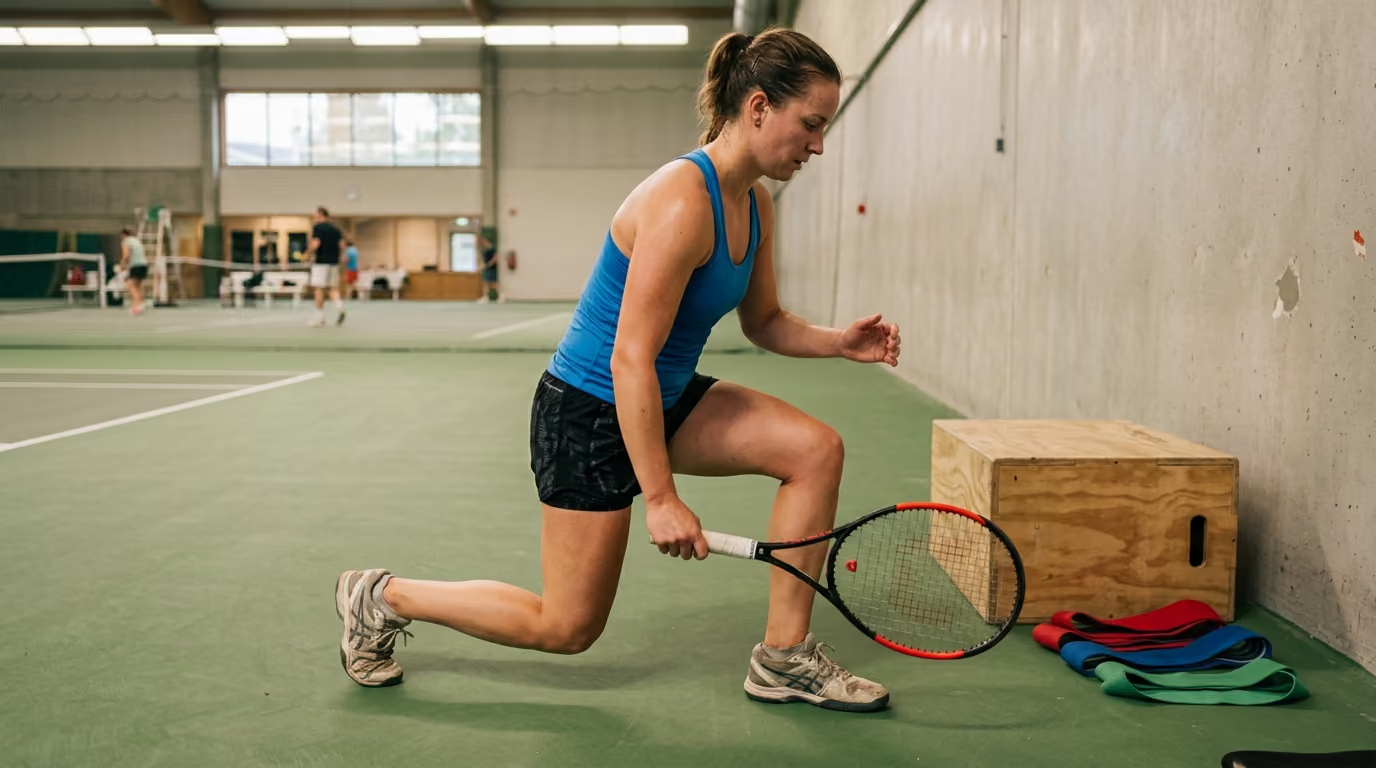
The notation reads from left to right as: eccentric phase, pause in the lengthened position, concentric phase, and pause in the shortened position. For example, a split squat written with a tempo of 4-2-X-1 requires a specific timing pattern. First, you lower your hips for a controlled four-second descent. Second, you hold a steady pause for two seconds at the bottom. Third, you rise as fast as your technique permits, which is represented by the "X." Fourth, you pause for one second at the top before starting your next repetition.
Understanding these phases helps you target the correct adaptations. A slow repetition is not a single, uniform action. You can alter the timing of different components depending on your specific needs. For example, you might choose to lengthen only the lowering phase, or you might insert a long pause at a difficult joint angle.
These variations produce different physical effects on your muscles. A slow eccentric phase paired with an explosive lifting phase trains your muscles to absorb force. A very slow movement in both directions creates a different metabolic challenge. By adjusting these variables, you can customize your training to match your physical capacity.
To get the most out of slow training, you should understand how your muscles produce force. Muscle actions are divided into eccentric, concentric, and isometric phases. Each phase plays a distinct role in movement on the court, and each phase responds differently to changes in tempo. You can learn more about these training methodologies by reviewing our strength and conditioning resources.
An eccentric action occurs when your muscle produces force while it is lengthening. An example is lowering your body into a deep lunge. The muscle acts like a brake to control your descent. Controlled eccentric work creates a strong training stimulus with less external weight.
A concentric action occurs when your muscle shortens while producing force. This is the propulsive force you use to push off the court or drive your body forward. For racquet athletes, the lifting or pushing phase is usually performed with fast intent. This helps preserve your ability to express force rapidly.
An isometric action occurs when your muscle produces force without any visible movement at the joint. Holding the bottom position of a split squat is a classic isometric hold. This type of training helps build tolerance at specific joint angles. It is a highly effective way to practice full-body tension.
Current sports science research reveals that slow training is a valuable alternative to traditional lifting. A systematic review reported that neither isolated slow nor isolated fast tempos were clearly superior for muscle growth. Instead, a combination of slower eccentrics and faster concentrics is often the most practical compromise. Another study showed that two-second and four-second eccentric phases produced similar lower-limb muscle growth and strength gains in participants. Therefore, you do not need to use excessively slow speeds to see a benefit.
However, specific studies show promising results for targeted eccentric work. One study comparing eccentric squat tempos reported significant strength gains in both groups. The slow-eccentric group showed a larger strength increase, with an effect size of 1.60 compared to 0.99 for the fast group. The slow-eccentric group also produced greater improvements in vastus lateralis muscle growth. This suggests that slow eccentrics can be a powerful tool for developing specific leg strength.
When considering your overall training program, it is helpful to reference standard guidelines. The American College of Sports Medicine recommends that intermediate and advanced athletes use a wide range of resistance training methods. For power development, they suggest using light loads moved at fast contraction velocities. Slow strength training should not replace all fast movements. Instead, it serves as a foundation for control, helping you prepare your body for faster, sport-specific actions.
Racquet sports require you to navigate unpredictable environments. You must constantly change direction, decelerate your momentum, and stabilize your trunk during rotative movements. Traditional strength training often focuses solely on how much weight you can lift. Slow training shifts the focus to how well you can control your body through space. You can find more information on preserving joint health in our healthy aging and athletic longevity resources.
Using slower speeds helps you build local muscular endurance. It increases your total time under tension. This is the total time your muscles are actively producing force during a training set. This sustained work helps build the capacity of your muscles to resist fatigue.
Slow work also gives you time to focus on your alignment. You can pay close attention to your foot position, knee tracking, and hip stability. This awareness is crucial for building athletic longevity. It helps you build movement patterns that protect your joints during fast play.
You can organize your exercises into five key categories to build court capacity:
Using these categories ensures your training covers all the physical demands of your sport. You can find additional movement strategies in our mobility and movement resources.
Each racquet sport places unique physical demands on your body. Understanding these differences allows you to tailor your slow strength work. You can focus on the specific joint angles and movement patterns you use most on the court. Let's look at how tennis, pickleball, and padel differ in their requirements.
Tennis is played on a large court. It requires explosive sprints, massive lateral lunges, and deep rotational turns. You must absorb heavy forces when you decelerate to hit a groundstroke. Your lower body must tolerate deep positions in a wide stance.
To prepare for these demands, your slow strength work should focus on deep lateral lunges and split squats. A slow eccentric phase helps build the structural capacity of your quadriceps and glutes. This preparation makes it easier to decelerate safely on the court. It also improves your ability to push off and recover your position.
Pickleball is played on a smaller court, but it requires highly repetitive movements. You must spend a lot of time in a low, crouched position near the kitchen line. This posture requires constant isometric endurance from your quadriceps and calves. The lateral movements are shorter but occur at a very high frequency.
Your slow strength training should emphasize long isometric holds. Holding a split squat or a wide squat helps build the endurance needed for the kitchen line. Focus on controlled calf raises with a pause at the top. This builds the capacity of your lower leg to handle quick steps.
Padel involves constant rotational movements, wall play, and overhead shots. You must quickly turn your torso to play balls off the glass. You also need strong shoulder control to perform repetitive overheads. Your hips must remain mobile and strong to change direction in a tight space.
For padel, prioritize rotational trunk control and shoulder stability. Use slow, controlled cable rotations or Pallof presses. Focus on slow-tempo push-ups and rows to build shoulder strength. This training improves your ability to transfer force from your legs through your core.
To get stronger over time, you must progress your exercises. When you do not have heavy weights, you need other ways to make exercises more challenging. You can think of your training variables as four dials that you can adjust. These dials are tempo, range of motion, leverage, and density.
You can increase the difficulty of an exercise by slowing down. Start with a standard two-second descent. As you get stronger, progress to a three-second or four-second eccentric phase. You can also add a brief pause at the bottom of the movement.
A full range of motion is generally best for building strength and muscle. Research shows that full-range training produces greater lower-limb muscle growth than partial-range training. However, partial ranges are useful if you are managing joint discomfort. Start with a pain-free range, then gradually increase the depth as your comfort improves.
You can change your body position to make an exercise harder. Moving from a two-legged squat to a single-leg split squat increases the load on your working leg. You can also change your stance or hold a weight in one hand. This challenges your balance and forces your core to work harder.
Density refers to how much work you perform in a given time. You can make your workouts more dense by shortening your rest periods. For example, reduce your rest from 90 seconds down to 60 seconds. You can also perform your exercises in a circuit format.
To structure your training throughout the year, use this three-zone model:
Using these zones systematically helps you progress from basic movement quality to court-ready performance.
Here are three structured routines you can use in different environments. These workouts use slow tempos to challenge your muscles without requiring heavy barbells. Always warm up with light movement before starting.
This routine requires only your body weight. Focus on precise tempo control for every repetition.
Use this circuit when you are traveling and have limited space. It keeps your joints active and maintains your physical capacity.
Note: Always ensure any physical setup is completely stable before beginning an exercise.
This routine is ideal if you have access to weights but want to focus on control and joint safety.
While slow training is highly effective, it is easy to make mistakes that limit your progress. Being aware of these pitfalls will help you train more safely and effectively.
Some players believe that slowing down every exercise is the best way to train. However, sports science does not support this blanket claim. Extremely slow speeds can actually reduce the amount of force you can produce. To build athletic power, you still need to perform fast, explosive movements in your training program.
Increasing your time under tension is a great way to challenge your muscles, but it is not a magic solution. You still need to ensure you are working with sufficient effort. If a weight is too light, simply moving it slowly will not trigger the adaptations you want. You must combine controlled tempos with progressive challenge.
A common mistake is using momentum to push out of the bottom of a lift. For example, during a squat, players often drop quickly and bounce back up. This action bypasses the most challenging part of the movement. Adding a deliberate pause removes this momentum and forces your muscles to do the work.
If you must distort your alignment to maintain a slow count, the exercise is too difficult. Do not let your knee collapse or your back arch just to finish a four-second descent. If your technique starts to break down, reduce the weight or the repetition count immediately. Your priority should always be high-quality movement.
Slow strength training can have a unique impact on your body's recovery. Understanding this impact helps you plan your workouts around your court sessions. You can find detailed strategies on recovery methods in our recovery science resources.
Slowing down the lowering phase of an exercise increases the eccentric demand on your muscles. Unfamiliar eccentric exercise is well known to cause muscle soreness. This soreness is not a sign of joint damage, but it can temporarily affect your performance.
To avoid excessive soreness, you should introduce slow training gradually. Do not start with long, intense negatives on your first day. Begin with a conservative volume, such as two sets per exercise. Allow your body several weeks to adapt before you increase the difficulty.
If you have a busy week of matches, you should reduce your slow strength training volume. Avoid introducing new slow exercises right before a tournament. Instead, focus on short maintenance sessions that preserve your movement quality without creating excessive fatigue.
While slow strength training is a safe and effective way to build capacity, you must listen to your body. It is normal to feel muscular fatigue and temporary soreness after a workout. However, you should be able to distinguish these feelings from pain that requires professional attention. You can find more information about joint care and wellness in our player health articles.
You should consult a qualified healthcare provider if you experience sharp, escalating pain during or after an exercise. Pay close attention to any swelling or warmth around a joint. A sudden loss of strength or joint function is also a clear sign that you need a professional assessment.
Slow training is often used in tendon rehabilitation, but it must be tailored to your specific situation. If you suspect you have tendon issues, do not try to self-treat with random tempo protocols. A physical therapist can provide a personalized program that targets your specific tendon needs.
Revisit this guide whenever you are planning a new training phase, traveling with limited gym access, or recovering from a competitive season. It serves as a practical blueprint for maintaining your physical capacity in any environment.
By mastering tempo, pauses, and controlled movement, you can build a highly resilient body that supports your play on the court for years to come.
Follow Evercourts for practical insights on tennis, pickleball and padel performance, movement, recovery and healthy ageing. Stay connected for new articles, research-led guidance and ideas to help you play well and keep playing for years.


Read practical guidance for better movement, smarter preparation and a game that keeps working for you.
explore the Blog