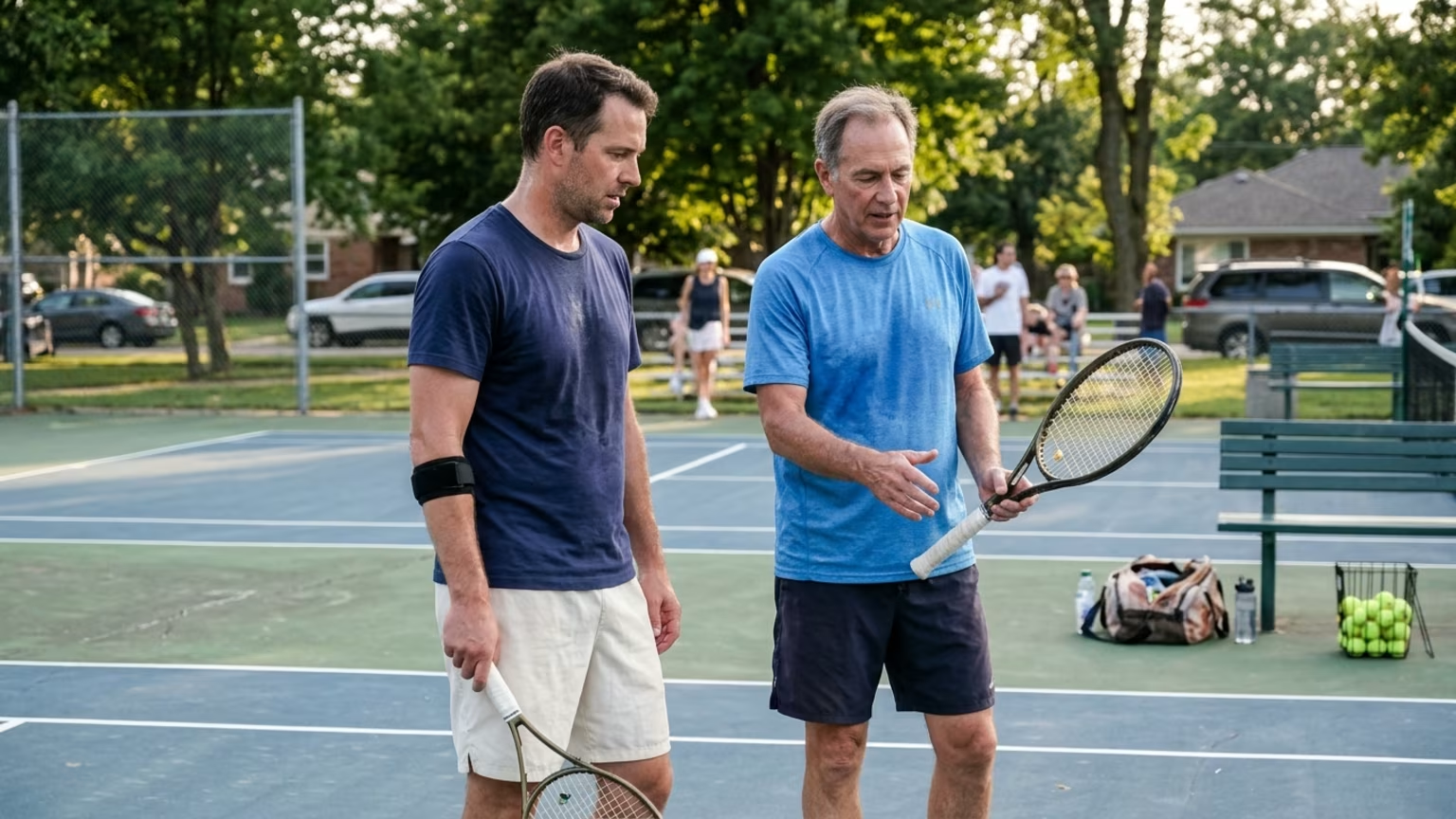

A new tennis-elbow guide separates light hitting from competition. Here is what its staged approach means for adult recreational players.




On November 19, 2026, DR+ published a tennis-elbow recovery guide reviewed by Dr. Caleb Seet Yu Shiang that recommends rebuilding strength before a staged return to tennis.
The article sets out three phases: settling symptoms, rebuilding tendon capacity and returning to sport. Its central recommendation is to reduce activities that aggravate the elbow without defaulting to complete rest. For tennis, it places shadow swings or light drills before short rallies, longer sessions and competitive play.
In the rebuilding phase, DR+ describes wrist-extension holds followed by slow wrist extension when comfortable. Grip strengthening and forearm rotation also feature in the guide. The article's rationale is that rest may ease discomfort without restoring tendon strength.
This is a clinician-reviewed information article, not a new clinical trial or an official tennis policy. Its proposed exercises and timings are a framework for discussion with a doctor or physiotherapist rather than a universal clearance plan. The guide explicitly allows clinicians to adjust the progression to the individual.
For a professional player, competition is the obvious endpoint of this framework. For an adult recreational player, its most useful feature is the separation between returning to some tennis and returning to the full demands of a league match.
That distinction changes the question worth asking. Instead of focusing only on the date of the next fixture, the discussion can focus on which playing demands have been reintroduced and how the elbow responded. It keeps attention on the activity itself rather than the status of being back.
DR+'s sequence makes competition the later step rather than the first test. Shadow swings and light drills sit at the beginning of its tennis progression. Short rallies follow before longer sessions and eventual competitive play.
The editorial lesson is to give each of those stages its own meaning. A return to controlled hitting is a milestone worth recognising. It should be described as that milestone rather than compressed into a broad claim that a player has returned to tennis.
The difference between practice tolerance and match readiness is central here. A separate sports-injury article also describes a progression from everyday comfort and strength toward practice tolerance and repeated competitive demands. It advises against making the first practice a prolonged, maximum-effort session.
An adult player's goal may be a regular social session rather than a tournament comeback. Within this framework, that still deserves a clear endpoint tied to the intended playing demands. The relevant comparison is with the tennis being resumed rather than the visibility or ambition of a professional return.
The DR+ guide also looks beyond court time. It names extra matches, a new racquet, tighter strings and a new pulling programme as activity changes worth discussing when symptoms appear. Those examples are prompts for a clinical conversation about what changed.
For someone who combines tennis with pickleball or gym training, that wider view is especially relevant. DR+ applies its approach across those activities as well as badminton. The practical interpretation is to bring the whole activity picture to the clinical discussion rather than treating a day without tennis as a day without gripping work.
In that context, thinking beyond the racquet itself is a better starting point than assuming an equipment change explains everything. The useful question for a clinician is how court activity and other gripping work fit together.
This is where the guide offers a particularly useful perspective for recreational players. Its account is not confined to the tennis session that a player wants to resume. It also includes the other activities that may need to feature in a discussion about managing the return.
DR+ advises paying attention to symptoms during play and by the following morning. It recommends reducing duration or intensity when the elbow feels worse the next day. That makes the response to a session part of the discussion about progression rather than treating completion of the session as the only result.
Applied to recreational tennis, the useful feedback is concrete: what activity took place and how the elbow felt afterwards. That information can make a discussion with a physiotherapist or doctor more specific. It is more informative than describing the whole week as either successful or unsuccessful.
Questions about an uncertain diagnosis, persistent symptoms or worsening symptoms on return belong with a qualified clinician. The guide also advises medical review when pain keeps recurring with sport.
Over the next season, the useful development to watch is whether return-to-tennis advice becomes more precise about the difference between restarting activity and resuming competition. This guide gives that discussion a clear sequence. Its editorial value lies in making the separate stages visible.
For adult players, the strongest follow-up would connect court progression with the rest of their gripping workload and the response after each stage. For coverage of professional returns, the same distinction would make reports of training more informative without treating practice as proof of match readiness.
The standard worth asking of future guidance is practical clarity: identify the activity being resumed, describe the response and keep personal decisions with the player and their clinician. A return should be understood as a progression rather than reduced to a date.
Follow Evercourts for practical insights on tennis, pickleball and padel performance, movement, recovery and healthy ageing. Stay connected for new articles, research-led guidance and ideas to help you play well and keep playing for years.


Learn how to turn, track and recover for pickleball lobs with a gentle partner drill, plus what fall research says about balance and footwork.

Tennis match data explain why conditioning involves repeated bursts and recovery. Apply the pattern without treating research averages as personal targets.

A flexible pickleball warm-up progressing from easy movement to controlled lunges, side steps, shadow swings and dinking, with readiness-based adjustments.
Read practical guidance for better movement, smarter preparation and a game that keeps working for you.
explore the Blog
