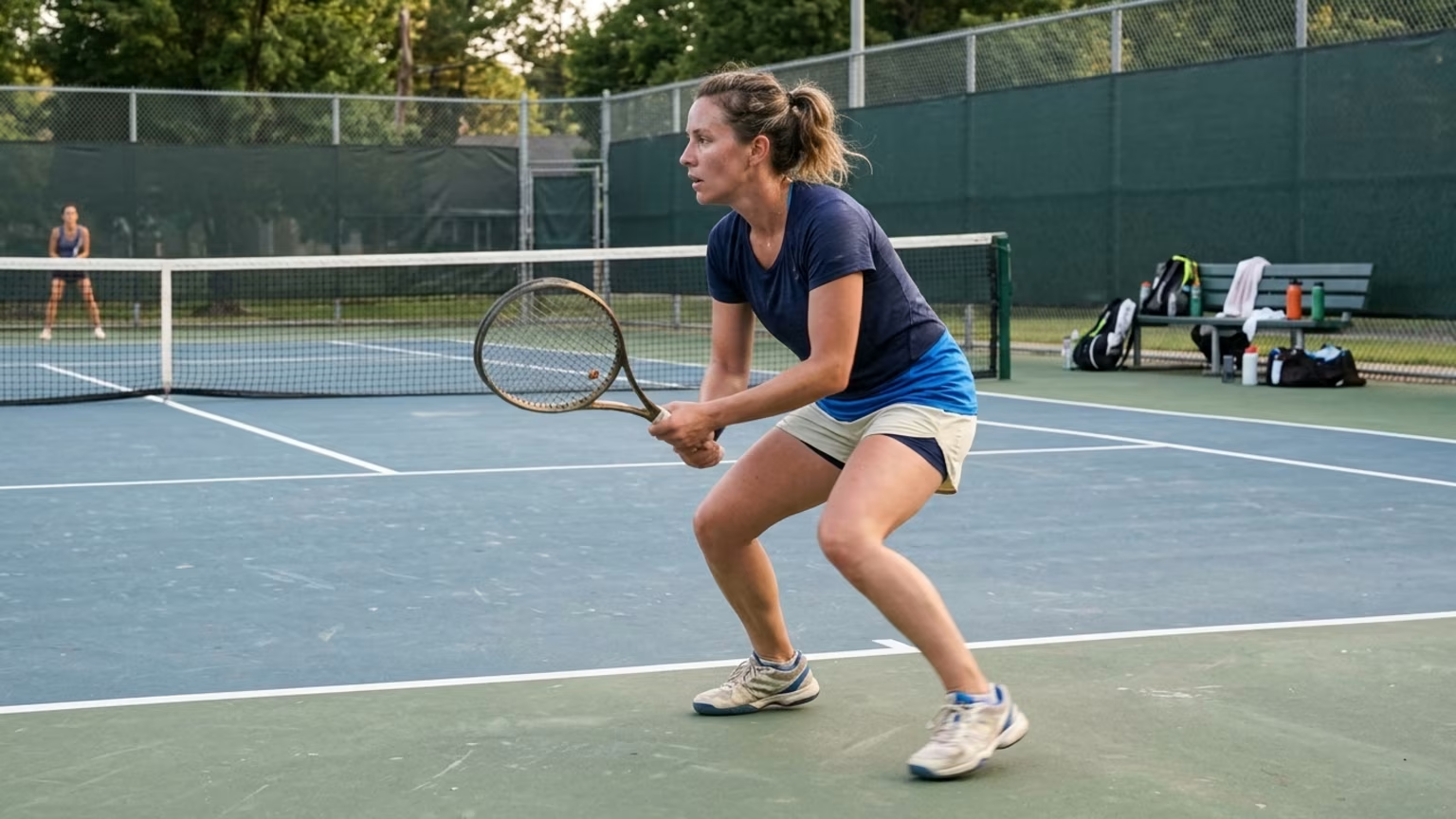

How tennis footwork connects braking, balance and recovery, with controlled practice ideas and signs that deserve professional assessment.




Tennis footwork is the way you move into position, steady yourself for a shot and recover for the next ball. It includes the approach to contact and the movement that follows it.
A tennis-fitness coaching article describes court movement as reading and reacting, accelerating and braking, then balancing and recovering. That sequence explains why being quick in a straight line is only one part of moving well on court.
For a long match, the useful goal is not constant motion for its own sake. It is coordinated movement that connects one shot to the next. Thinking about energy economy this way keeps attention on positioning and control rather than simply trying to run harder.
Each movement asks you to do more than cover distance. The tennis-fitness article explains that players produce force to get moving and control force when slowing down or changing direction. A fast arrival still needs to become a balanced position for contact.
That makes braking part of footwork rather than something separate from it. The approach to the ball, the final adjustment and the recovery all belong in the same repetition. This connects with the role of controlled stopping in court movement, where arriving ready to hit matters as much as getting there.
For players moving between tennis, pickleball and padel, repeated explosive efforts and changes of direction are the relevant movement demands to consider. The useful question is how each start connects to a stop, an adjustment or another movement. Starting quickly is only part of that task.
A sports-science overview of tennis reports a comparison involving six professional men who competed on hard courts and clay. Rallies averaged 6.7 seconds on hard courts and 7.5 seconds on clay. The same comparison reported roughly 2.5 changes of direction per rally.
The overview also describes junior male players completing an 80-minute simulated match. It reports averages of 39.7 hard accelerations and 57.9 hard decelerations. Hard actions were defined as speed changes of at least 3 m/s².
These are professional and junior examples, not adult recreational benchmarks or measurements of pickleball and padel. The coaching guidance below is not trial evidence and establishes no ideal dose or universal technique. It does not demonstrate that the drills lower energy expenditure, prevent injury or extend playing years. Energy economy remains the practical aim rather than a proven result.
A footwork coaching guide lays out a progression from shadow movement to marker work and then partner-fed balls. It offers a way to organise practice around the shot rather than making speed the only objective.
A separate coaching guide emphasises arriving with enough space to hit and making final adjustment steps. In this progression, speed is not the only thing to notice. Space for contact, balance at arrival and the recovery position are all useful coaching observations.
The sequence also separates two questions: where the player is trying to go and how the player arrives. A repetition concerns both. Contact and recovery are parts of one movement pattern rather than unrelated tasks.
The footwork guide recommends side shuffles for short movements and crossover steps for longer distances. It also challenges the habit of returning automatically to the center mark.
Recovery is described instead in relation to the opponent’s possible responses. The shot just played helps shape where the next ready position belongs. That makes recovery a positioning decision as well as a movement.
A useful rehearsal therefore includes moving back into a suitable position after the simulated or fed shot. Reaching the ball is not the end of the pattern. The next reply is already part of the task.
This gives practice a clearer purpose than simply covering ground. The question becomes whether the movement finishes somewhere useful for what comes next.
Healthy aging gives this discussion a wider purpose than sharper footwork alone. The World Health Organization says any amount of physical activity is better than none and highlights muscle strengthening across age groups. Those are the general health principles beneath the court-specific coaching.
For adult players, that supports a broad view of physical capability. Footwork practice can sit within an approach that includes regular activity and strengthening rather than taking the place of either. Fast feet are one part of the picture.
Understanding the movement cycle also gives players clearer language for discussing their game. Was the difficulty getting started, stopping under control or finding space for contact? Did the recovery fit the shot? These are more useful coaching questions than treating every difficult ball as evidence of being too slow.
For an experienced player, this is not an argument for becoming cautious about every step. It is a reason to judge practice by more than raw pace. A session can have a clear movement focus without trying to copy professional match intensity.
That perspective belongs alongside training and match habits built around continued play and a court schedule that fits everyday life. Athletic longevity is a wider project than any single drill.
When movement becomes painful or less reliable, the issue is no longer simply which footwork pattern to rehearse. A tennis health article recommends gradual preparation for match-speed movement and assessment for recurring pain, swelling, locking or instability.
Those signs warrant discussion with a qualified physio or healthcare provider. Decisions about symptoms and playing belong with that individual assessment rather than a generic footwork drill. Painful or increasingly tired movement is a reason to scale back rather than make the practice faster.
Some days, looking after your movement matters more than testing its speed. There is room for that judgment in a game you hope to keep playing.
Follow Evercourts for practical insights on tennis, pickleball and padel performance, movement, recovery and healthy ageing. Stay connected for new articles, research-led guidance and ideas to help you play well and keep playing for years.


Learn how to turn, track and recover for pickleball lobs with a gentle partner drill, plus what fall research says about balance and footwork.

Tennis match data explain why conditioning involves repeated bursts and recovery. Apply the pattern without treating research averages as personal targets.

A flexible pickleball warm-up progressing from easy movement to controlled lunges, side steps, shadow swings and dinking, with readiness-based adjustments.
Read practical guidance for better movement, smarter preparation and a game that keeps working for you.
explore the Blog
