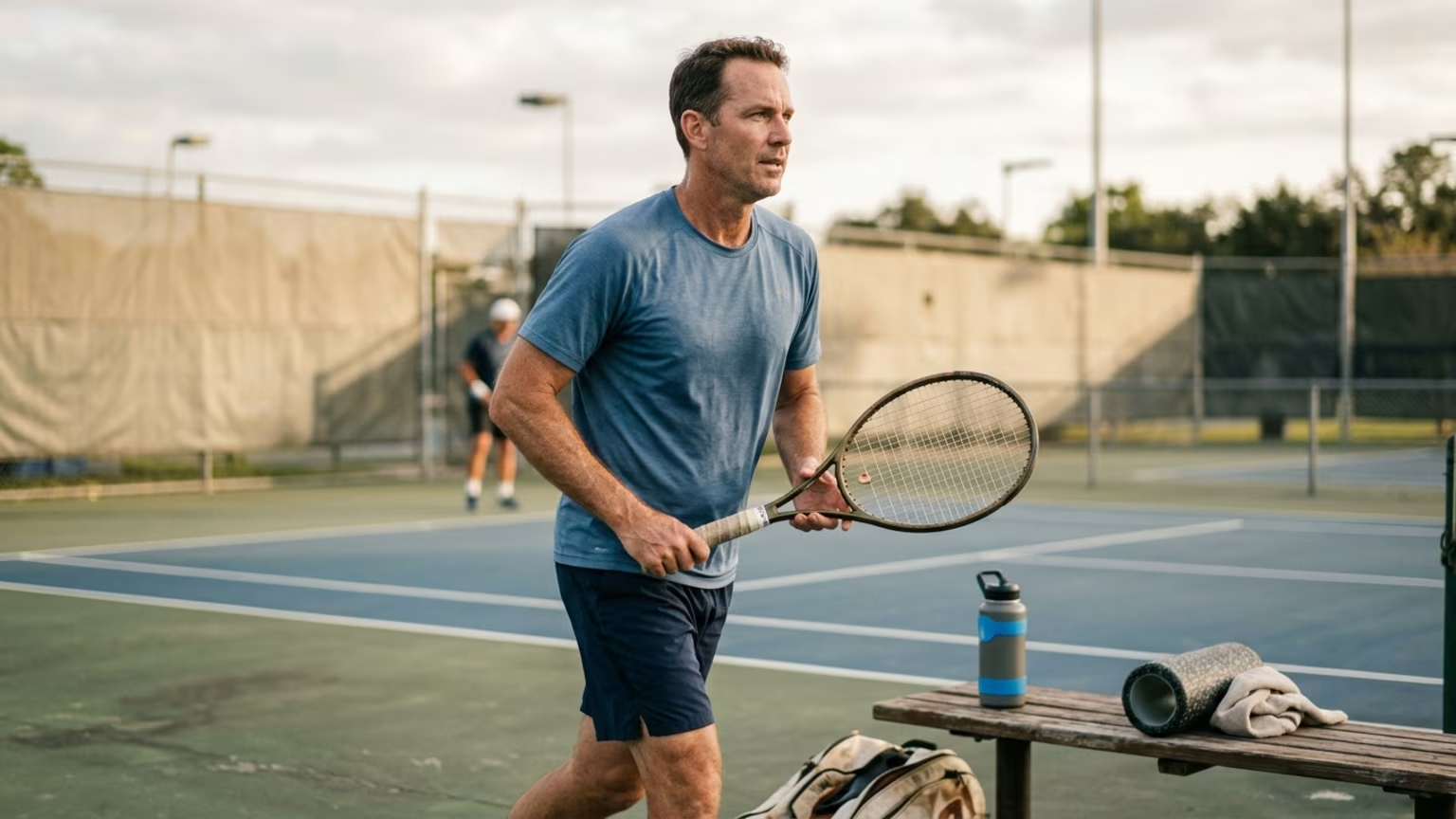

Discover how controlled deceleration, sensible training variation, and balanced recovery habits help adult racquet sports players stay on the court for years.




Competitive matches test every physical capability a player possesses. The environment is chaotic, demanding instant reactions to unpredictable shots. This forces sudden sprints and emergency lunges across the playing surface. High-speed play relies entirely on existing physical reserves rather than building them.
Every sprint, sudden change of direction, and explosive overhead extracts a toll on muscles and joints. If a player lacks foundational strength, they often finish points in awkward, leaning positions. This constant off-balance recovery increases the workload on the body during every single point, accelerating fatigue. Treating every time on court as a high-intensity test leaves little room for physical adaptation.
Many adult players make the mistake of turning every court appearance into a maximum-effort test. If a player returns from a break and jumps straight into a weekend tournament, they risk overloading their tissues. A more sustainable approach is to increase duration, frequency, or intensity one at a time. The Orthopaedic Research and Education Center explicitly notes that no warm-up can prevent every injury.
Therefore, managing total exposure during high-speed play remains a critical habit for older adults. A useful structure distinguishes among hard sessions, moderate sessions, and easy sessions. Competitive matches, high-speed movement drills, and demanding strength work all qualify as hard sessions. While they are necessary for performance, they require significant recovery time before the next test.
Controlled capacity training stands in direct contrast to chaotic match play. This modality involves slower, deliberate practice of court movements. A player rehearses deceleration, balance, and recovery steps without the pressure of a live ball. It focuses intensely on how the body stops and absorbs force.
Deceleration is a highly trainable movement skill that improves court efficiency. A 2026 biomechanics study found that greater hip and knee flexion and a lower center of mass were associated with stronger horizontal braking characteristics during multi-step deceleration. Players should practice walking or jogging into a two-step stop before attempting full-speed sprints. This controlled rehearsal allows players to find a stable ready position without reaching or lunging awkwardly.
WHO recommends 150 to 300 minutes of moderate activity, or 75 to 150 minutes of vigorous activity, alongside muscle-strengthening work at least twice weekly. UK physical-activity guidance similarly advises older adults to include strength, balance, and flexibility work at least twice weekly. Integrating exercises like split squats, hip hinges, and calf raises supports the rigorous demands of court movement.
Our team understands this off-court reality well. I used to think a tough conditioning block was the only way to improve my court endurance. Then I started tracking my sleep. I noticed that on days I slept less than six hours, my reaction time at the net was noticeably sluggish, and I felt gassed by the second set. Prioritizing consistent rest did more for my late match stamina than any extra sprints ever did. Recovery is the true foundation of performance.
Tennis generally involves more court coverage and longer-distance acceleration than pickleball. The sheer size of a tennis court requires players to reach high speeds before initiating a braking sequence. This forces the lower body to absorb massive forces over a longer distance. Building an aerobic base for racquet sports helps athletes maintain movement quality during these extended rallies.
Pickleball emphasizes frequent short movements near the non-volley zone, creating a unique rhythm. This specific movement pattern demands rapid weight transfers and constant readiness to change direction. ValuePenguin reported that recorded pickleball injuries had nearly quadrupled since 2018. The available report does not establish participation-adjusted risk, but the growing participant base clearly creates more opportunities for physical overload.
Padel adds wall rebounds, constrained court geometry, and repeated reaction changes to the physical equation. The glass walls force players to pivot rapidly and track unpredictable ball trajectories. This multidirectional chaos requires exceptional balance and spatial awareness to navigate safely. For any of these sports, cross-training across courts provides varied movement exposure that challenges the body in beneficial ways.
Across all three sports, consistent off-court habits determine on-court success. Prioritizing between-point and between-match recovery strategies helps players maintain high movement quality under fatigue. Combining hard matches with balance and proprioception training ensures the body is prepared for whatever the sport demands next.
When evaluating which modality better supports athletic longevity, controlled capacity training emerges as the clear winner. High-speed match play is the reward for hard work, but it cannot be the sole method of physical preparation. Relying entirely on competitive sessions inevitably depletes joint resilience over time. Deliberate capacity building provides the structural armor required for decades of consistent play.
Adult players who embrace sensible training variation position themselves for long-term success. Separating intense competition from relaxed technical practice prevents chronic physical depletion. Players must monitor their bodies closely, noting unusual soreness or reduced range of motion the day after a session. These signals should prompt a lighter day of movement rather than a stubborn attempt to push through fatigue.
The Orthopaedic Research and Education Center recommends building lower-body capacity and increasing pickleball exposure progressively to manage these demands. Implementing low-speed deceleration drills and balanced recovery habits ensures players can confidently absorb force when the pace accelerates.
Ultimately, returning to those roughly 19,000 annual emergency room visits provides essential perspective. Most of these incidents involve older adults who may have asked their bodies to perform beyond their prepared capacity. By valuing controlled deceleration, balanced recovery, and gradual progression, players rewrite their future on the court. The true victory is remaining capable and stepping onto the court year after year.
Follow Evercourts for practical insights on tennis, pickleball and padel performance, movement, recovery and healthy ageing. Stay connected for new articles, research-led guidance and ideas to help you play well and keep playing for years.


A recent live-play test of a silent pickleball highlights its value for practice, but standard balls still perform better for match play and power control.

An evidence check on sports supplements like tart cherry juice. Learn why racquet sports players should prioritize core nutrition over functional foods.
In late 2026, Oura analyzed wearable data to see how recreational tennis impacts heart health and recovery. Learn what this means for your athletic longevity.
Read practical guidance for better movement, smarter preparation and a game that keeps working for you.
explore the Blog
