

A practical look at tennis acceleration, braking, lateral movement and rotation, with a flexible framework for strength work and recovery.




Whole-point preparation means getting ready to accelerate, brake, move sideways and rotate through a tennis point. The useful picture is not just a player reaching the ball. It is that player arriving under control, making the stroke and recovering for the next movement.
A tennis-training practitioner's overview describes these connected demands alongside coordination through the lower body and trunk. That gives recreational players a useful way to think about preparation: court coverage and stroke production belong in the same picture. A training week can reflect both without becoming a second job.
Looking at the whole point changes what counts as useful preparation. The practitioner describes a sequence of starts, stops, direction changes and recovery alongside rotational stroke actions.
Acceleration is the quick start toward a ball. It matters within the larger movement sequence, but it is not the entire task. Practising only that first burst leaves the arrival and return to position outside the rehearsal.
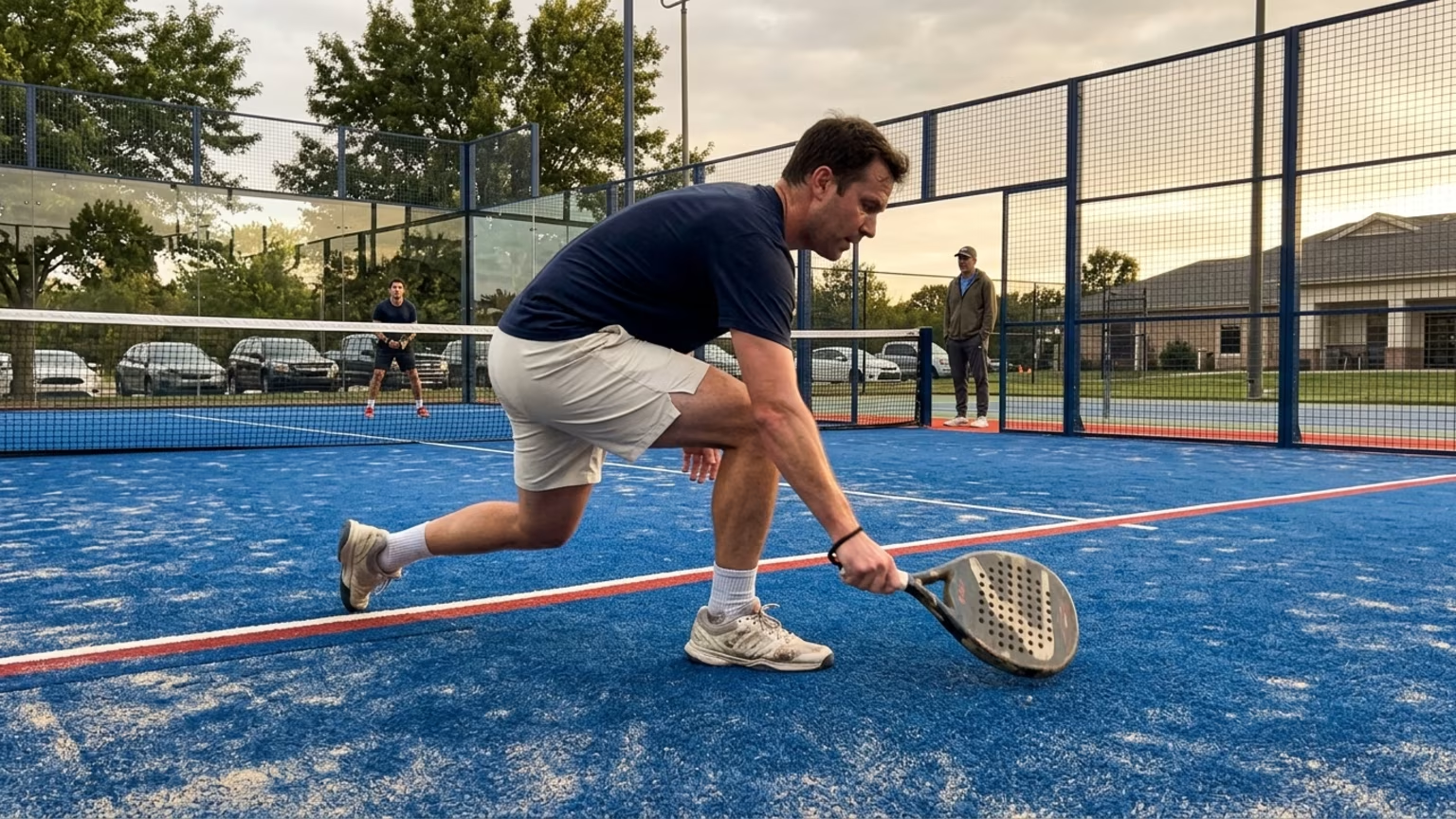
Braking means controlling momentum as you arrive. In the practitioner's account, stopping and changing direction are training considerations in their own right. The practical implication is to give controlled stops some attention rather than treating them as something that will take care of itself.
Sideways movement and changes of direction also feature in the source's description of tennis. They broaden the movement task beyond a straight run. Recovery to position belongs here too: preparation is about what happens after contact as well as before it.
Groundstrokes and serves involve rotation alongside coordinated lower-body and trunk movement. The practitioner describes the trunk as helping transfer and control force between the lower and upper body. That is a reason to consider rotational capacity alongside court movement rather than treating stroke preparation as an arm-only task.
For players who also enjoy pickleball or padel, these movement categories offer questions to take to a coach. Where do repeated quick efforts and changes of direction appear in your play? Which stops or sideways movements deserve practice? Our guide to comparing movement across courts offers a separate starting point for those conversations.
Treat these recommendations as practitioner guidance rather than a tested programme for all adult players. They do not establish a single ideal weekly schedule or show that a particular routine reliably prevents injury. The tennis-based guidance is also not a measured workload comparison with pickleball or padel.
In guidance for recreational tennis players, a practitioner suggests one or two structured resistance sessions a week as a possible starting point. The suggested frequency depends on playing volume and experience. Goals and recovery matter too.
The broader training overview presents strength work as a way to develop force-producing capacity. Its suggested options include compound exercises, carries and cable or anti-rotation work. Medicine-ball work is another option in that account. This is a menu of training elements rather than a reason to fit every exercise category into every week.
For movement practice, the practitioner describes work that can progress from controlled stopping and lateral movement to faster changes of direction. The useful principle is to practise control as well as speed. That offers a direction for planning without turning the exercise list into a personal prescription.
Athletic longevity gives this framework its purpose: maintain the capabilities involved in playing while leaving room to keep enjoying the sport. For adult players, the practical question is not how much extra work can fit into a calendar. It is how court time and supporting work can fit together.
Recovering to position during a rally is different from recovering between sessions. The weekly framework concerns the latter.
Here is a planning framework drawn from the practitioner's guidance and its emphasis on individual recovery.
For a closer look at movement practice, our guide to preparing the movements behind court coverage provides related reading. Keep the broader purpose in view: a useful plan makes space for playing, physical preparation and recovery.
This approach also keeps the focus on capability rather than collecting exercises. The relevant question is whether the week accounts for the demands of the point and remains workable for the player. More training categories on paper do not make a plan more suitable by themselves.
Recurring aches or stiffness are reasons to take the discussion beyond a general training article. If discomfort is affecting how you move or whether you feel able to play, consult a qualified physio or healthcare provider. Personal decisions about symptoms and suitable exercise need individual guidance.
The opening picture still matters: reach the ball, arrive under control and prepare for the next movement. When pain or stiffness is getting in the way of that sequence, seek qualified help with the next decision rather than simply adding another drill.
Follow Evercourts for practical insights on tennis, pickleball and padel performance, movement, recovery and healthy ageing. Stay connected for new articles, research-led guidance and ideas to help you play well and keep playing for years.


Understand split-step timing, use opponent contact as a practical cue, and connect a small preparation movement with balanced court positioning.

Boca Paddle’s reported November 18 opening pairs pickleball and padel with tournament facilities, day passes and warm-up space.
FIP and Mondo emphasize consistent padel surfaces. Here is what the partnership means for competition, club courts and recreational players.
Read practical guidance for better movement, smarter preparation and a game that keeps working for you.
explore the Blog
