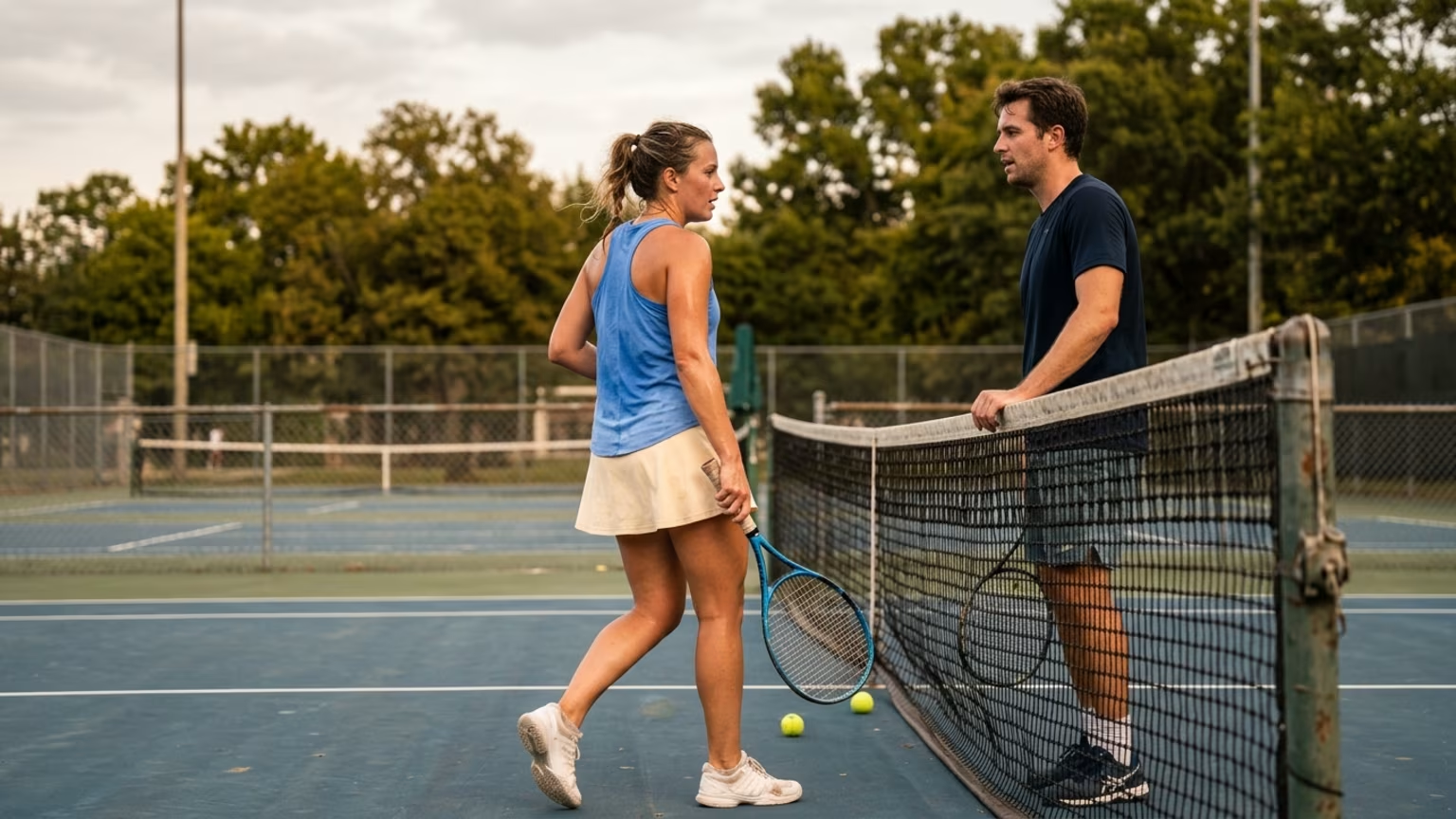

Discover how tennis, pickleball, and padel place unique movement demands on your body, and learn practical ways to train specifically for your primary sport.




Sprinting for a wide forehand and planting the foot hard instantly exposes the hidden physical toll of sudden directional changes. It is a fleeting moment of tension on the court. Yet, it perfectly reveals exactly how demanding a single split-second reaction can be.
Court movement is the physical capacity to accelerate, stop, rotate, and maintain balance continuously while tracking a moving ball. Tennis, pickleball, and padel all demand efficient footwork and quick reactions from players. However, the exact physiological requirements of these sports are fundamentally distinct. The court geometry, scoring environment, and equipment change how much braking or rotation you actually perform. Understanding how these movement demands differ helps you train correctly, maintain your fitness, and enjoy the game longer.
Acceleration measures your ability to reach a ball quickly. Deceleration reflects your capacity to brake under control without losing posture. Rotational power allows you to transfer energy into your strokes smoothly. Finally, dynamic balance ensures you can perform all these actions without falling or wasting recovery steps. Every player relies on these four pillars constantly.
The playing surface creates the first major difference in movement demands. A regulation tennis court is 23.77 metres long, measuring 8.23 metres wide for singles and 10.97 metres for doubles. This vast space requires players to cover long distances, accelerate into open areas, and brake forcefully from high speeds. Tennis singles typically demands heavy eccentric braking to lower your centre of mass safely.
A tennis player must control their outside leg and avoid sliding past the ideal hitting position. This creates an enormous workload for the lower body during a match. The sheer size of the court ensures that high-speed running remains a primary physical challenge. This expansive environment contrasts sharply with the demands of smaller courts.
Pickleball compresses players into a much tighter area. Pickleball uses a 20-by-44-foot court for both singles and doubles. This restricted space limits full sprints, placing a premium on short reactive acceleration and sudden directional changes. Players frequently brake at low distances, lunge toward short balls, and hold low postures near the non-volley zone.
You need immense strength in your quadriceps, calves, and ankles to stop efficiently from these low positions. Pickleball constantly forces players to transition rapidly from forward lunges to lateral blocks. This requires highly efficient muscle control. The lack of long recovery space means movement is nearly continuous.
Padel introduces an entirely unique playing environment. Padel is normally played two against two on an enclosed 10-by-20-metre court. Players must track the ball, monitor their partner, and anticipate rebounds off the glass walls. Padel requires controlled lateral movement, backward retreats under lobs, and rotational control.
Unlike tennis, the ball may remain playable after reaching a wall. This forces the player to accelerate based on unpredictable rebound angles. Acceleration and deceleration are clearly just the beginning of the challenge. If you are cross-training between racquet sports, you must prepare your body for these shifting physical realities.
Current research highlights distinct movement profiles for each sport without declaring one inherently harder. A recent racket-sports editorial summarized research describing padel as having longer rallies and more volleys. In contrast, tennis doubles showed more high-speed actions and aggressive baseline play. This means padel players endure sustained rally involvement, while tennis players face more high-velocity sprints.
Pickleball is sometimes mistakenly viewed as physically effortless. However, a recent pickleball injury study examined the lower-limb demands of the sport. It linked these demands to repeated directional changes, lunges, jumps, accelerations and decelerations. In one recent study, 38.1% of participants reported at least one pickleball-related injury in the previous 12 months. This statistic reflects a specific study population rather than an annual rate for the entire sport.
Despite not representing a universal injury rate, this data underscores the true physical toll of smaller courts. A separate study of amateur padel players in Saudi Arabia reported relatively common ankle sprains and persistent recurrent instability. This shows that all racquet sports place significant stress on the lower body. Scientific evidence clearly supports targeted physical preparation to handle these forces.
When it comes to training these movements, the scientific consensus advises against universally perfect programs. A recent review found low-certainty evidence for some tennis-performance benefits from neuromuscular training. The authors explicitly noted that the findings did not establish one specific training modality as superior. Research suggests that recreational players should prioritize basic strength and movement quality.
Older adult guidelines clearly emphasize balanced physical preparation. Older-adult guidance recommends 150 to 300 minutes of moderate activity or 75 to 150 minutes of vigorous activity weekly, plus muscle strengthening at least twice weekly and balance work where appropriate. Official older-adult guidance also includes single-leg stance, heel-to-toe walking, and repeated sit-to-stand exercises as examples of balance-supporting activity.
Understanding your primary sport allows you to train the specific physical qualities your game repeatedly exposes. This targeted approach forms the foundation of healthy aging and sustainable court performance. Instead of aimless jogging, tennis players can prioritize single-leg strength, rotational power, and shoulder durability. Pickleball players can focus heavily on lateral lunges, short reactive acceleration, and balance.
Padel players can emphasize turning, wall-rebound orientation, and repeated balance corrections. Focusing on these specific variables helps prevent the physical fatigue that inevitably leads to sloppy technique. If your trunk or shoulder tires during a match, your mechanics will eventually suffer. Targeted lower-body strength ensures you can absorb impact safely, which keeps you playing consistently.
In our experience, proper preparation makes a profound difference. As one of our team members notes, "I remember finishing a tough two hour padel match on a cold Tuesday night and waking up the next morning feeling like my lower back was locked in concrete. For a long time, I just accepted this as the price of playing hard in my forties. But once I started spending just ten minutes on targeted hip mobility before heading to the club, the stiffness almost completely vanished. It taught me that we do not have to accept pain as a default state of aging."
Recreational players should simply copy the principles of professional training rather than the extreme volume. Start with simple two-leg strength, progress to split-stance control, and finally add planned lateral movement. This sensible progression builds a robust physical base for any sport. Training these specific capabilities significantly reduces your risk of preventable setbacks.
Even with a sensible warm-up routine, physical limitations can still surface during intense play. Recognizing when to seek outside help is a critical skill for any adult athlete. You should consult a qualified physiotherapist if you experience persistent pain, obvious swelling, or ongoing joint instability. Attempting to play through these clear warning signs often worsens the underlying problem.
Players must also stay continually alert for gradual movement breakdowns on the court. If your knee collapses inward repeatedly during lunges, it strongly warrants professional attention. If you suddenly need extra recovery steps to stop, or if your landing becomes audibly noisy, your body is struggling to absorb force. A clinical assessment can safely identify the root cause of these unconscious compensations.
A responsible physical therapist will guide you through evidence-based rehabilitation without pushing unnecessary medical treatments. They can help you restore proper braking mechanics and regain full confidence in your single-leg balance. Pain that alters your natural swing is a primary indicator that something needs adjusting.
Your ultimate goal is to train the exact movement patterns you want to use in competition. Stop any drill immediately if your form deteriorates or if you feel sharp discomfort. Start identifying your most common on-court physical breakdowns today, and tailor your weekly conditioning to fix them safely.
Follow Evercourts for practical insights on tennis, pickleball and padel performance, movement, recovery and healthy ageing. Stay connected for new articles, research-led guidance and ideas to help you play well and keep playing for years.


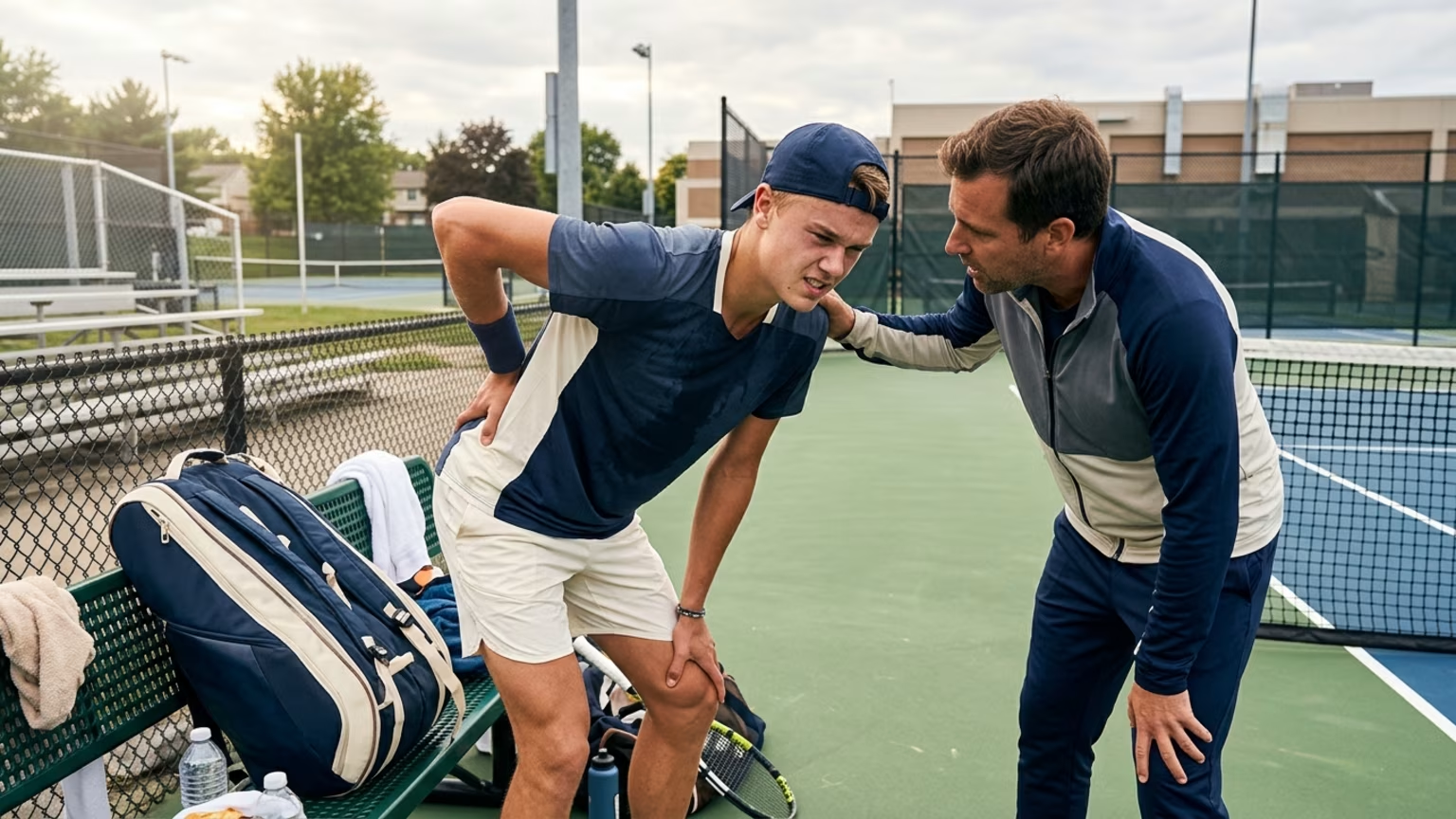
Holger Rune withdrew from the European Open with a back problem. The facts behind his decision and a grounded perspective for recreational players.

The Dink’s October 17 guide emphasizes deep returns, ball-height decisions and positioning against faster pickleball opponents.

A new report outlines padel and tennis gear trends. Learn how to assess adjustable rackets, sensor feedback and smart-court claims.
Read practical guidance for better movement, smarter preparation and a game that keeps working for you.
explore the Blog
