

Improve your tennis, pickleball and padel footwork by mastering the split step, directional push and tactical recovery. Learn proper movement mechanics today.




Faster footwork does not actually come from moving your feet faster. True agility relies on precise stopping, balanced preparation and intelligent recovery. On August 5, 2026, Pickleball.com published a comprehensive look at court footwork featuring insights from coach Michael Loyd. The feature challenged the common habit of continuous motion without a stable base.
Loyd detailed how establishing a firm, quiet foundation is the actual key to quick movement across the court. For years, recreational players have watched professionals glide around the court and assumed that rapid foot speed was the primary driver of success. This recent publication highlights that the opposite is true. Controlled landings and deliberate pushes dictate how well a player covers the playing surface.
The foundation of effective court movement begins before the opponent even makes contact with the ball. A split step is a short unloading and landing action from the ready position that allows the player to begin moving in either direction after reading the opponent's shot. According to recent coaching resources, the split step should end with a usable landing, not a tall jump or a flat-footed stop.
Michael Loyd, quoted by Pickleball.com, describes the split step as a ready hop timed with the opponent's contact. He advises players to keep their weight on the balls of their feet rather than on their heels or excessively on their toes. He also recommends stopping, split-stepping and setting the feet after opponent contact instead of moving continuously without a stable base. This ensures the player is fully prepared to react to the incoming trajectory.
Once the feet are set, the next critical phase is the directional push. After the landing, the player should push from the leg opposite the direction of travel. For example, a player must use the left leg to initiate movement to the right. This mechanical truth applies across all racquet sports.
Movement does not conclude when the racquet meets the ball. After hitting, players should recover toward a tactically appropriate neutral or covering position before preparing for the next ball. Mastering these essential footwork skills builds a repeatable rhythm that minimizes wasted energy during long matches.
Professional racquet sports highlight explosive speed, dramatic slides and superhuman recovery. Elite players possess the physical conditioning to absorb massive braking forces without compromising their joints. Adult recreational players frequently try to replicate this visual speed by rushing their footwork or skipping foundational steps entirely. This approach usually leads to poor balance and compromised athletic longevity.
For the weekend league player, the priority must shift from sheer speed to movement quality. Arriving at the ball under control is far more critical than arriving early but off balance. A drill that combines a split step, wide-ball movement, shadow swing and recovery reflects the repeated structure of a point better than a ladder-only routine. By practicing court-based conditioning routines, players can train their bodies for the exact movements they need.
I learned the importance of proper preparation the hard way on the courts. "When I first started playing pickleball, I noticed how many people skipped warming up entirely. They would jump straight out of their cars and right up to the kitchen line. I tried doing that and immediately pulled a calf muscle."
"Pickleball requires just as much explosive lateral movement as tennis, just in a tighter space. Since then, I always spend five minutes doing dynamic lunges and ankle rolls. It changes everything about how confident I feel pushing off the baseline." Players who prioritize these functional preparations will perform better over time.
Consistent mechanics keep players healthy and active on the court for decades. Rushing into high-intensity play without reinforcing these movement patterns increases the risk of lower-body strains. Proper mechanics allow adult players to enjoy their time on court without constant soreness.
While the fundamental split step remains consistent, the subsequent recovery varies significantly between disciplines. In pickleball, coach Michael Loyd recommends recovering diagonally toward the centre after a wide ball because that can close more reply angles than moving straight backward. The unique geometry of the pickleball court dictates this specific path. Players must respect these geometric constraints to defend effectively.
Padel introduces entirely different spatial variables with its enclosed glass walls and tight doubles format. Players must manage the ball rebounding behind them while maintaining their relationship with their partner. A padel coaching source recommends isolating split-step timing with partner cues, then progressing to fed balls and shadow movement. This structured progression helps players adjust to the specific timing required for wall play.
Understanding proper multi-planar movement training is vital when navigating the corners of a padel court. Tennis demands even greater total court coverage than its smaller counterparts. The recovery step in tennis must account for deeper baseline exchanges and much wider angles. Players often need to cover vast expanses of the court, meaning their recovery steps must be highly efficient.
In all three sports, teaching players to recover correctly is just as important as teaching them how to strike the ball. Establishing consistent court positioning serves as the anchor for defensive stability. The evercourts team consistently highlights that proper positioning reduces the need for desperate lunges. Good footwork makes the court feel smaller and more manageable.
Training these movement patterns does not require a player to push to the point of complete physical exhaustion. The objective is neural adaptation, motor control and sustained athletic longevity. High-intensity interval sessions have their place, but movement quality deteriorates rapidly when the body is heavily fatigued. For adult players, a few focused repetitions of a split step and recovery are incredibly valuable.
Coaches suggest breaking the movement down into its component parts to ensure mastery. Players can practice the ready hop without a ball, focusing entirely on landing softly and maintaining their balance. They can then add the directional push, actively thinking about driving off the opposite leg. This isolated focus builds a stronger mind-body connection before the pressure of a match begins.
Once the mechanics feel natural, players can introduce shadow swings to the sequence. Combining the split step, the push, the balanced stance and the tactical recovery creates a closed loop of movement. This loop forms the foundation of every single rally. Shadow training allows players to refine their mechanics without the stress of tracking an incoming ball.
Only after the shadow movements become automatic should players introduce live ball feeds. This progressive approach ensures that the player is actually training their movement patterns rather than just scrambling to make contact. Building these habits slowly will yield much faster reaction times during actual competition.
Over the next competitive season, we expect recreational coaching programs to prioritize deceleration mechanics just as heavily as raw acceleration. The modern game demands incredible stopping power across all three major racquet sports. We anticipate that standard practice plans will increasingly feature controlled braking exercises to better support healthy aging and sustained performance.
Players who participate in multiple racquet sports will need to adapt their movement strategies carefully. Switching from a deep tennis baseline to a tight pickleball kitchen line requires an acute awareness of how recovery distances change. Coaching methodologies will likely reflect this shift by integrating sport-specific shadow drills into everyday warm-up routines.
As the understanding of court mechanics deepens, players will realize that agility is an acquired skill. Remember that faster footwork does not actually come from moving your feet faster. It comes from landing softly, pushing off the correct leg and recovering with tactical intent. True agility is simply the ability to establish a stable base over and over again.
Follow Evercourts for practical insights on tennis, pickleball and padel performance, movement, recovery and healthy ageing. Stay connected for new articles, research-led guidance and ideas to help you play well and keep playing for years.


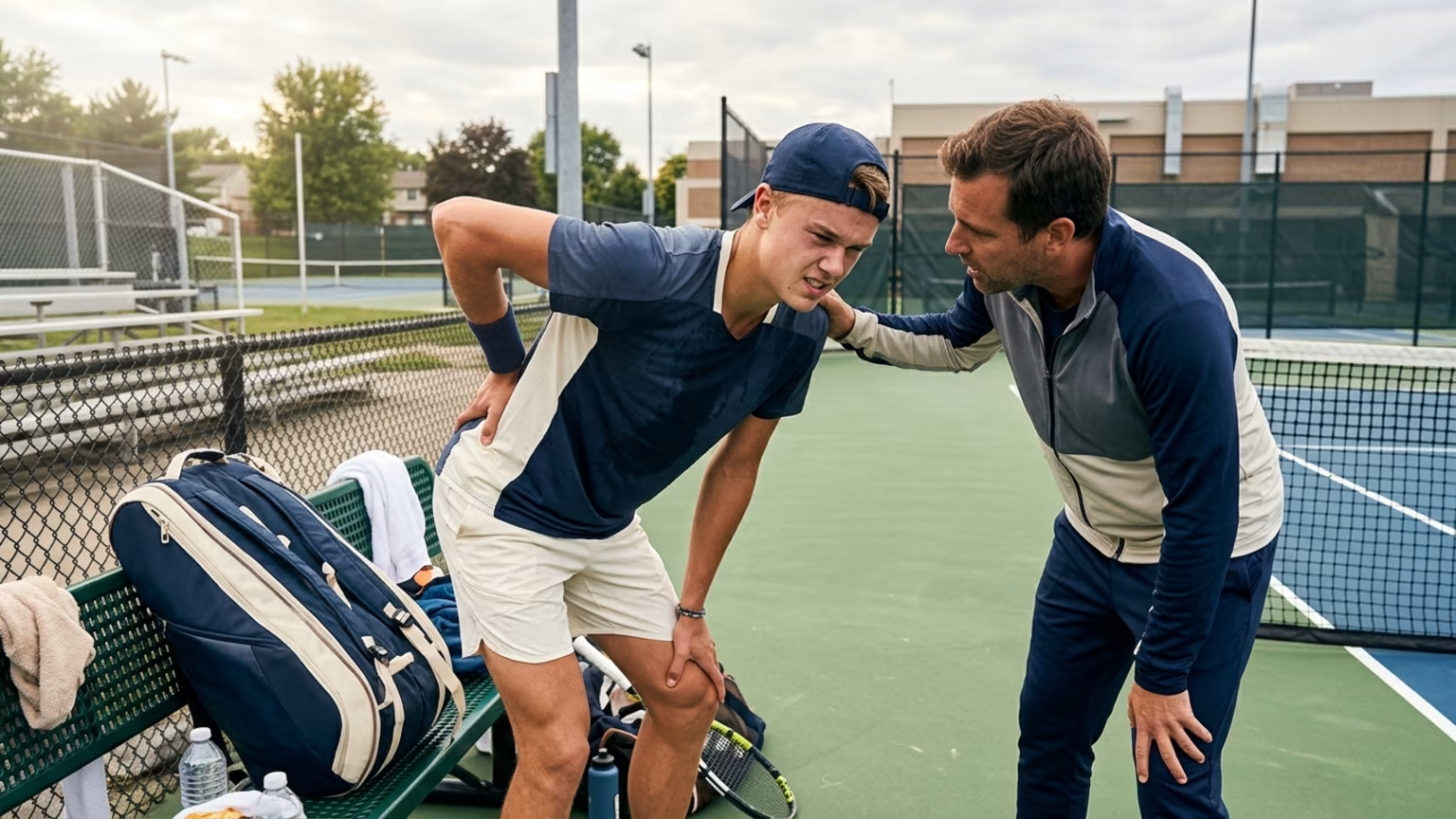
Holger Rune withdrew from the European Open with a back problem. The facts behind his decision and a grounded perspective for recreational players.

The Dink’s October 17 guide emphasizes deep returns, ball-height decisions and positioning against faster pickleball opponents.

A new report outlines padel and tennis gear trends. Learn how to assess adjustable rackets, sensor feedback and smart-court claims.
Read practical guidance for better movement, smarter preparation and a game that keeps working for you.
explore the Blog
