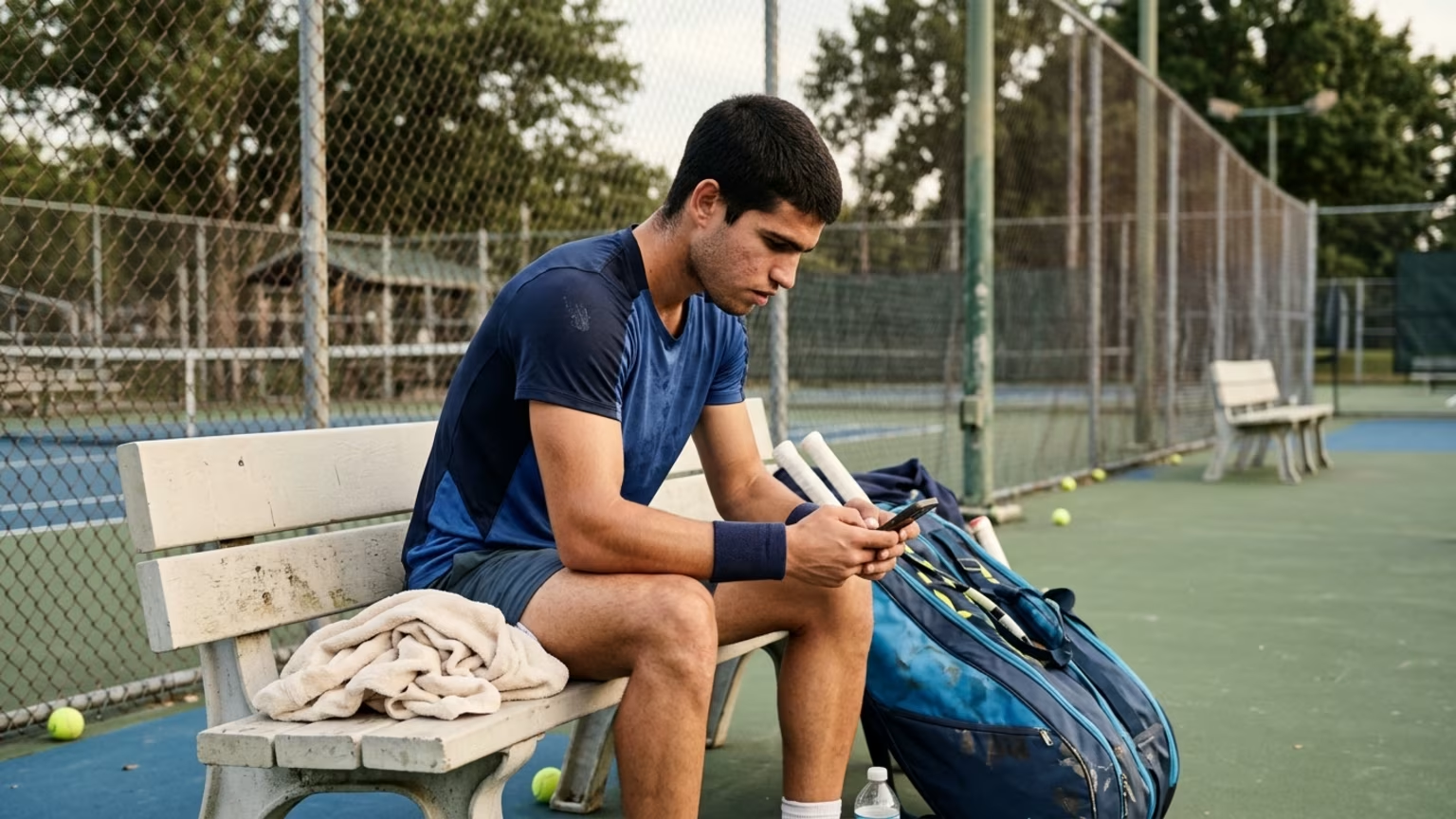

Alcaraz’s next ATP event was expected to be Paris after his Shanghai loss, but a possible exhibition makes the calendar gap more nuanced.




On October 13, 2026, Tennishead reported that Carlos Alcaraz was not expected to play another ATP event before the Paris Masters after his third-round loss to Zizou Bergs in Shanghai.
Alcaraz lost 5-7, 6-7(4) in a match lasting two hours and two minutes, according to Tennishead. The defeat ended his Shanghai Masters campaign. The ATP Tour described Bergs’s victory as the biggest win of his career and reported that he advanced to the fourth round.
The schedule detail was narrower than a declaration that Alcaraz would stop playing. Tennishead identified Paris as his next expected ATP event while also listing him for the Six Kings Slam exhibition in Riyadh. The wording was “not expected,” not a confirmed withdrawal announcement.
The report listed the 2026 Paris Masters for November 2 to 8 and the ATP Finals as beginning November 15. Those dates frame the anticipated calendar. They do not confirm Alcaraz’s participation in both events.
For Alcaraz, the immediate story concerns which professional event may come next. For an adult league player, the useful lesson is about reading that calendar correctly. An empty stretch on an ATP schedule is not automatically a stretch without tennis.
The exhibition listing makes that distinction concrete. It separates official tour competition from another possible competitive appearance. Reading “no ATP event” as “complete rest” would change the meaning of the report.
At the professional level, the named events are the story because they define the next reported competitive appearances. At club level, the more useful distinction may be between league commitments and other court time. The comparison is about how to describe a calendar, not about making a weekend schedule look like Alcaraz’s.
The coverage does not establish that this gap is a recovery intervention or an injury-prevention measure, and it supplies no tested rest duration for recreational players. That is the evidence boundary. The practical discussion can still focus on commitments, fatigue and personal goals without presenting Alcaraz’s calendar as a model to copy.
As an editorial starting point, three questions help keep those categories separate:
For a club player, not entering a tournament is a different choice from not playing at all. A calendar discussion should name what remains rather than relying on the word “break.” That is a useful starting point for planning around actual match commitments.
The same caution applies to tennis, pickleball and padel readers. A professional tennis result offers context for a professional tennis schedule. It does not turn that schedule into a training prescription for another sport or for a different player.
A disappointing league result also does not have to become a verdict on every part of a player’s routine. As an editorial approach, separating the result from the next decision keeps the review manageable. The relevant question is what fits the player’s commitments and goals, not what an elite player appears to be doing between televised events.
That perspective is also useful when putting elite return stories in context. If pain or an injury concern is driving a personal decision, qualified care is the appropriate place to discuss it. A tournament update is not an individual health assessment.
Tennishead’s published statistics offer a more specific account of the defeat than the phrase “shock exit.” Bergs finished ahead in total points and winners:
The error totals are worth keeping alongside the winners. A reading focused only on Alcaraz’s errors would leave out Bergs’s similar count and higher winner total. The match figures describe what happened, rather than providing a complete explanation of why it happened.
The report also recorded Alcaraz winning 66% of points behind his first serve, compared with Bergs’s 79%. Alcaraz converted both break points he earned. Bergs converted three of four.
That combination is more precise than saying Alcaraz failed whenever he had an opportunity. He converted the break chances recorded for him, while Bergs had more chances and won a larger share of first-serve points. Those are observations from this match.
The longer-window figures belong in a separate category. Tennishead listed Alcaraz 15th on the ATP Tour’s Serve Rating measure over the preceding 52 weeks, with a score of 285.0. It also reported a 72.7% first-serve-points-won rate and an 87.6% service-games-won rate.
Putting the single-match figures beside the longer-window numbers can be informative, but they answer different questions. The Shanghai figures describe one contest. The Serve Rating and service-game figures describe the period specified in the report. An assessment of off-season priorities should keep that distinction visible rather than using the loss as a summary of his entire serving record.
Tennishead also reported commentator Rennae Stubbs’s view that Alcaraz should work on his serve in the off-season, particularly for faster courts. That is her proposed technical priority. It should be read as commentary rather than as Alcaraz’s announced preparation plan.
Paris is the next ATP checkpoint identified in the report. Before then, the useful updates will be about actual entries and whether the possible exhibition appearance takes place. Those developments would clarify the playing calendar more than assumptions about how Alcaraz is spending the interval.
The off-season question is separate. If Alcaraz later describes serve work or other preparation priorities, that would give the discussion a player-stated basis. Stubbs’s assessment supplies a point to follow, not a forecast of what he will change.
For next season, the editorial standard should be clearer distinctions between official competition and other court commitments. A schedule story becomes more useful when it identifies the activity and its stated purpose. The blank space between tournament names should not do that explanatory work on its own.
For adult players, the lasting takeaway is modest but useful: describe the calendar you actually have. An unexpected exit closes one event. The next decision deserves its own context rather than a borrowed recovery story.
Follow Evercourts for practical insights on tennis, pickleball and padel performance, movement, recovery and healthy ageing. Stay connected for new articles, research-led guidance and ideas to help you play well and keep playing for years.


Holger Rune withdrew from the European Open with a back problem. The facts behind his decision and a grounded perspective for recreational players.

The Dink’s October 17 guide emphasizes deep returns, ball-height decisions and positioning against faster pickleball opponents.

A new report outlines padel and tennis gear trends. Learn how to assess adjustable rackets, sensor feedback and smart-court claims.
Read practical guidance for better movement, smarter preparation and a game that keeps working for you.
explore the Blog
