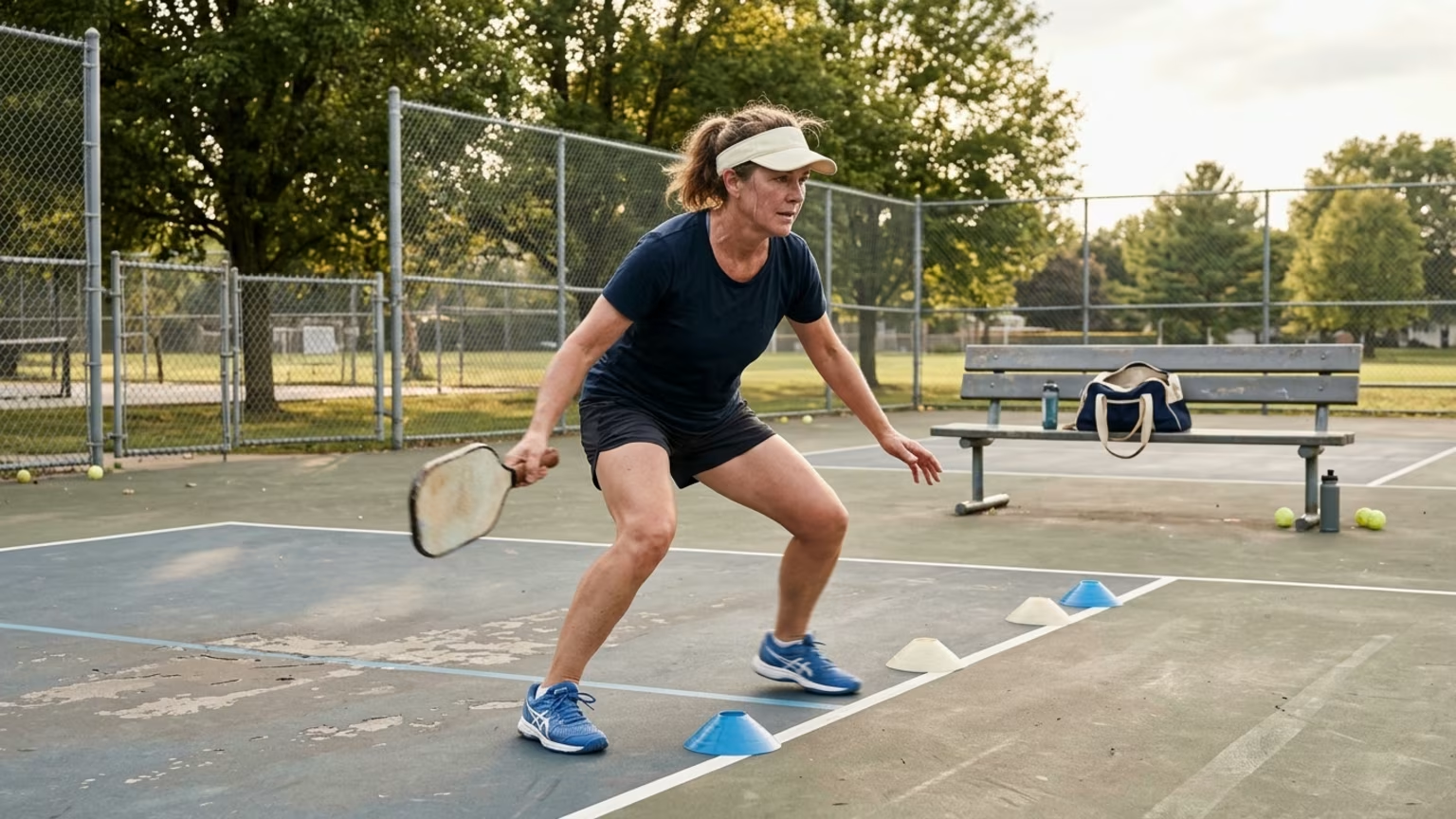

Understand court balance, the limits of pickleball research and supported ways to practise controlled movement before adding speed.




Balance is the ability to stay steady while standing, moving or changing direction. On court, it includes arriving at a ball and controlling what happens after the shot. The stop and the recovery matter as much to this discussion as the first quick step.
For an adult player who feels less steady than before, the useful question is not whether a single-leg stance looks impressive. It is whether a movement stays manageable from start to finish. That shifts attention toward foot placement, controlled weight shifts and the ability to settle before moving again.
Practising those elements before adding speed is a sensible coaching approach. The aim is movement that remains under control, not a difficult balance trick.
Tennis, pickleball and padel ask players to repeat short explosive efforts and change direction. A movement can begin with a quick push toward the ball and finish with a stop or a recovery step. Balance has to be considered across that whole sequence.
For tennis and padel players, a useful way to think about the demand is to separate three moments: getting to the ball, controlling the arrival and preparing to move again. This is a movement framework rather than a test of playing ability. It gives practice a purpose beyond simply moving faster.
In pickleball, the research discussed below gives particular reason to pay attention to lunging and backward movement. Those situations bring the finish of a movement into focus: where the feet land and whether the player can regain a steady position.
That is why a controlled stop belongs in the footwork conversation. Reaching the ball is only part of the movement being practised.
A secondary summary of a 2024 pickleball study reports that 42% of 92 recreational players had fallen during play. It also reports that 30% had fallen more than once. Lunging and backward movement were the leading reported circumstances. Players who had fallen performed more slowly on a pickleball-specific change-of-direction test.
The same summary reports that 61% of players aged 55 and older had fallen, compared with 33% of younger players. Those figures describe this sample. They are a reason to take older players' movement concerns seriously, not a prediction about what will happen to any individual.
A secondary account of a follow-up study describes a 10-week program combining strength, balance, change-of-direction and agility work. At five-month follow-up, 25% of the trained group reported a fall during play compared with 44% of the comparison group. This offers an encouraging reason to investigate combined movement training rather than assuming one balance exercise provides the answer.
There is broader context too. A summary of a 2019 Cochrane review reports that balance and functional exercise reduced fall rates by 24% among older adults generally.
The boundaries matter. The 2024 pickleball study did not test balance training, so the association between falls and slower direction changes does not show that balance drills prevent falls. The follow-up study involved 29 people and was non-randomized, so its results do not establish that the program caused the difference. The general older-adult finding is not a racquet-sport estimate, and the pickleball findings do not establish equivalent risks or training effects for tennis or padel.
The practical takeaway is modest but useful: controlled movement deserves attention alongside strength and agility.
For athletic longevity, the useful goal is to keep movement practice connected to the demands of playing. Understanding balance gives an adult player a clearer language for what feels different: the approach, the stop or the recovery. It also separates a specific movement concern from a broad assumption that getting older means giving up the game.
The following approach is general coaching guidance, not a tested pickleball prevention protocol or clinical assessment.
Standing practice and court-movement rehearsal answer different questions. The first asks whether a simple position or weight shift feels steady. The second asks whether steadiness is retained through a step, a stop and a change of direction. Neither needs to become a competition over the hardest variation.
A stable floor and a sturdy counter or other support provide the setting described in the balance-practice guidance. A comfortable two-foot stance or controlled weight shifts are the starting options. There is no need to remove support to make the practice count.
The useful observation is whether the movement feels steady and manageable. A narrower stance, single-leg balance or reaching can be considered only when the current version feels steady. Greater difficulty is not the aim by itself.
Keeping the task simple also makes the observation more useful. A player can notice the weight shift without having to solve a fast ball or an unexpected direction change at the same time. In this context, simpler is a way of paying attention rather than a judgment about ability.
For court movement, the suggested starting point is small controlled steps and direction changes. The range stays within what the player can stop and recover from. Speed, distance or reactive demands come later rather than arriving together at the start.
Foot placement becomes a practical observation here. Can the movement finish in a position that feels settled, or is another hurried step needed to regain balance?
Connecting the reach with the recovery keeps the focus on a complete movement. The 2024 study summary also reports recommendations for multidirectional lunges, lower-body strength and power work, and direction-change practice involving backward movement.
For long-term participation, the value lies in treating these as related abilities rather than chasing a single balance score. Our discussion of strength and lateral movement demands provides another way to consider that broader picture. Progress is a matter of keeping the task controlled before making it more demanding.
A fall during play, ongoing unsteadiness or fear of falling that changes movement are reasons to discuss balance with a qualified physiotherapist or healthcare provider. Feeling unsafe during simple supported movement is another reason to seek individual guidance rather than making the task harder.
A clinical resource on balance assessment describes increasingly difficult standing positions used in formal screening. Such screening belongs in a clinical setting, not in an unsupported home challenge for someone who already feels unsafe. A clinician can help decide what assessment and practice are appropriate for that person's situation.
The goal is not to turn every uncertain step into a problem. It is to give a genuine change in steadiness the attention it deserves.
There is room for patience in a game built around quick reactions. Being steady enough to enjoy the next point is a worthwhile kind of progress.
Follow Evercourts for practical insights on tennis, pickleball and padel performance, movement, recovery and healthy ageing. Stay connected for new articles, research-led guidance and ideas to help you play well and keep playing for years.


Learn how to turn, track and recover for pickleball lobs with a gentle partner drill, plus what fall research says about balance and footwork.

Tennis match data explain why conditioning involves repeated bursts and recovery. Apply the pattern without treating research averages as personal targets.

A flexible pickleball warm-up progressing from easy movement to controlled lunges, side steps, shadow swings and dinking, with readiness-based adjustments.
Read practical guidance for better movement, smarter preparation and a game that keeps working for you.
explore the Blog
