
Build a court-ready warm-up from easy movement to controlled hitting, with sport-specific adjustments and options for limited time or cool conditions.




A court-ready warm-up addresses the jump from everyday movement to the footwork and strokes of a match. This framework provides a repeatable sequence that starts easily and finishes with controlled versions of the actions you are about to play.
For an active or aging player, the goal is preparation rather than another workout. The focus is practical capability: moving sideways, recovering position and swinging with control. Athletic longevity is the wider aim; a warm-up is the preparation piece rather than the whole plan.
The evidence sets an important boundary. A 2026 scoping review in Sports Medicine - Open mapped 964 warm-up studies and found that 34 included an injury-related outcome, symptom measure, proxy or perceived protection measure. The authors caution that improvements in performance tests do not establish fewer injuries or better match outcomes. The review also does not establish one optimal routine for tennis, pickleball and padel.
The schedules below are provider guidance and editorial examples rather than tested minimums. The published padel guide attributes its exercise selection to LTA guidance but explicitly identifies its timing as the author's arrangement. These examples provide useful organization without becoming individual prescriptions.
The source-supported framework moves through general activity, dynamic mobility and activation, court footwork and progressive hitting. Keep that order as the organizing principle rather than treating the warm-up as an unrelated collection of exercises.
The published padel routine begins with gentle cardio before progressing into more specific exercises. ATI Physical Therapy similarly recommends starting a pickleball warm-up slowly and building the pace under control.
The practical emphasis is straightforward: begin below playing intensity. This opening phase is general movement rather than a test of speed or conditioning. Save the more demanding court actions for later in the sequence.
The padel example includes squats and lunges alongside wall press-ups. It also uses leg swings and arm rotations. ATI Physical Therapy's pickleball examples include calf raises and arm circles.
These are examples of the movement phase rather than a requirement to perform every exercise from both lists. Together they show how preparation can involve the legs and upper body before hitting begins. Our guide to moving rehearsals before play provides related context for this part of the sequence.
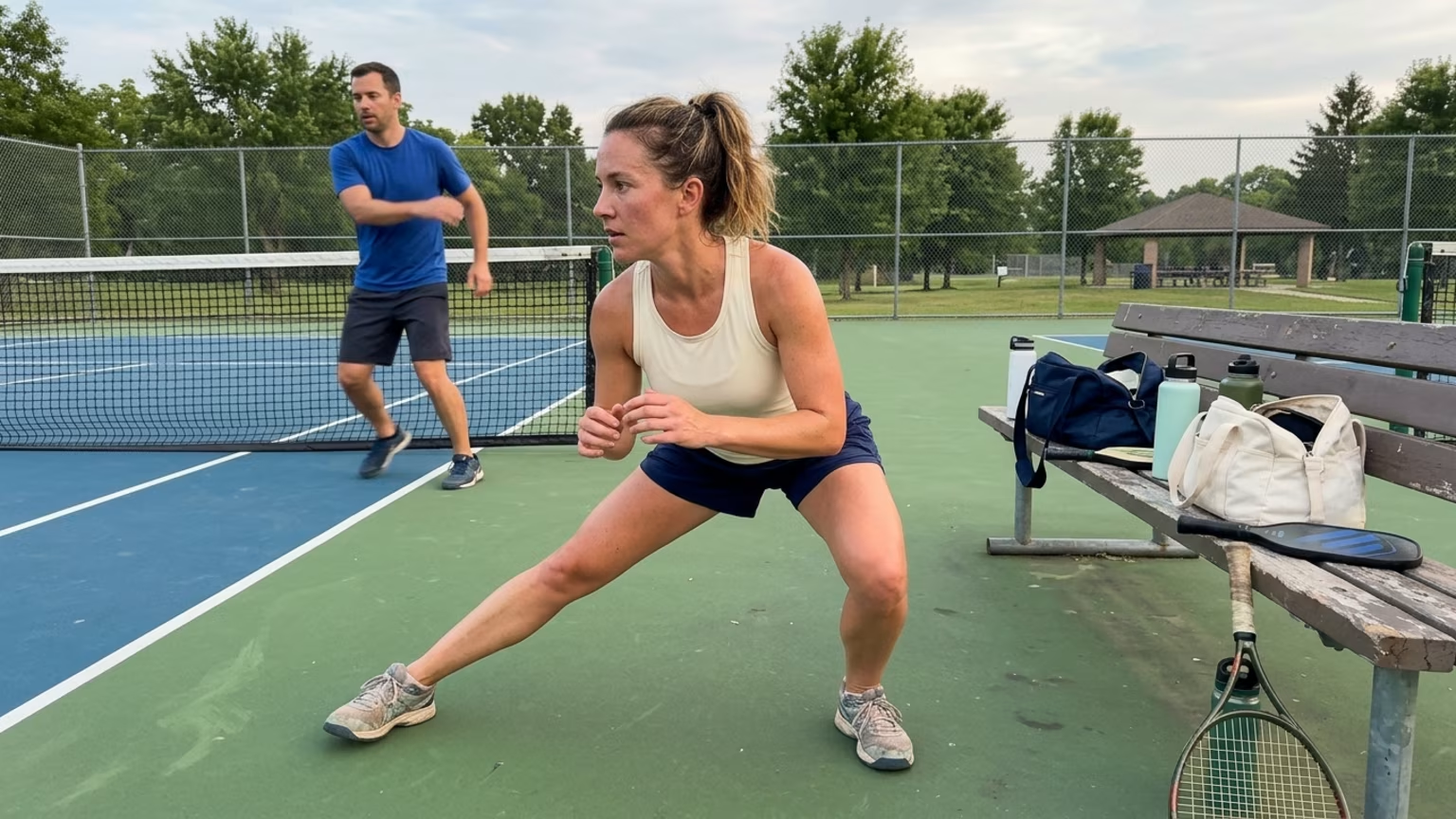
Side shuffles appear in both documented routines. The broader practical framework also includes lateral recovery and split-step-like movement before progressing toward playing pace.
This is where court footwork patterns fit into the warm-up. The emphasis shifts from moving generally to rehearsing how the feet organize the next shot. Keep the movement connected to the session ahead rather than turning this phase into an exhausting agility workout.
ATI Physical Therapy recommends easy paddle swings followed by gentle rallies. The padel guide develops this phase further: back-court rallying progresses into net play and overheads. Rally drills and serves and returns follow within its on-court example.
The useful principle is increasing specificity alongside pace. Start with controlled contacts and then include the strokes the session will require. The final phase should resemble the sport being played rather than remain a general exercise routine.
ATI Physical Therapy recommends approximately 5 to 10 minutes for its gradual pickleball warm-up. The padel guide describes a longer arrangement with about 12 minutes of courtside movement followed by about eight minutes on court.
Those examples serve different practical situations. They are not competing instructions that every player must reconcile into one duration. The repeatable feature is the progression from easy movement toward controlled court actions.
If court access is very limited, the padel guide's three-minute fallback retains an easy back-court rally and serves. Its practical priority is to preserve some specific hitting rather than attempt every exercise from the longer routine.
For a cool day, a commercial padel guide suggests extending the easy-movement portion. The practical adjustment is to allow a more gradual opening instead of rushing directly into faster footwork or hitting.
For a demanding match, keep the purpose equally clear. ATI Physical Therapy advises building pace under control and finishing prepared rather than fatigued. A harder match is not a reason to turn the warm-up into a separate conditioning session.
A pickleball health-information guide advises returning players to begin with shorter sessions and gradually increase playing time. That is a separate decision from which exercises belong before the first rally.
Use the warm-up to organize preparation while treating overall playing load as its own planning task. When returning after injury or making decisions around a health condition, seek individual guidance from a qualified healthcare professional.
Keep the general sequence but change the final movement and hitting emphasis. The practical distinction is what needs rehearsing: lateral recovery, paddle control or a progression into net and overhead actions.
For tennis, a practical application is to pair lateral recovery with controlled groundstrokes. Include volleys when net play is part of the planned session rather than making every warm-up contact a baseline exchange.
The movement emphasis is getting into position and recovering after the stroke. Build the pace progressively using the court movements and shots that belong to the session.
ATI Physical Therapy's examples provide a clear starting point: side shuffles and calf raises alongside arm circles. Easy paddle swings then lead into gentle rallies.
Here the final rehearsal links lateral movement with controlled paddle contacts. Retain that transition rather than ending the warm-up immediately after the general exercises.
The padel guide documents the clearest staged hitting sequence. Its back-court rallies lead toward net play and overheads before later rally drills and service practice.
That progression changes the movement task from back-court exchanges to net positioning and overhead actions. The sport-specific adjustment is to include those actions rather than borrowing a hitting phase that never reaches them.
Follow Evercourts for practical insights on tennis, pickleball and padel performance, movement, recovery and healthy ageing. Stay connected for new articles, research-led guidance and ideas to help you play well and keep playing for years.


Learn how to turn, track and recover for pickleball lobs with a gentle partner drill, plus what fall research says about balance and footwork.

Tennis match data explain why conditioning involves repeated bursts and recovery. Apply the pattern without treating research averages as personal targets.

A flexible pickleball warm-up progressing from easy movement to controlled lunges, side steps, shadow swings and dinking, with readiness-based adjustments.
Read practical guidance for better movement, smarter preparation and a game that keeps working for you.
explore the Blog
