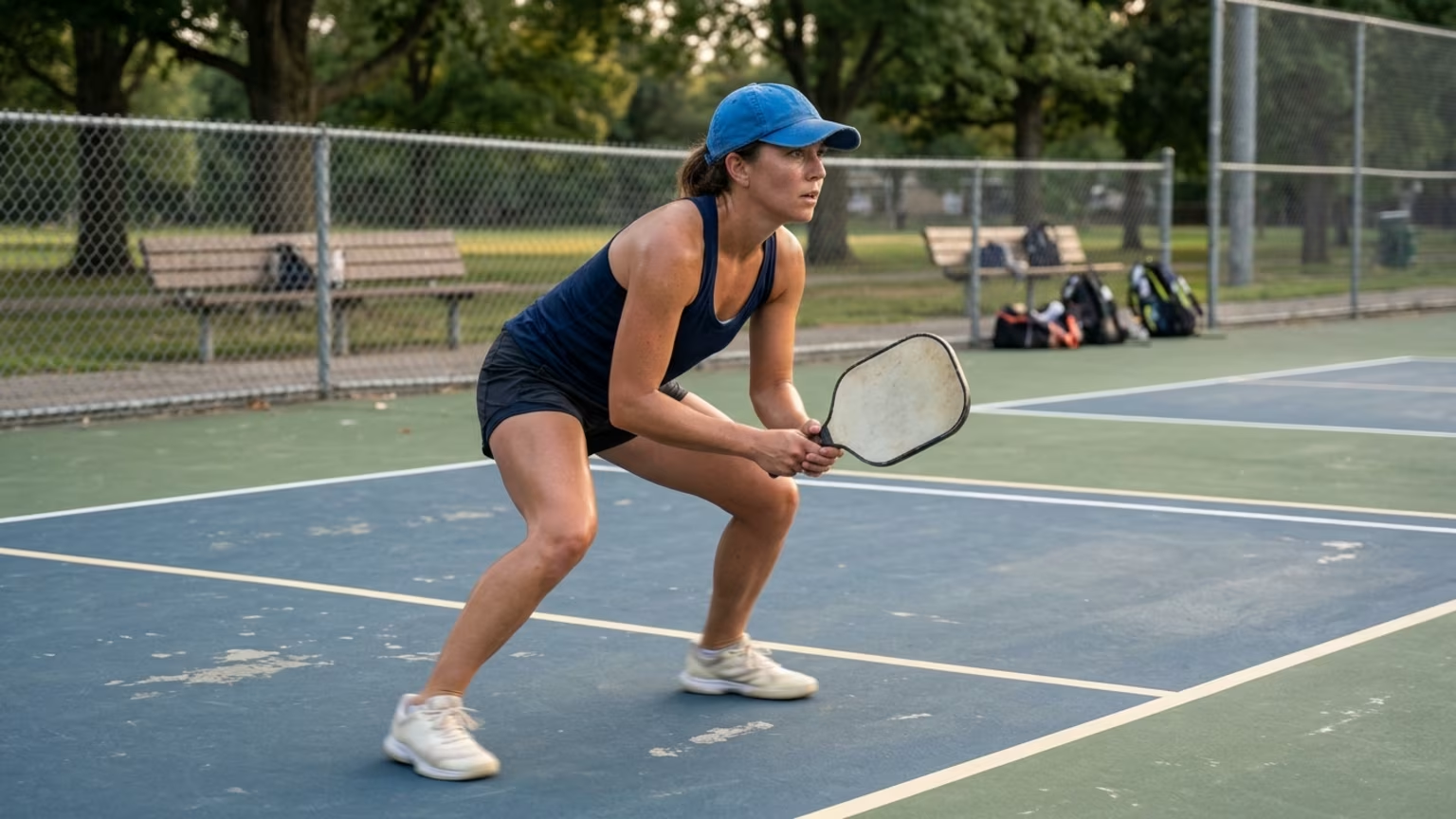

Pair footwork patterns with cue-based feeds. Learn what tennis research supports and how to keep first-step practice controlled and adjustable.




Reactive footwork means choosing where to move from information provided by an opponent or the ball, rather than following a route you already know. A memorized footwork pattern rehearses a known movement. A reactive drill adds a decision about which movement to make.
Both have a place in practice. Patterns let a player work on steps, balance and recovery without also solving an uncertain feed. Reactive work asks the player to notice a cue and select a response. The useful distinction is not good drills versus bad drills, but learning the movement versus choosing it.
Tennis, pickleball and padel demand repeated bursts of movement and changes of direction. Each new shot asks a practical question: where is the ball going, and what movement fits? Running quickly through a fixed route does not require the same decision as responding to a direction that has not been announced.
In tennis, the research question has included reading an opponent's stroke to anticipate direction. For pickleball and padel, the relevant practice question is similar: does the drill require information from the play, or is the route already known? That is a way to examine a drill's purpose, not a reason to copy every tennis exercise into another sport.
Repeated explosive starts also have to connect with controlled movement and recovery. Practice can therefore include both the route and the information that triggers it. Evercourts' guide to the movement patterns used around the court provides related context for the movement side.
In a 2002 tennis study described in a research overview, eight skilled players anticipated stroke direction faster than eight less-skilled players. More effective visual search accounted for part of the difference.
The same study reported that recreational players receiving perceptual training improved on laboratory and field-based anticipation tests compared with matched placebo and control groups. That supports giving the act of reading a shot its own place in practice.
Anticipation is the reading part of the task. A player may have a sound movement pattern yet still need practice choosing when and where to use it. Conversely, knowing the destination does not settle whether the movement itself is comfortable and controlled.
A 2026 review of tennis perceptual training counted 26 reports representing 24 study units and 766 participants. Only three study units reported outcomes linked to structured scored play or competition-derived ratings.
Keep the evidence boundary clear: the direct study was small and did not compare pattern drills with reactive drills. The review also noted a single reviewer and search download caps. Match transfer and benefits for older adults or other racquet sports remain uncertain. The sources establish neither a practice dose nor a progression schedule, and they do not show long-term preservation of physical capacity.
Published tennis coaching guidance suggests starting with a predictable feed and adding depth variation before increasing pace or adding another direction. A separate coaching article describes movement without a ball, followed by predictable feeds and then random directions. The progression below uses those coaching ideas, not a trial-tested program.
The feeder's job is to make the choice clear enough to respond to, not to win the exchange. A ball sent beyond comfortable reach changes the physical problem as well as the decision. The adjustable feed matters more than making the exercise look demanding.
For adult players, athletic longevity is a planning goal rather than a contest to make every drill harder. Keeping both types of practice available gives a session a clear purpose: rehearse a movement or respond to information. Speed is not the only useful way to describe the task.
A helpful observation is whether the movement changes when uncertainty is added. Was the step comfortable when the direction was known? Did balance become harder to manage when the feeder chose the side? Those observations describe the practice demand more clearly than simply saying that a player has lost a step.
The practical value of understanding the distinction is clearer communication. A player can ask for more time rehearsing a known route or for a manageable choice between directions. That is more specific than asking for a harder footwork session, and it leaves room to adjust the task around the person.
Use comfort and control to shape the practice conversation rather than treating age as the explanation for every difficulty. Evercourts' guide to noticing how you feel between matches offers related context. For padel players, looking at first-step mechanics and posture keeps the movement side of that conversation in view.
Seek advice from a qualified physio or healthcare provider when discomfort keeps returning during these tasks or when familiar movements no longer feel comfortable and controlled. Those are reasons to discuss the difficulty, not to assume that the answer is more reaction practice.
Useful details to bring to that conversation include:
A clinician can help with questions about your individual situation. A coaching progression is not a substitute for that conversation when movement is uncomfortable or difficult to control.
Keep the practice responsive to the ball and to the player.
Follow Evercourts for practical insights on tennis, pickleball and padel performance, movement, recovery and healthy ageing. Stay connected for new articles, research-led guidance and ideas to help you play well and keep playing for years.


Learn how to turn, track and recover for pickleball lobs with a gentle partner drill, plus what fall research says about balance and footwork.

Tennis match data explain why conditioning involves repeated bursts and recovery. Apply the pattern without treating research averages as personal targets.

A flexible pickleball warm-up progressing from easy movement to controlled lunges, side steps, shadow swings and dinking, with readiness-based adjustments.
Read practical guidance for better movement, smarter preparation and a game that keeps working for you.
explore the Blog
