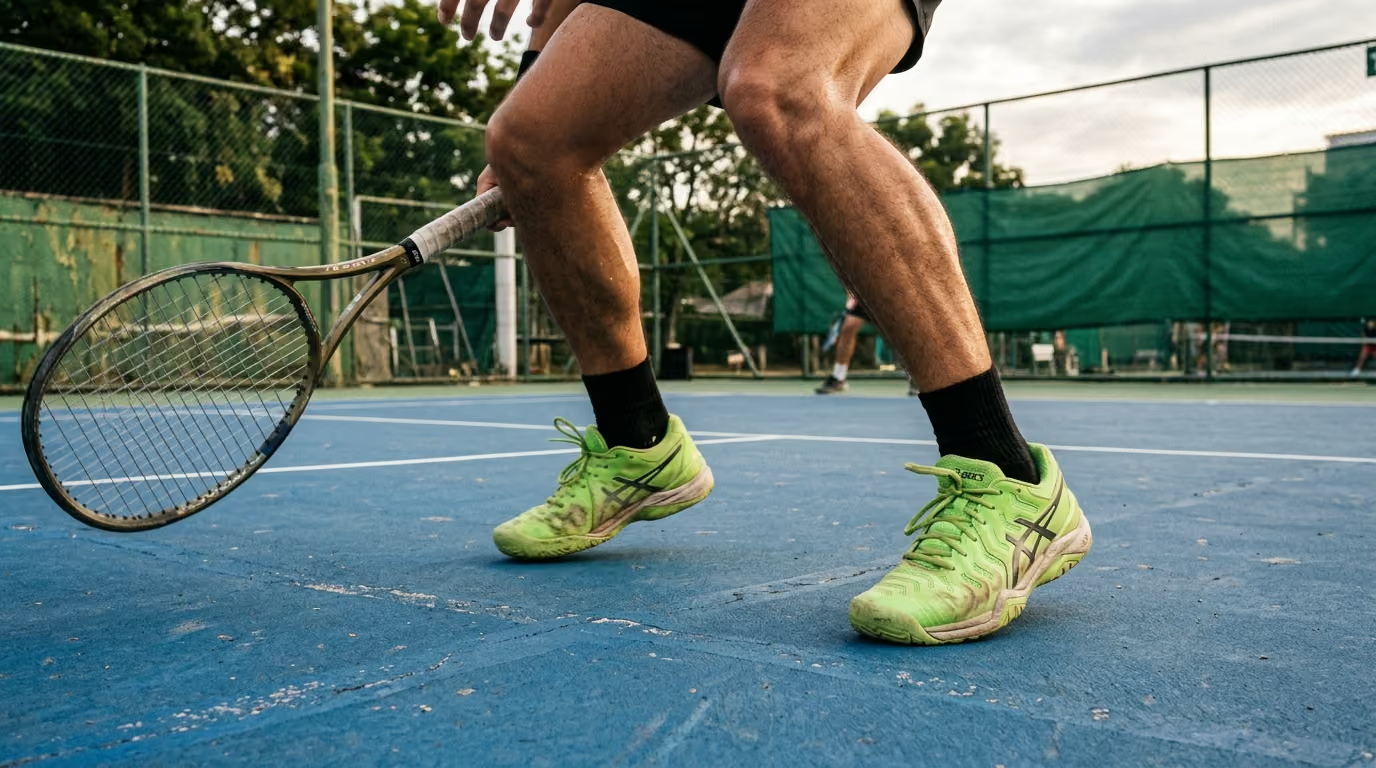
While court movement is often simplified to footwork, it actually involves a complex interplay of momentum management, force absorption, and balance under pressure.




Court movement is often described as footwork. However, this term does not capture the full physical reality of what happens during a rally. True court movement is not just about moving your feet quickly. It is a highly coordinated process of managing momentum, absorbing force, and maintaining balance under pressure.
To move efficiently on court, players must master a spectrum of linear, lateral, diagonal, rotational, and multi-directional patterns that combine acceleration with deceleration. Effective training requires building joint mobility, eccentric braking strength, and reactive decision-making rather than running preplanned drills. By focusing on how we absorb and redirect force, we protect our joints and sustain our performance over time.
This guide provides a comprehensive taxonomy of racquet sports movement. We will examine the mechanics of how you move, the physical demands of different directions, and how to structure your training. This practical framework will help you move more fluidly, reduce your injury risk, and support your athletic longevity.
Sports science has shifted away from viewing movement as simple speed. Modern research treats court movement as a sequence of linked tasks. These tasks include perception, initiation, acceleration, positioning, deceleration, stabilization, striking, and recovery.
One of the most important concepts in modern movement science is the distinction between change of direction and agility. A change of direction is a preplanned movement where you know exactly where you are going before you start. Agility, on the other hand, requires you to perceive a stimulus, make a decision, and then execute a movement.
A study comparing repeated change of direction and reactive agility tasks found that they are different physical skills. The correlation between a player's performance on preplanned drills and reactive drills is surprisingly low. This means a player can be exceptionally fast during a cone drill but struggle to move efficiently when reacting to a real ball or opponent.
The physical demands of these movements are highly intense. Research on horizontal deceleration shows that braking steps involve incredibly high impact forces and loading rates. For example, biomechanical studies on badminton lunges show that players regularly experience vertical impact forces up to three times their body weight. Horizontal forces can reach up to two times body weight during rapid stops.
These forces place immense stress on the lower extremities. A systematic review published in 2024 reported that lower-limb injuries represent over 52% of all injuries in badminton. Ankle sprains are the most common acute injury, followed closely by muscle strains.
In tennis, epidemiological reviews show a similar pattern. Lower-extremity injuries occur at a high rate of 23.0 per 1,000 match exposures, with the ankle being the most common site of acute trauma. Most of these injuries happen during the braking and deceleration phases of movement, rather than during straight-line running.
The way players manage these loads varies by skill level. Comparative studies of professional and amateur court athletes show that professionals are highly skilled at distributing forces. Elite players tend to use greater knee moments to absorb impact. Amateurs often rely more on ankle range of motion and exhibit greater ankle inversion, which may explain why they experience a higher rate of lateral ankle sprains.
To train your movement effectively, you need a systematic way to categorize your actions on the court. Looking at movement as merely forward, backward, or sideways is too simplistic. Instead, we can classify every court movement along five distinct dimensions.
This dimension describes the path your body travels relative to the court. It includes linear, lateral, diagonal, rotational, and multi-directional patterns.
This refers to what your body is trying to accomplish at any given millisecond. The objective changes constantly during a point. You may need to accelerate from a standstill, brake to a stop, reposition your feet, stabilize your trunk, jump to reach a high ball, land safely, or recover back to a tactical base.
This is the specific technical foot pattern you use to achieve your mechanical objective. It includes the split step, side shuffle, crossover step, chasse step, pivot, lunge, hop, and crossover recovery.
This refers to the anatomical planes of motion where your joints must produce and absorb force. Linear movements occur mostly in the sagittal plane. Lateral movements occur in the frontal plane. Rotational movements occur in the transverse plane.
This connects the physical movement to the tactical reality of the game. It includes open-skill reactions, stroke preparation, defensive court coverage, and recovery to your tactical home base.
Understanding each directional category allows you to identify your personal movement limitations. We can break down the five primary directions of court travel to look at their mechanics, physical needs, and training progressions.
Linear movement occurs when you travel directly along the court’s length or width without changing your heading. This includes running forward to reach a short drop shot, backpedaling to track down a lob, or sprinting straight toward the net.
Mechanically, linear movement requires rapid acceleration and high-force deceleration. Horizontal deceleration is particularly demanding because your body must absorb forward momentum over a very short distance.
To perform this safely, you need excellent ankle dorsiflexion. This allows your shin to tilt forward, lowering your center of mass. You also require hip flexion and extension strength to drive your body forward and pull it to a stop.
Many players make the mistake of running upright into a ball and trying to brake at the very last instant. This creates a high-impact collision between the foot and the court, placing excessive stress on the patellar tendon and lower back.
To improve your linear movement, use this step-by-step training progression:
Lateral movement occurs across the width of the court. It is highly common in baseline rallies. An observational study of male tennis players at the French Open reported that approximately 72% of their movements were lateral. While this specific percentage varies by surface and playing style, it highlights the importance of side-to-side efficiency.
Lateral movement relies heavily on hip abduction and adduction. Your groin muscles and outer glutes must work together to slide your body across the court. It also requires excellent ankle inversion and eversion control to prevent your ankle from rolling under lateral force.
A common technical error is crossing your feet too early when a simple side shuffle would keep you balanced. Another error is landing with your outside foot too far from your body, which can cause your knee to collapse inward.
To train lateral movement safely, focus on frontal-plane control:
Diagonal movement combines forward or backward travel with lateral displacement. This is the most common way players cover the court because balls are rarely hit directly at you or perfectly sideways.
Diagonal movement is physically demanding because it requires you to solve two mechanical problems at once. You must generate forward speed while managing the changing rotation of your pelvis, hips, and trunk.
This pattern requires exceptional hip rotation in both directions. It also demands eccentric braking strength in your quadriceps to manage deep diagonal lunges. Research shows that diagonal lunges produce high knee torque and compressive forces, particularly when you reach your maximum lunging distance.
A frequent error is treating a diagonal approach like a straight-line sprint. This causes you to arrive at the ball with your feet parallel, which makes it incredibly difficult to rotate your hips or recover quickly.
Train diagonal movement with this systematic progression:
Rotational movement involves turning your body, pivoting on a loaded foot, and transferring force from the ground up through your kinetic chain. This is how you generate power for open-stance groundstrokes, backhand pivots, and overhead smashes.
Rotation is not just an upper-body action. It must start at the feet and hips. You need usable internal and external hip rotation, along with thoracic spine mobility, to dissociate your upper body from your lower body.
When players lack hip or thoracic mobility, they often force rotation through their lumbar spine. The lower back is designed for stability, not rotation. Forcing rotation here is a common cause of chronic back soreness among racquet athletes.
To develop safe rotational power, follow this progression:
Multi-directional movement is the integration of all previous patterns. A typical rally does not consist of isolated steps. It is a continuous chain of reading the ball, splitting, accelerating, braking, striking, and recovering.
This category should be trained as movement chains. If your first step is fast but your braking is poor, your overall movement will feel clunky and slow. You must train the transition from one movement direction to another.
To build true multi-directional efficiency, your training must introduce uncertainty. Since preplanned drills do not fully transfer to match play, you must incorporate reactive elements.
Use this progression to build reactive multi-directional skill:
Every single movement you make on the court follows a specific cycle. By understanding this cycle, you can identify exactly where your movement efficiency breaks down.
The split step is the starting point of the movement cycle. It is a small, active hop that timing-wise coincides with your opponent’s contact with the ball. The goal is to land with your feet wide and your muscles pre-tensioned, ready to spring in any direction.
A common mistake is splitting too early. If you land before your opponent strikes the ball, you lose your momentum and become stationary. Conversely, splitting too late means you are still in the air when the ball is traveling toward you, delaying your reaction time.
Your landing position should be low, with your weight on the balls of your feet. Your knees should track over your toes, avoiding any inward collapse.
Once you perceive the direction of the ball, you must push off with your outside foot to drive your body toward the target. This phase requires rapid, horizontal force production.
Your trunk should lean forward slightly to assist with acceleration. Your first step should be decisive, using either a crossover step for longer distances or a side-shuffle step for shorter adjustments.
As you approach the ball, you must transition from accelerating to braking. This is where many joint injuries occur. You must lower your center of mass by bending your knees and hips, which helps distribute the impact forces.
Avoid landing with a completely straight, locked knee. This forces your joint capsule and tendons to absorb the entire impact, rather than letting your muscles do the work. Your final braking step should be wide and stable.
The final step before your stroke must place you at an optimal distance from the ball. If you stop too close, your swing will be cramped. If you stop too far away, you will have to reach, which compromises your balance and power.
Your trunk should remain stable as your shoulders turn to prepare the racquet. You must maintain a solid connection to the ground, as this is where your swing's power originates.
The movement cycle does not end with the stroke. Immediately after contact, you must push off your outside foot to recover back toward the center of the court.
Your recovery strategy depends on how far you had to run. If you were pulled wide, you will likely need a powerful crossover step followed by side shuffles. If you only moved a short distance, a quick side-shuffle recovery is usually sufficient to regain your position.
To move like an athlete, you must build the underlying physical capacities. Specialized guides on mobility and movement resources can provide deeper targeted exercises, but we can look at the primary anatomical regions here.
Your ankles and feet are your only contact points with the court. They must be stiff enough to transfer force during acceleration, yet mobile enough to bend during deep lunges.
Ankle dorsiflexion is the ability to pull your toes toward your shin. If your calves are tight and your dorsiflexion is limited, your body will compensate by lifting your heel early or collapsing your knee inward. This compensation increases your risk of plantar fasciitis and patellar tendinopathy.
To support your ankles, include calf raises with a slow eccentric (lowering) phase, soleus wall sits, and single-leg balance exercises on your practice days.
The knee acts as a shock absorber during court movement. It must tolerate high forces in both the sagittal plane (bending and straightening) and the frontal plane (resisting side-to-side collapse).
To protect your knees, you must build strength in your quadriceps, hamstrings, and glutes. Exercises like split squats and lateral lunges are excellent because they mimic court positions. Focus on keeping your knee aligned with your second toe during these movements.
Avoid the old advice that your knees should never go past your toes. On the court, your knees must go past your toes to allow you to get low. The key is to build the strength to control that position.
Your hips are the engine of your court movement. They provide the power for sprinting and the mobility for deep reaching.
I remember finishing a tough two hour padel match on a cold Tuesday night and waking up the next morning feeling like my lower back was locked in concrete. For a long time, I just accepted this as the price of playing hard in my forties. But once I started spending just ten minutes on targeted hip mobility before heading to the club, the stiffness almost completely vanished. It taught me that we do not have to accept pain as a default state of aging.
Our team recommends prioritizing hip internal and external rotation mobility. When your hips move freely, your lower back does not have to twist excessively to cover the court. This simple shift is a cornerstone of healthy aging and athletic longevity.
Your mid-back, or thoracic spine, must rotate freely to allow you to coil and uncoil during strokes. If your thoracic spine is stiff, your body will attempt to find that rotation in your lower back or shoulder, leading to overuse injuries.
You can develop thoracic rotation by performing half-kneeling T-spine rotations and open-book stretches. This rotation must be paired with trunk stability. Your core muscles must remain strong during braking to prevent your upper body from folding forward.
Repetitive overhead strokes place immense rotational stress on your shoulders and elbows. This is especially true in badminton and tennis.
To protect your upper body, you need excellent scapular control and rotator cuff endurance. Your shoulder blade must glide smoothly along your rib cage to allow your arm to move safely overhead. Incorporate face pulls, external rotation exercises, and progressive overhead throwing to build shoulder resilience.
While all racquet sports share basic movement principles, court dimensions and surfaces create unique physical demands. Understanding these differences allows you to tailor your training.
Tennis involves the largest court dimensions, leading to higher top speeds and longer acceleration phases. Players must cover significant distances, requiring excellent linear and diagonal speed.
The playing surface also alters movement mechanics. On clay courts, players slide to brake, requiring specialized slide-control mechanics. On hard courts, the friction is much higher, resulting in abrupt stops and intense joint loading.
To excel in tennis, your training must emphasize high-velocity deceleration and eccentric strength. You must build the capacity to absorb heavy impacts repeatedly.
Pickleball is played on a much smaller court, which significantly reduces the need for long-distance sprinting. Instead, it demands incredibly rapid lateral shifting and split-second reactions.
The most critical area on a pickleball court is the non-volley zone, commonly called the kitchen line. Players spend much of the game in a deep, wide stance, lateral-shuffling to keep their balance while hitting low dinks.
This position requires sustained isometric strength in your quadriceps and glutes. It also demands excellent ankle stability to manage the constant, micro-adjustments required during fast hand exchanges.
Padel is played inside an enclosed glass court, which introduces complex rotational and multi-directional demands. Players must interact with the back and side walls, requiring them to turn, track the ball, and quickly pivot back to face the net.
This sport features a high volume of overhead shots, such as the bandeja and vibora. These strokes require repetitive, combined thoracic extension and rotation, which can place significant stress on the shoulder joint and lower back.
Padel movement is characterized by constant, short adjustments. You must be comfortable turning your back to the court and quickly recovering your footing after the ball rebounds off the glass.
To apply this taxonomy practically, let us look at four common movement sequences you will encounter on the court.
This is a classic defensive movement pattern used when an opponent pulls you wide to your forehand side.
This sequence occurs when the ball bypasses you and rebounds off the back glass, requiring you to turn and play it off the wall.
This sequence happens when you are forced to transition from a deep defensive position up to the non-volley zone line.
This is the standard movement used to reach a short drop shot near the net.
To build these movement skills, you need a structured training program. You can integrate this training into your routine across five progressive phases. For a complete physical program, explore our strength and conditioning resources.
The goal of this phase is to build the physical foundation. Before you try to move fast, you must ensure your joints have the strength and mobility to handle the forces.
Once you have the physical capacity, you can begin learning the specific footwork patterns.
In this phase, you begin developing the power and braking strength required for competitive play.
This phase bridges the gap between physical training and actual match play by adding decision-making.
The final phase ensures you can maintain high-quality movement even when you are tired.
You do not need an expensive sports science lab to test your movement capacity. You can use these simple self-assessments to identify your strengths and weaknesses.
Even highly fit players can make critical movement errors. Correcting these simple mistakes can dramatically improve your efficiency. To learn more about common physical errors, explore our guides on injury prevention resources.
Many players focus entirely on how fast they can run, completely ignoring how they stop. This results in running too fast into the ball, leading to an unbalanced stroke and a slow recovery.
Always remember that your ability to accelerate is limited by your ability to decelerate. If your body knows it cannot stop safely, it will subconsciously limit your top speed to protect your joints. Focus on training your braking steps, and your overall speed will naturally increase.
Agility ladders are popular because they look impressive on social media. However, they only train rhythm and preplanned foot coordination. They do not train the high-force deceleration, deep lunging, or reactive decision-making required on a real court. Use ladders as a warm-up tool, but do not mistake them for comprehensive agility training.
Every step you take on the court has a physical cost. Understanding how movement affects your body is key to managing fatigue and supporting your athletic longevity. We cover these topics deeply in our recovery science resources.
Rapid changes of direction rely heavily on eccentric muscle contractions. Eccentric contractions occur when your muscles lengthen under load, such as when your quadriceps absorb your weight during a deep lunge. This type of muscle action causes micro-tears in the muscle fibers, which leads to delayed onset muscle soreness.
If you play multiple matches without allowing your muscles and tendons to recover, this fatigue accumulates. Over time, your muscles lose their ability to absorb shock, shifting the impact forces directly onto your joints, tendons, and lower back.
To manage this recovery cost, always include a proper warm-up before you play and a cool-down afterward. Focus on active recovery, such as light walking, gentle mobility work, and adequate sleep to help your tissues heal between sessions.
This guide is designed to help you improve your movement efficiency and support your athletic longevity. However, it is not a substitute for professional medical advice.
You should consult a qualified physical therapist, sports physician, or athletic trainer if you experience any of the following warning signs:
Working with a healthcare provider can help you address underlying biomechanical issues before they turn into chronic injuries, keeping you on the court for years to come.
Lower back stiffness is often caused by a lack of mobility in your hips. When your hips cannot rotate fully during your strokes, your body forces your lumbar spine to twist to find that extra range. Since the lower back is designed for stability rather than rotation, this repetitive twisting leads to muscle soreness and joint irritation. Improving your hip internal and external rotation will help protect your lower back from this excess stress.
Yes, you can make significant gains in court speed by improving your braking efficiency. Many recreational players are slow not because they lack sprinting speed, but because they take too long to slow down and stabilize before hitting the ball. By training your eccentric leg strength and learning to lower your center of mass during deceleration, you can stop faster, execute your stroke sooner, and recover back to the center more quickly.
While a deep lunge allows you to reach further, it also places immense stress on your lower body. Biomechanical research shows that longer lunges significantly increase knee torque and joint compression forces. It is best to earn your lunging depth gradually. Focus on building the necessary quadriceps and glute strength to control a shallow lunge before attempting to sink into a deep, maximum-reach position.
You do not need to spend hours on movement training to see results. Incorporating just ten minutes of targeted movement drills into your warm-up routine twice a week can make a big difference. Focus on one specific pattern, such as lateral shuffling or diagonal lunging, during each session. This consistent, low-volume approach allows you to build skill and coordination without adding excess fatigue to your weekly play schedule.
Follow Evercourts for practical insights on tennis, pickleball and padel performance, movement, recovery and healthy ageing. Stay connected for new articles, research-led guidance and ideas to help you play well and keep playing for years.


Read practical guidance for better movement, smarter preparation and a game that keeps working for you.
explore the Blog