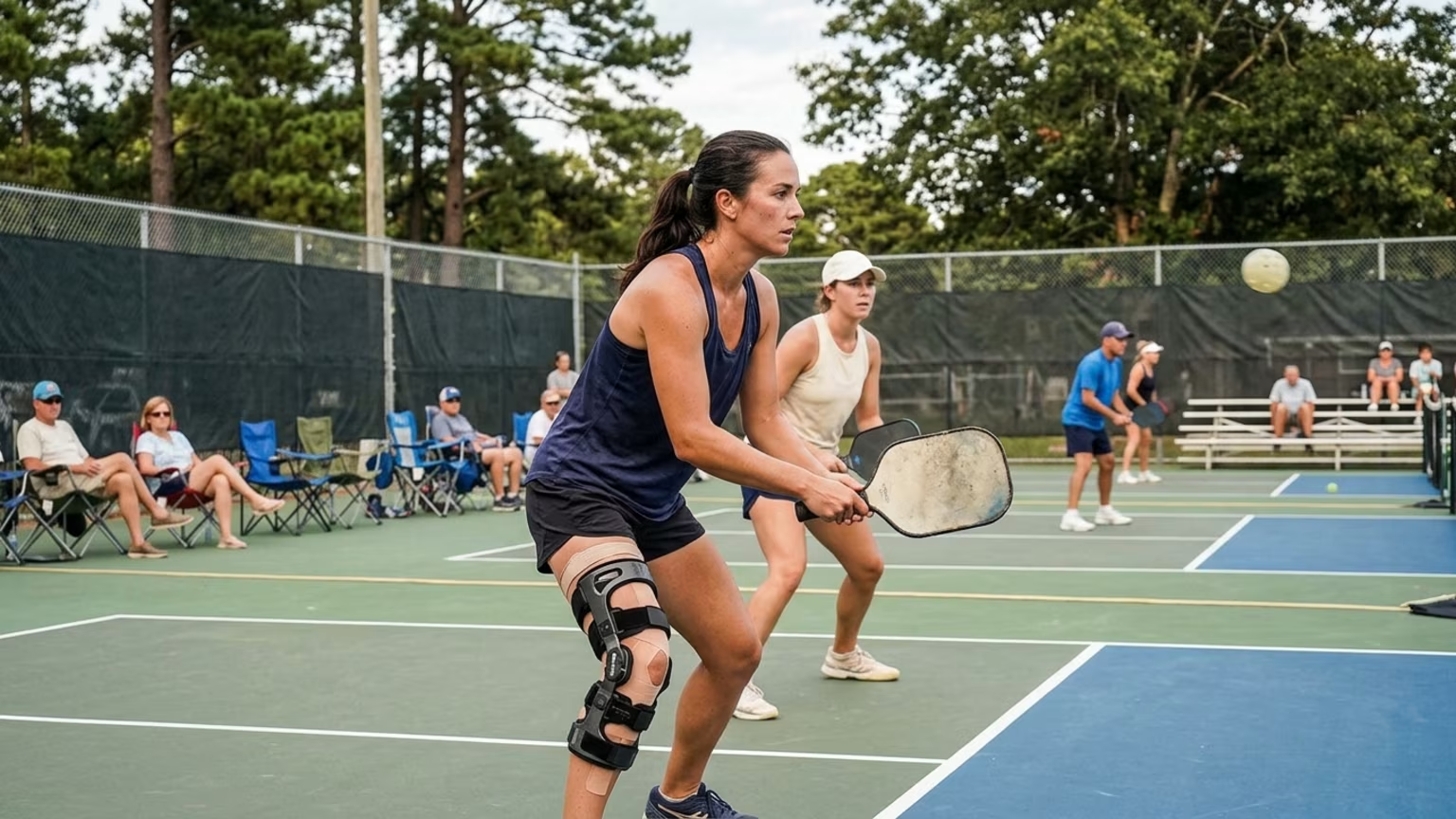

Lea Jansen’s reported broken patella at Virginia Beach highlights the pressures behind injury decisions, not a recovery timetable for recreational players.




On October 15, Lea Jansen competed in women’s doubles at the Virginia Beach Open with a broken patella in her left leg alongside Kate Fahey, according to Times Now.
Times Now’s October 16 report said Jansen had withdrawn from women’s singles and mixed doubles before the tournament. She continued in women’s doubles with Fahey and reached the quarterfinals.
Her explanation centered on that partnership. As quoted by Times Now, Jansen said she played in part because she was partnering with Fahey, adding that “if this is the last time I go out, I’d like to do it with Kate.” The remark made her personal reason for appearing an important part of the story.
Times Now also reported that Jansen expected to miss the following three months and had withdrawn from every remaining event on her 2026 schedule. Her continued participation in doubles therefore sat alongside substantial withdrawals elsewhere in her schedule.
The report does not provide clinical details of the fracture, a treatment plan or a treating clinician’s assessment. It does not establish that competing caused or lengthened the expected absence. Jansen’s three-month expectation is a reported personal timeline, not medical clearance or a recovery standard for other players.
At tour level, this was a decision about a particular partnership and tournament. Jansen’s own account gives that choice emotional weight. For an adult league player, the useful lesson is to recognize those competing priorities without treating the professional’s decision as something to copy.
A partner’s presence can matter deeply to the meaning of an event. It still belongs in a different conversation from the question of whether an individual should participate with a serious injury. Loyalty is a sporting value, not a substitute for personal medical advice.
For a player facing that decision, a qualified clinician is the appropriate source of guidance about their own circumstances. A professional’s entry in a draw or a post-match interview should not carry that responsibility. Our discussion of keeping elite comeback stories separate from personal recovery decisions takes the same editorial approach.
Evercourts’ focus is on helping players perform well today and keep enjoying racquet sports for years. In that frame, stepping away from an event should not be presented as a lack of ambition. The goal is an informed decision rather than matching an athlete’s public display of commitment.
For coaches, the defensible takeaway is to discuss the player in front of them rather than use Jansen’s appearance as a test of commitment. Her decision is not a benchmark that teammates need to meet. A useful conversation keeps these issues separate:
Those are discussion points, not return-to-play criteria. They leave personal medical decisions with qualified care while giving the player room to explain the sporting reasons that matter to them.
Format changes also need careful interpretation. Jansen withdrew from singles and mixed doubles while continuing in women’s doubles. That reported choice should not become a general recommendation to switch to doubles when injured.
For the weekend player, choosing which events matter is a separate planning task from deciding whether an injury permits participation. Our guide to fitting competition choices around a sustainable season provides a broader framework for that planning conversation.
Times Now reported that Jansen and Fahey beat Daria Walczak and Alex Walker 11 to 2 and 11 to 4 on October 15. The outlet also described Jansen as a seven-time PPA Tour gold medalist.
Those details establish the competitive context: an accomplished professional won a match and progressed in the draw. They are sporting results. The editorial mistake would be to turn that success into reassurance about another player’s injury decision.
Broader pickleball research requires the same care. A 2026 medRxiv preprint examined U.S. injury, search-interest and participation series from 2014 to 2023. It cautions that descriptive trends moving together do not establish a relationship or make search interest a substitute for injury surveillance.
That population-level analysis does not address Jansen’s fracture or provide a return timetable. Its relevance here is a reporting principle: a conclusion should stay within the kind of evidence being presented.
The next development worth watching is what Jansen reports about her future participation. Any later tournament entry or withdrawal should be described for what it is, rather than turned into a verdict on the wisdom of the Virginia Beach decision.
For players and coaches, the more useful question will be how clearly future coverage distinguishes competitive plans from the basis for a return. An announced intention to play and a clinician-informed participation decision are different kinds of information.
Over the next season, injury reporting should move beyond treating persistence as the main story. The better standard is clear context that respects an athlete’s personal choices without asking recreational players to follow them. A professional comeback can be compelling without becoming a deadline for the club court.
Follow Evercourts for practical insights on tennis, pickleball and padel performance, movement, recovery and healthy ageing. Stay connected for new articles, research-led guidance and ideas to help you play well and keep playing for years.


Holger Rune withdrew from the European Open with a back problem. The facts behind his decision and a grounded perspective for recreational players.

The Dink’s October 17 guide emphasizes deep returns, ball-height decisions and positioning against faster pickleball opponents.

A new report outlines padel and tennis gear trends. Learn how to assess adjustable rackets, sensor feedback and smart-court claims.
Read practical guidance for better movement, smarter preparation and a game that keeps working for you.
explore the Blog
