
A research-led look at pickleball movement demands, with scalable strength, balance, mobility and direction-change practice for adult players.




Movement-specific conditioning is off-court practice that develops the strength, balance and control used in court movements. For pickleball, that means considering short accelerations and stops alongside sideways shuffles and lunges.
General cardio can remain part of the picture. The useful distinction is between keeping active and making room to practise the particular movements your sport asks of you. An off-court plan can address both without becoming a complicated gym program.
For an adult player, the goal does not have to be turning every session into a speed test. A more useful starting point is a manageable approach built around lower-body strength, comfortable mobility and controlled movement.
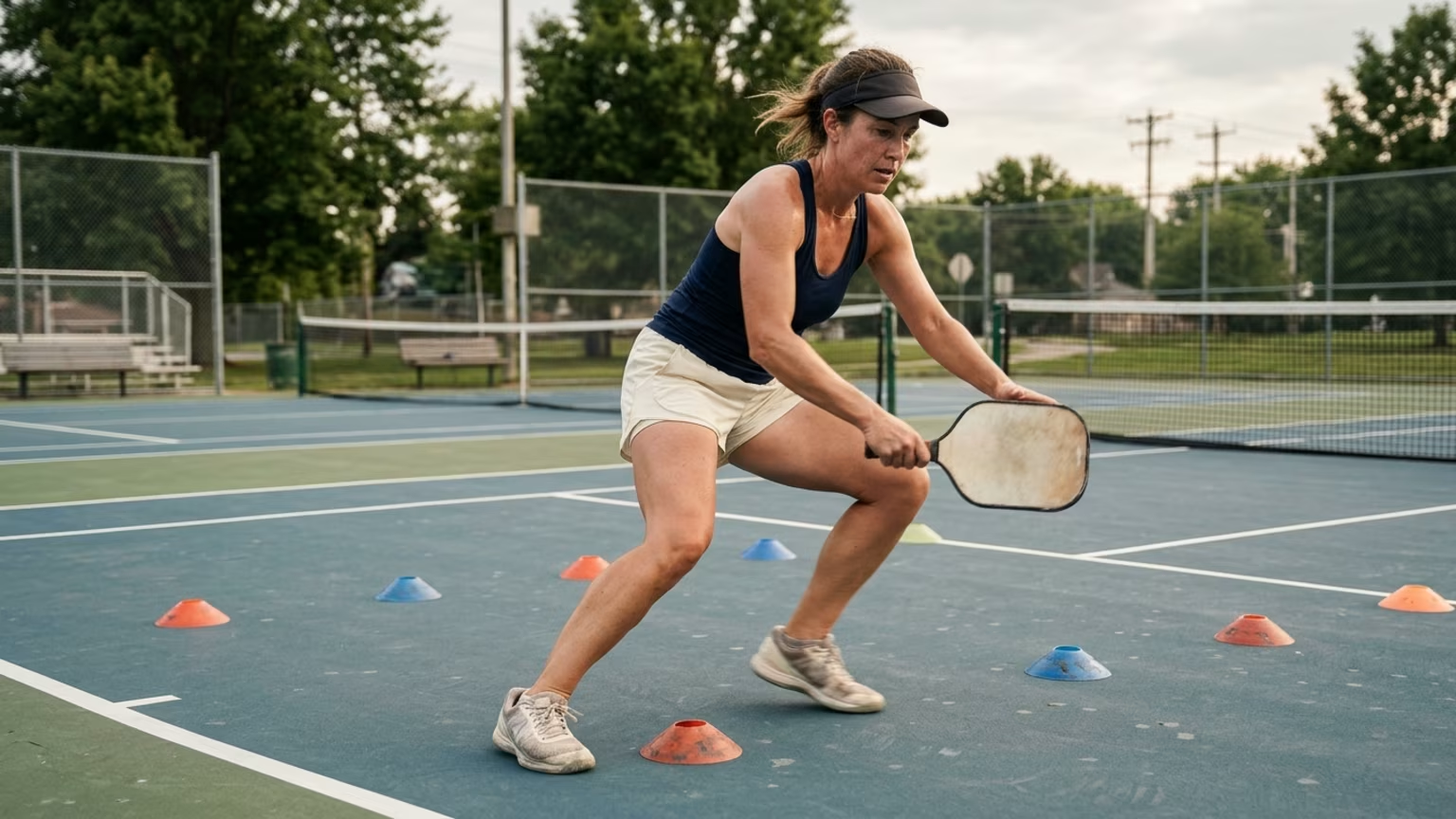
Pickleball involves brief movements in different directions rather than continuous travel at one pace. An acceleration starts the movement. A lateral shuffle changes position sideways. A lunge and a quick stop add different movement tasks to the same rally.
That makes it reasonable to consider more than aerobic conditioning when planning off-court activity. Strength work and balance practice give those capacities their own place in the plan. Controlled direction changes also provide an opportunity to practise the movement itself rather than simply making a workout more tiring.
The same planning principle is relevant to tennis and padel. Repeated explosive efforts and changes of direction make movement control part of the conditioning question across all three sports. That does not mean their training plans need to be identical.
Thinking about the movement demands behind a pickleball rally helps keep the discussion specific. The question becomes which capacities the plan addresses, not just how much exercise it contains.
A 2026 retrospective study indexed in PubMed compared U.S. emergency-department cases for pickleball and tennis from 2014 to 2024. It included 1,442 pickleball cases and 2,699 tennis cases.
These figures describe treated emergency-department cases, not every injury or complaint among players. Without a player-based or playing-hour denominator, they do not establish an individual player's injury risk or show that risk is rising.
A secondary account of a 2024 study reports that stronger hip abductors were associated with faster change-of-direction times in 92 recreational pickleball players. The account also reports that falls were often associated with lunging or moving backward.
That strength finding is correlational. It does not demonstrate that strengthening those muscles causes faster movement or prevents falls. The finding also comes through a secondary account rather than the original study presented here.
Taken together, these sources support discussing movement control and strength as relevant training considerations. They do not establish a routine that prevents every pickleball injury or validate a particular exercise sequence or dose.
The practical interpretation is straightforward: give relevant movement capacities attention alongside aerobic activity. Keep the distinction between a sensible training template and a tested injury-prevention program clear.
For athletic longevity, a useful planning priority is repeatability. The aim is a manageable approach that keeps relevant physical capacities in view while leaving room for playing and rest.
That shifts attention away from assembling the hardest possible workout. It puts the emphasis on choosing suitable variations and keeping movement controlled. Our discussion of consistent training rather than extreme gym intensity follows that same planning principle.
The following template organizes the practical suggestions supported by the research material. It describes movement options rather than prescribing an individual training session.
Comfortable ankle, hip and trunk movements can come before the strength and direction-change work. The emphasis is on a manageable range rather than forcing a larger movement.
This part of the template does not need to become a separate performance challenge. It gives mobility a clear place in the session before the more demanding movement tasks.
A supported sit-to-stand or squat can sit alongside a step-up and a shallow forward or lateral lunge. These are options for practising lower-body strength within the template.
An easy variation and a comfortable range provide the starting point. Progression belongs where movement remains controlled, rather than being driven by how advanced an exercise looks.
Support and movement range are useful ways to adjust the task. A player does not need to choose the deepest or most demanding version simply because it resembles a difficult reach on court.
Single-leg standing near a stable support provides a simple balance task. Keeping both hands near the support makes assistance available. Reducing hand support is one way to increase the challenge while remaining safe.
The emphasis is controlled practice rather than testing how long someone can manage without help. The available support is part of the exercise setup, not something that has to be removed to make the practice worthwhile.
Slow, planned side steps between two marks offer a starting option for direction-change practice. A gentle stop and return can then become part of the task.
Speed or unpredictability can increase only while the player remains balanced and pain-free. A faster movement is not automatically the better choice within this template.
The useful connection to pickleball is the movement pattern: travel sideways, stop and change direction. The starting version can remain simple while giving that pattern deliberate attention.
The scalable feature is the choice of variation. Support, range and speed can reflect current ability rather than an imagined standard for every adult player.
Rest also needs a place in the plan. These movement categories belong within a sustainable week of playing and training, not on top of every other activity without adjustment.
For someone focused on years of play, that is a useful way to frame off-court work. It is preparation that fits around the sport rather than a separate contest over exercise difficulty.
Pain, dizziness or unsteadiness during an exercise are reasons to reduce or stop that activity. A qualified physiotherapist or healthcare provider can offer individualized guidance about those symptoms and appropriate exercise choices.
Players with relevant health concerns or a history of falls should also seek that guidance. The discussion can focus on suitable movements and levels of support rather than pushing through an unsuitable variation.
Keep the ambition on the court, and let control set the pace off it.
Follow Evercourts for practical insights on tennis, pickleball and padel performance, movement, recovery and healthy ageing. Stay connected for new articles, research-led guidance and ideas to help you play well and keep playing for years.


Learn how to turn, track and recover for pickleball lobs with a gentle partner drill, plus what fall research says about balance and footwork.

Tennis match data explain why conditioning involves repeated bursts and recovery. Apply the pattern without treating research averages as personal targets.

A flexible pickleball warm-up progressing from easy movement to controlled lunges, side steps, shadow swings and dinking, with readiness-based adjustments.
Read practical guidance for better movement, smarter preparation and a game that keeps working for you.
explore the Blog
