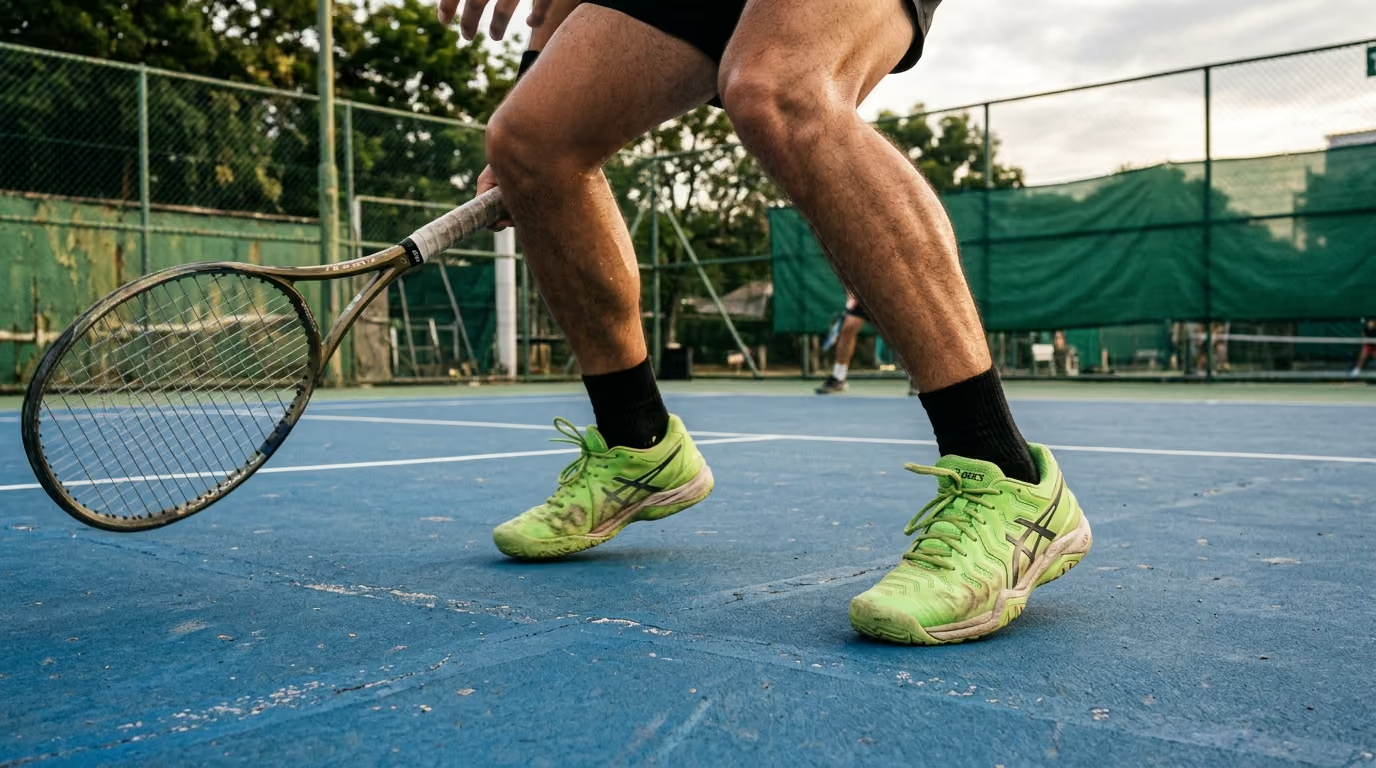

A sustainable weekly training plan for tennis, pickleball, and padel balances technical practice, physical conditioning, and structured recovery to prevent injury.




Imagine finishing a competitive two hour match on a cold Tuesday night. You play hard, chase down every short ball, and go home feeling accomplished. The next morning, however, your lower back feels like it has been set in dry concrete, your shoulder aches when you reach for a coffee mug, and you dread the thought of your scheduled Thursday game. Many recreational players accept this cycle of pain and stiffness as the unavoidable cost of playing court sports as they age.
To build a sustainable weekly training plan, you must balance technical practice, physical conditioning, and structured recovery while avoiding sudden spikes in playing time. This is achieved by designating specific high-demand, moderate-demand, and low-demand days across your calendar. By systematically organizing your week, you ensure your body adapts to the physical stress of the court without leading to chronic fatigue.
This comprehensive guide will help you move away from haphazard scheduling and toward a structured, research-backed framework. Whether your preferred sport is tennis, pickleball, or padel, the goal remains the same. You want to accumulate useful court time week after week, protect your joints, and perform at your highest level.
To build an effective plan, you must first understand what you are tracking. Workload is divided into two distinct categories: external load and internal load. Managing the relationship between these two factors is the foundation of athletic longevity.
External load is the objective, physical work you perform on and off the court. This is the data you can easily write down in a notebook or track with a wearable device. It includes the exact number of minutes you spend on the court, the number of matches you play, and the sets completed.
It also covers off-court metrics. These include your sprinting volume, change-of-direction drills, and the sets and reps you perform during resistance training. While external load is easy to measure, it only tells half of the story.
Internal load is your body’s unique physiological and psychological response to that physical work. The same external workout can feel completely different depending on several lifestyle variables. Factors such as poor sleep, work stress, hot weather, or mild dehydration will immediately increase your internal load.
A practical way to track this is the session rating of perceived exertion, which is often called the session-RPE method. To use this tool, multiply the duration of your session in minutes by your post-session effort rating on a scale from zero to ten. For example, a ninety-minute doubles match that you rate as a six out of ten produces a nominal session load of 540 arbitrary units.
This simple calculation serves as a useful trend-monitoring tool rather than a perfect physiological measurement. If your session-RPE numbers are climbing while your actual playing minutes remain the same, your body is struggling to recover.
Sports science has spent decades analyzing how athletes adapt to training stress. Two key areas of research are highly relevant for racquet sports: workload ratios and concurrent training.
The relationship between your short-term training and long-term training base is often analyzed using the acute-to-chronic workload ratio. Your acute workload represents what you have done in the last seven days. Your chronic workload represents your historical average over the past four weeks.
Some athletic circles treat specific ratio numbers as a universal boundary for injury prevention. However, a systematic review published in Sports Medicine warns that this relationship is highly complex and heterogeneous across different sports. Another review highlights that while a sudden spike in short-term training relative to long-term training is associated with increased injury risk, the ratio should not be used as a standalone medical predictor.
The practical takeaway is straightforward. Avoid sudden spikes in your weekly playing time, do not double your match frequency overnight, and build a stable physical base before entering intense tournaments.
Court players require multiple physical qualities simultaneously. You need strength to decelerate, power to sprint, and aerobic capacity to recover between long rallies. Training these different qualities within the same week is known as concurrent training.
A meta-analysis examining training sequence showed that performing strength training before endurance work produced greater gains in lower-body strength. The reverse sequence, however, did not negatively impact aerobic capacity development.
Another systematic review noted that concurrent training can cause a small blunting of strength adaptations in males, though this effect was not observed in females. To apply this practically, prioritize the specific adaptation you need most during your current training block. If you want to build leg strength, lift weights before you run, or perform your strength sessions on separate days from your high-intensity court play.
While tennis, pickleball, and padel share similar court concepts, they place distinct physiological demands on your body. Understanding these differences allows you to tailor your weekly preparation and protect vulnerable areas. This is why specialized strategies for athletic longevity must be sport-specific.
Tennis features a large court area, requiring wide lateral sprints, explosive sliding, and deep lunges. Rallies can be long and physically punishing. Because of these demands, tennis players must cover significant ground and absorb high ground-reaction forces.
A systematic review of racquet sports injuries reported that tennis injury rates vary from 3.5 to 56.6 injuries per 1,000 hours of exposure. This wide range reflects differences in player age, competitive level, and court surfaces. The review noted that muscle and ligament injuries make up a massive portion of these cases, with the ankle being one of the most common injury sites.
Padel is played on a smaller, enclosed court, but it features incredibly fast-paced play, frequent wall interactions, and constant overhead striking. The game requires repeated acceleration, rapid braking, and high levels of torso rotation.
A systematic review focused on padel injuries found an incidence rate of roughly three injuries per 1,000 training hours, which rose to eight injuries per 1,000 match hours. The elbow was identified as the most common injury location, followed closely by the knee, shoulder, and lower back. Tendinous and muscular strains were the primary injury types, which is supported by a separate scoping review pointing to high stress on the upper limb and trunk.
Pickleball is played on a smaller court, which makes it highly accessible. However, it still places notable demands on rapid reaction times, quick lateral shuffling, and deep squats in the non-volley zone.
An epidemiological study of older pickleball players found that over 32% of participants reported an injury during the previous year. Lower-extremity issues made up nearly 58% of these reports, while muscle or tendon strains accounted for over 61%. Furthermore, emergency-department surveillance data showed a massive increase in pickleball injuries over the last decade, with players aged 60 to 79 being highly susceptible to wrist fractures, hand injuries, and falls.
Building a sustainable schedule does not require complex software. You can design an effective routine by following a logical, step-by-step process. This framework ensures you balance court time with the necessary off-court preparation.
Before writing down a single practice session, look at your actual calendar. Identify your work hours, family commitments, and travel schedules. Note any history of joint pain or soft-tissue injuries. You must base your training plan on your current sustainable baseline rather than an idealized, professional athlete's schedule.
You cannot improve every physical quality at the same time. Choose one primary objective for the next four to six weeks. Your priority might be recovering from minor joint soreness, building leg power, or increasing your match endurance. This focus tells you which sessions require your peak energy and which sessions can be modified.
Look at your entire week as a single bucket of stress. Do not just count your formal team practices or private coaching sessions. You must also factor in competitive league matches, heavy lifting sessions, and demanding physical chores at home. If your work stress increases, your training volume on the court must temporarily decrease to prevent overload.
Schedule your most demanding days first. These are your tournament matches, long singles battles, or high-volume weight training. Ensure these high-demand days are preceded by a rest day or a very light technical day. Never schedule consecutive maximum-effort sessions that load the exact same muscle groups.
The day before a tournament or a competitive league match should be kept light. Avoid high-volume lower-body lifting, exhausting conditioning drills, or unfamiliar exercises. Instead, focus on a short activation routine. This can include light dynamic stretching, brief footwork drills, and low-volume technical hitting to build confidence.
To improve your physical capacity, you must gradually increase the challenge over time. However, you should only change one training variable at a time. If you decide to increase your weekly playing time, keep your strength training weights stable. According to historical guidelines from the American College of Sports Medicine, you can safely increase resistance loads by two to ten percent once you can comfortably exceed your target repetitions.
Your body does not grow stronger during hard training; it adapts during recovery. Plan a deload week every four to six weeks. During a deload, reduce your total court volume by twenty to forty percent. Focus on technical refinements rather than high-stakes match play, and cut your strength training sets in half to allow your joints to heal.
Many court players make the mistake of only playing their sport to get in shape. However, playing a sport when you are physically unprepared is a major contributor to tendon pain. You need a baseline of strength to protect your joints from the impact of hard courts. To do this safely, players should integrate structured off-court strength work into their routine.
The American College of Sports Medicine recommends performing muscle-strengthening activities at least two days per week. For general strength, using weights around eighty percent of your one-repetition maximum for two to three sets is highly effective.
For power development, focus on moving moderate loads of thirty to seventy percent of your maximum as quickly as possible during the lifting phase. This explosive movement helps you react faster when lunging for a drop shot or changing direction at the kitchen line.
This session focuses on building a stable foundation in your hips, knees, and core. Perform this workout on a day when you do not have intense court play scheduled.
This workout combines full-body strength with explosive movement patterns. It is designed to keep you agile and stable during long, multi-directional rallies.
I remember finishing a tough two hour padel match on a cold Tuesday night and waking up the next morning feeling like my lower back was locked in concrete. For a long time, I just accepted this as the price of playing hard in my forties. But once I started spending just ten minutes on targeted hip mobility before heading to the club, the stiffness almost completely vanished. It taught me that we do not have to accept pain as a default state of aging.
A proper warm-up should prepare your cardiovascular system and joints for the specific movements of court sports. Static stretching, where you hold a position for a long time, is best saved for after your game. Before you play, use dynamic movements that elevate your heart rate and prepare your muscles to contract.
Spend ten minutes performing these movements before every match or practice session. Do not skip this step, even if you are running late for a casual hitting session.
A sustainable training plan cannot be entirely rigid. You must learn to listen to your body and adjust your daily schedule based on your current physical readiness. Using a simple traffic-light system is an excellent way to organize your subjective feedback.
A green light means you slept well, have no unusual muscle soreness, and feel motivated to move. Your joints feel smooth and you have no lingering pain from your previous sessions. On these days, you can complete your scheduled hard matches or heavy lifting sessions with full confidence.
An amber light indicates that you are carrying elevated fatigue. Perhaps you slept poorly, have notable muscle soreness, or feel a minor, familiar ache in your shoulder. On amber days, you should modify your session. Reduce your playing volume, focus on technical drilling rather than competitive games, or lower the weights in your strength workout.
A red light means you are experiencing sharp joint pain, worsening tendon symptoms, or significant physical exhaustion. It also applies if you are suffering from an illness. On red days, you must stop. Replace your court session with complete rest, gentle walking, or light mobility work, and focus on managing player health rather than pushing through.
Many enthusiastic court players fall into predictable scheduling traps. Recognizing these errors before they lead to an overuse injury will save you months of frustrating rehabilitation.
The most common misconception is that playing more hours will always lead to faster improvement. While court time is essential for technical mastery, there is a point of diminishing returns.
When you play through excessive fatigue, your reaction times slow down and your movement mechanics degrade. This leads to bad technical habits and exposes your joints to excessive forces. Focus on the quality of your court hours rather than the sheer quantity.
Many players assume that doubles play is automatically easy on the body. While it is true that you cover less court surface in doubles, the game still features high-intensity demands.
You must still perform rapid split-steps, react quickly at the net, bend low for drop shots, and rotate your trunk forcefully. Older players, in particular, should not treat a dense schedule of doubles matches as a form of active recovery. It still contributes significantly to your weekly physical stress.
A rest day does not mean you are confined to your couch. However, it does mean you must avoid adding any meaningful physical fatigue to your system.
Active recovery, such as an easy twenty-minute walk or light mobility work, can actually improve blood flow and accelerate healing. The key is to avoid activities that challenge your muscular endurance or irritate your joints. If a recovery activity makes you sweat heavily or causes joint discomfort, save it for a training day.
To help you apply these concepts, here are three sample weekly templates. These schedules are designed for different player profiles and are structured to balance court play with off-court physical preparation.
This schedule is ideal for players who want to maintain their skills while building a strong physical foundation.
This template is designed to address the specific injury patterns seen in older pickleball players. It prioritizes balance, lower-body strength, and controlled playing volume.
This schedule is customized for players recovering from common upper-limb issues. It carefully manages gripping demands and rotational stress.
Real life is rarely perfect. You will frequently encounter situations that disrupt your ideal schedule. Knowing how to adapt to these edge cases is a key skill for long-term athletic success.
If you can only train three days per week, do not try to compress a six-day schedule into those seventy-two hours. Instead, focus on the most high-yield activities.
Dedicate one day to high-quality court play, one day to a full-body strength session, and one day to a mixed technical and mobility session. This approach ensures you maintain your physical capacity without overloading your system.
When you have an upcoming tournament, you must taper your training. A taper means reducing your training volume while keeping your intensity high.
Two weeks before the event, reduce your strength training volume by fifty percent. One week before, cut your court time in half, but ensure your remaining hitting sessions are sharp and match-specific. This allows your nervous system to recover so you step onto the court feeling fast and explosive.
When returning to the court after an injury, your chronic workload baseline is zero. You must rebuild your physical capacity slowly.
Begin with short, low-intensity hitting sessions that last no more than twenty minutes. Ensure you have at least forty-eight hours of rest between sessions to monitor your joint response. Only increase your playing time when you can complete your current volume with absolutely no lingering pain. To guide this transition, you can consult practical injury prevention techniques designed for recovering players.
If you are dealing with a period of severe sleep deprivation or high work stress, your recovery capacity is compromised. On these days, avoid maximal-effort training.
Your risk of injury increases when your nervous system is exhausted. Switch your high-intensity singles match to an easy technical session, or focus on light mobility work instead of heavy squats. Your body will thank you the following week.
If you enjoy tennis, pickleball, and padel, you must count all three sports toward your total weekly volume. Do not treat them as separate physical buckets.
While switching sports changes your movement patterns, it does not erase the accumulated stress on your achilles tendons, knees, and shoulders. Keep your total playing days to a maximum of four per week, regardless of how you distribute the sports.
A structured weekly training plan is an excellent tool for managing physical stress, but it is not a replacement for medical care. You must be able to distinguish between normal muscle soreness and an evolving injury.
Normal post-exercise soreness, which is often called delayed onset muscle soreness, typically peaks twenty-four to forty-eight hours after a hard workout. This soreness is generally felt in the muscle bellies rather than your joints. It feels like a dull ache that improves once you start moving and warming up.
You should stop playing and consult a qualified healthcare provider, such as a physical therapist or sports physician, if you experience any of the following warning signs:
Seeking early professional guidance can help you resolve minor issues before they turn into chronic injuries that require months away from the sport. For more insights on how to stay healthy on the court, explore our comprehensive guides for court sports.
You should bookmark this guide and return to it whenever your physical circumstances change. Revisit these planning principles when you are preparing for a new competitive season, recovering from a physical setback, or transitioning between different court sports. Consistent, smart planning is the ultimate key to staying healthy, moving well, and enjoying the sports you love for decades to come.
Follow Evercourts for practical insights on tennis, pickleball and padel performance, movement, recovery and healthy ageing. Stay connected for new articles, research-led guidance and ideas to help you play well and keep playing for years.


Read practical guidance for better movement, smarter preparation and a game that keeps working for you.
explore the Blog