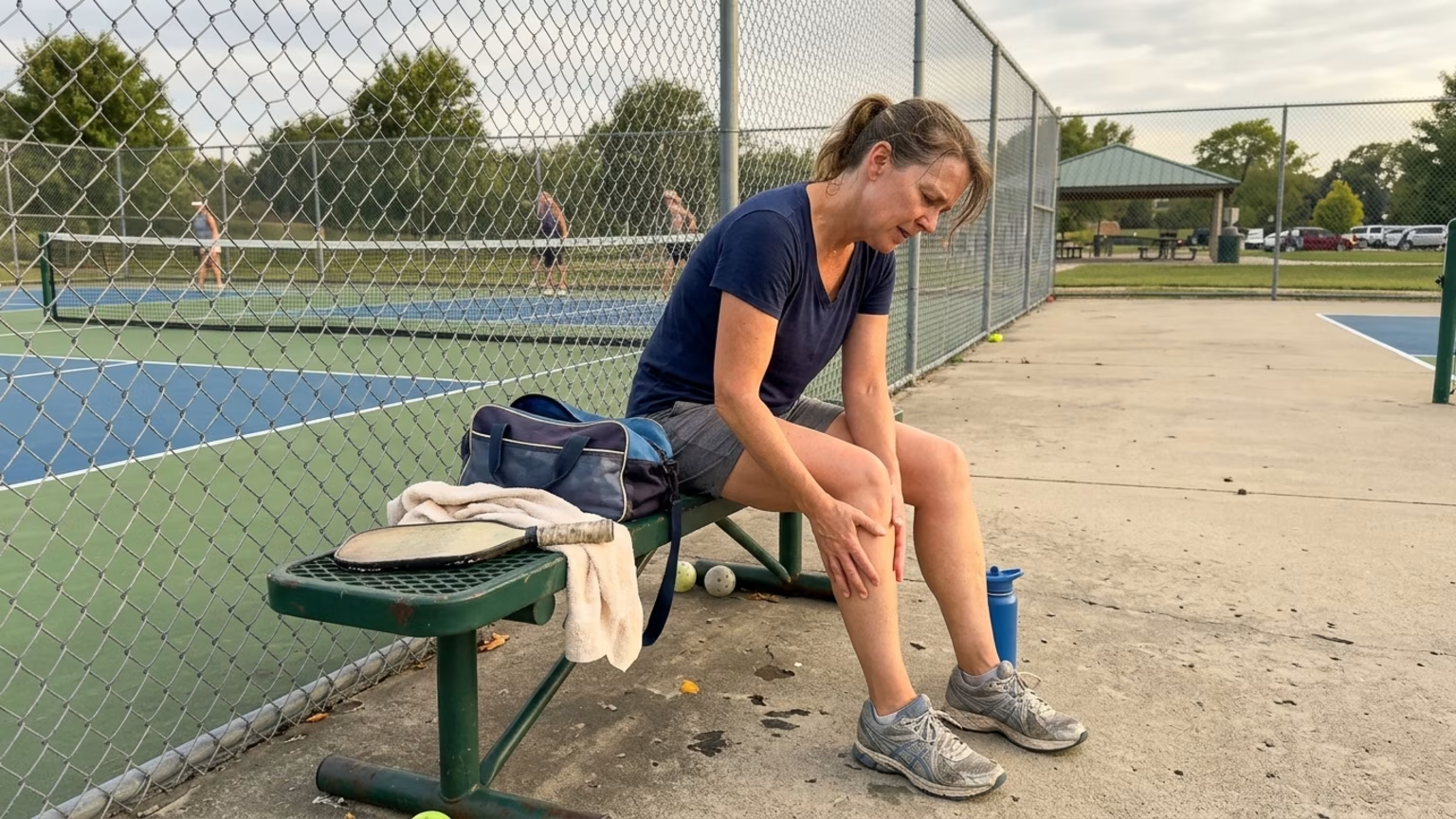

Four practical answers on post-play soreness, warm-up decisions, recurring pain and warning signs for tennis, padel and pickleball players.




Is this ordinary post-play soreness, or a signal to put the racquet or paddle down?
Baptist Health supports considering lighter activity when mild soreness eases during warm-up without changes in strength or movement, but advises stopping for worsening or movement-altering pain and seeking assessment for persistent or recurring symptoms.
Start with when the discomfort appeared and what it does afterward. Baptist Health describes delayed-onset muscle soreness, often called DOMS, as discomfort that typically begins hours after exercise. It becomes more noticeable over the next day or two before gradually improving. Unfamiliar activity or an increase in effort commonly comes before this pattern.
The important word is pattern. Discomfort arriving after play is only part of the picture. Whether it is improving and whether normal movement remains available also matter in Baptist Health’s guidance.
A practical way to describe the experience is to separate three observations:
These observations help describe symptoms. They do not identify a particular injury. Baptist Health explains that professional evaluation is the way to distinguish soreness from acute injury or overuse problems.
For players, the useful distinction is not simply “sore” versus “not sore.” It is improving discomfort versus symptoms that worsen or interfere with movement. There is no need to give every sore morning an injury label. Equally, calling something “just soreness” should not override a changing symptom pattern.
Baptist Health sports medicine physician Dr. Perry offers a conditional answer: mild soreness that eases during warm-up may be compatible with reduced-intensity activity when strength, range of motion and movement mechanics remain normal.
That final condition matters. Feeling better during warm-up is not a guarantee that continuing is safe. The guidance is a decision aid, not clearance to play through whatever happens next.
Read the conditions together rather than choosing the most reassuring one:
When those conditions hold, Dr. Perry’s guidance supports considering reduced intensity rather than automatically insisting on complete inactivity. It does not say that the usual effort or a full match is appropriate simply because the first few movements feel better.
The opposite pattern gives a clearer answer. If pain sharpens or worsens, stop the session. The same applies if symptoms begin changing how you move.
A useful distinction is permission to consider lighter activity, not permission to ignore symptoms. Keep the decision tied to what the symptoms are doing rather than to how much of the session remains.
The broader question of adjusting training when you feel run down belongs alongside this symptom check. It should not replace attention to worsening pain or changed movement.
Recurring pain deserves a different response from soreness that is gradually settling. Baptist Health recommends professional assessment when pain repeatedly returns as sport resumes. It also recommends assessment when symptoms fail to improve after several days of reduced activity.
Other reasons to arrange an assessment include persistent joint swelling or symptoms that interfere with ordinary daily activities. The decision is not based only on whether you can finish a game. What happens away from the court belongs in the conversation too.
Quirónsalud gives similar guidance for discomfort that lasts several days, progressively worsens or recurs with exercise. It also highlights symptoms associated with a previous injury: pain, reduced strength, instability or restricted movement.
For tennis, padel and pickleball players, the practical question is the same: what happens when you return to that activity? The cited guidance offers symptom-based decisions rather than separate thresholds for each sport. A recurring symptom should not be dismissed because the next session involves a different racquet or paddle.
When discussing the pattern with a qualified health professional, a useful description would include:
This is information for an assessment, not a checklist for diagnosing yourself. A brief record of symptoms between sessions is one way to organize those observations without trying to name the problem.
The practical response supported by Baptist Health is to reduce activity and seek advice when these patterns persist or recur. Individual decisions about continuing or returning to play belong with a qualified health professional who can assess the situation.
Baptist Health lists the following as reasons to seek prompt medical attention:
These signs are different from the persistent or recurring symptoms that warrant a non-emergency assessment. They are not situations for testing whether another warm-up makes things feel better.
The distinction is about urgency, not identifying a specific injury. Seek prompt care for these warning signs rather than trying to settle the soreness question on court.
The aim is not to prove how much discomfort you can tolerate, but to notice whether symptoms are settling or calling for assessment. Putting the racquet or paddle down when needed can sit comfortably beside an optimistic goal: enjoying your sport for years to come.
Follow Evercourts for practical insights on tennis, pickleball and padel performance, movement, recovery and healthy ageing. Stay connected for new articles, research-led guidance and ideas to help you play well and keep playing for years.


Agassi and Graf’s company has proposed a pickleball and padel club network. Here is what traveling players should watch before changing memberships.

Pleasanton is considering residential sport-court design standards. Here is what players should monitor before planning a private court.

A practical look at tennis acceleration, braking, lateral movement and rotation, with a flexible framework for strength work and recovery.
Read practical guidance for better movement, smarter preparation and a game that keeps working for you.
explore the Blog
