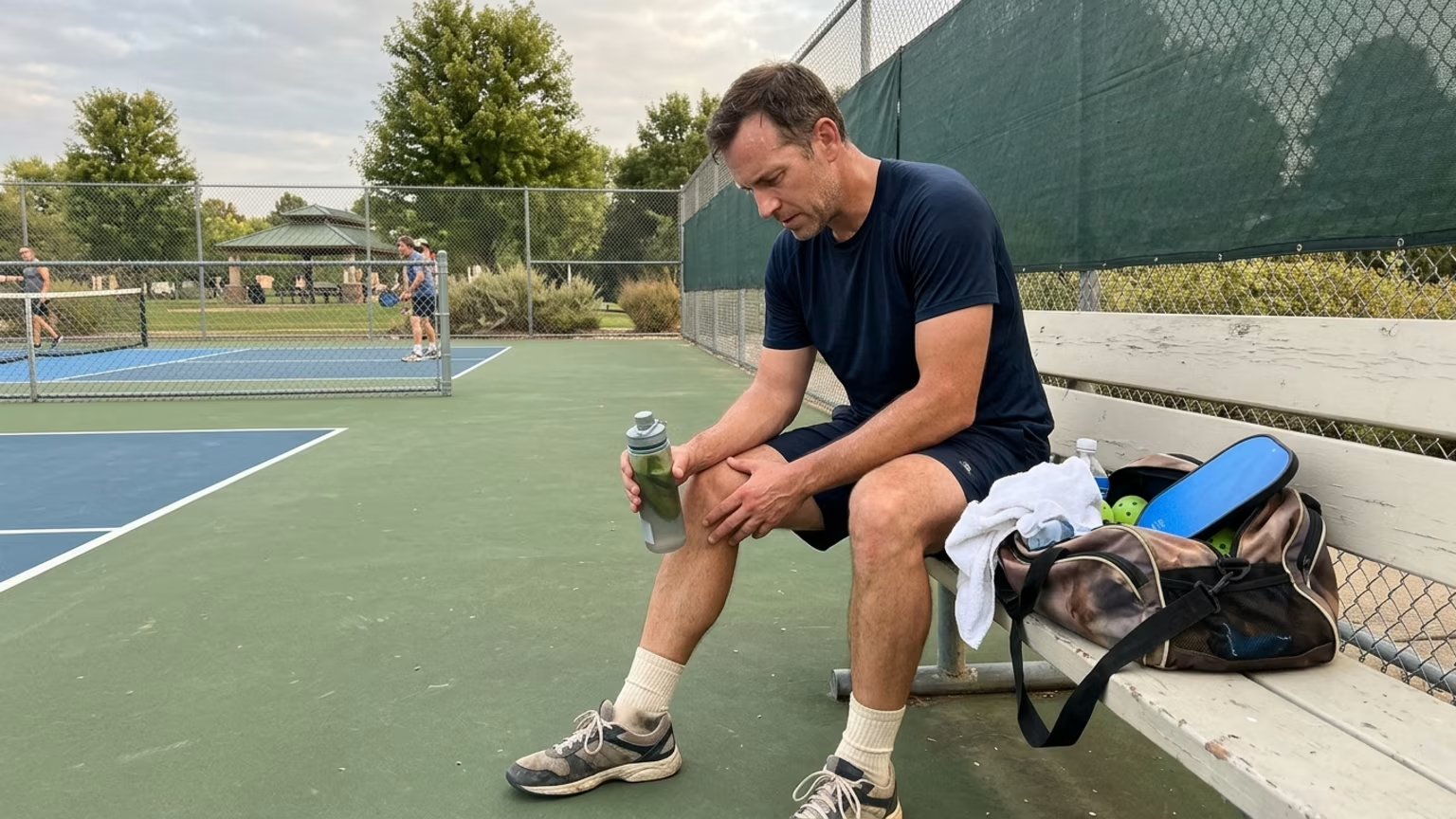

Four player questions on post-play soreness, warm-up relief, movement changes and when to seek qualified care across tennis, pickleball and padel.




Is this ordinary soreness or fatigue after play, or a signal to stop?
According to Baptist Health’s sports-medicine guidance, mild soreness that eases without changing normal movement may allow reduced activity, while worsening or movement-altering pain means stopping and persistent symptoms need qualified assessment.
These are general clinical observations rather than a diagnostic test or a comparison of injury rates. They do not establish separate clinical thresholds for tennis, pickleball and padel. The practical aim is to recognize a pattern that needs attention, not identify an injury yourself.
Baptist Health sports-medicine physicians describe ordinary soreness as a response to harder or unfamiliar activity. It often starts hours after exercise and becomes more noticeable over the next day or two before gradually improving. Muscles may feel stiff while still functioning normally.
Michael Swartzon, a sports-medicine physician quoted by Baptist Health, contrasts this with pain that is sharper or more localized. Swelling or weakness can also accompany a more concerning problem, as can a change in movement.
The useful question is not simply “How sore am I?” It is also “Is this improving, and am I moving normally?” Those questions keep attention on both the discomfort and its effect on function.
There does not have to be a memorable incident for pain to deserve attention. Baptist Health notes that overuse problems can develop gradually, without a dramatic moment on court. A quiet onset is therefore not a reason to dismiss symptoms that keep returning.
The distinction is between soreness that settles while normal function remains intact and symptoms that become sharper or more disruptive. Neither the timing nor the intensity of an ache should be considered in isolation.
Jason Perry, a primary-care sports-medicine physician quoted by Baptist Health, says mild soreness that eases during warm-up may permit reduced-intensity activity. Strength and range of motion should be normal, and mechanics should remain unchanged.
That is not an all-clear. Baptist Health also cautions that improvement during warm-up does not guarantee that continuing is safe. An adaptable pre-match warm-up belongs to preparation, not proof that an ache is harmless.
The source recommends paying attention at more than one point:
There is an important difference between lowering the demands of a session and altering your movement to tolerate pain. The guidance allows the former under the conditions above; it treats the latter as a reason to stop. Finishing with a modified swing is not the same as finishing with normal mechanics at lower intensity.
These observations can sit alongside notes about your response between sessions: when discomfort began, whether movement changed and what happened afterward. That keeps the pattern visible rather than letting the final few comfortable minutes stand in for the whole session.
For mild soreness that does not worsen or change movement, Baptist Health allows that light activity or reduced-intensity play may be appropriate. The practical choice is not always between a full match and no movement at all.
The general message remains consistent: normal movement matters, and worsening symptoms deserve a response. The sport provides context for the discussion rather than a different permission slip to play through pain.
Baptist Health gives shoulder recovery in tennis or pickleball as an example where serve volume and intensity may be increased gradually. This is an example of adjusting a specific sporting demand, not a return-to-play schedule for every sore shoulder.
The practical lesson is that resuming activity involves more than asking whether an ache has disappeared. Decisions about a personal return should sit with a qualified clinician who can assess the symptoms and the activity involved.
ATI Physical Therapy’s pickleball guidance gives a clear movement checkpoint: stop if pain makes you limp or changes your swing. That is more useful than treating the ability to continue a rally as evidence that everything is fine.
ATI also recommends shortening the next session or taking a day off when a player remains unusually tired or sore by the next playing day. Fatigue is therefore part of the playing decision, not something to disregard because another session is available.
For padel, the practical application is the general movement checkpoint: pain that changes how you move calls for stopping. Persistent or recurring symptoms belong in a conversation with a qualified clinician rather than an attempt to assign an injury label yourself.
Switching sports should not be treated as automatic clearance for the same symptoms. Baptist Health describes temporarily switching activities as one possible way to remain active, with assessment helping identify a suitable approach. Questions about adjusting activity across different courts belong alongside that discussion, not in place of it.
Baptist Health advises assessment when pain does not improve despite several days of reduced activity or repeatedly returns with sport. Ongoing joint swelling or symptoms that disrupt daily activities also warrant evaluation. Persistence is a reason to seek advice, not a fixed countdown every player must complete.
Baptist Health advises prompt medical attention for:
For chest pain, fainting or severe shortness of breath during play, ATI Physical Therapy advises stopping and seeking emergency help.
An assessment does not automatically mean abandoning all exercise. As Jason Perry explains through Baptist Health, it can help identify the cause of pain and find a safe way to remain active while a problem heals.
A lighter day or a well-timed assessment can sit within a long playing life rather than outside it. The satisfying measure is not how much discomfort a player can ignore, but how much room the game still has in the years ahead.
Follow Evercourts for practical insights on tennis, pickleball and padel performance, movement, recovery and healthy ageing. Stay connected for new articles, research-led guidance and ideas to help you play well and keep playing for years.


Learn how to turn, track and recover for pickleball lobs with a gentle partner drill, plus what fall research says about balance and footwork.

Tennis match data explain why conditioning involves repeated bursts and recovery. Apply the pattern without treating research averages as personal targets.

A flexible pickleball warm-up progressing from easy movement to controlled lunges, side steps, shadow swings and dinking, with readiness-based adjustments.
Read practical guidance for better movement, smarter preparation and a game that keeps working for you.
explore the Blog
