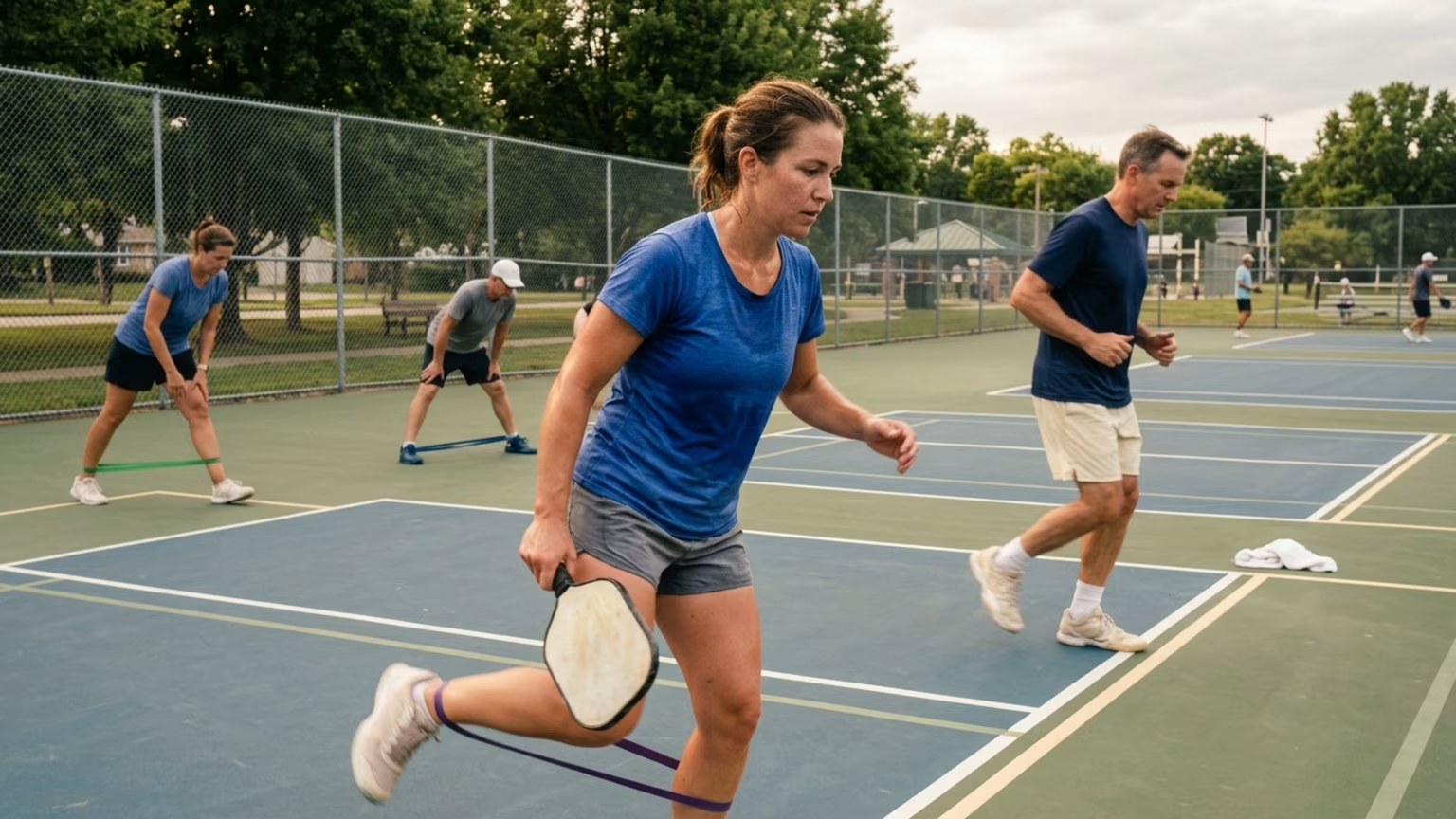

Learn how to build a reliable, adaptable pre-match preparation system for tennis, pickleball, and padel without wasting energy before the first point.




A complex pre-match warmup will not automatically save your joints or win you the first set. Most players waste time memorizing elaborate exercise routines when they actually need a reliable preparation system. The real goal is arriving at the baseline physically ready without adding unnecessary fatigue.
"How do I create a routine that prepares me for a match without exhausting me?" Build a simple sequence of general movement, controlled mobility, and sport-specific hitting that you scale for any match time.
"How should I change my preparation for an early league match compared to an evening game after sitting at a desk?"
Early starts require your body to have more time to transition from resting to moving. You should add several minutes of easy walking or gentle court movement before starting faster drills. The goal is to build gradually toward the demands of the first few points. You do not need to reproduce a full training session before the match.
Instead of jumping straight into full-speed hitting, focus on controlled mobility for your ankles, hips, and shoulders. You can begin your stroke rehearsal at a heavily reduced speed. Progress slowly to short lateral movements and controlled split-step patterns. Keep the final portion sport-specific but completely avoid exhausting jumps or long conditioning blocks.
Evening routines must address the stiffness that comes from prolonged daytime inactivity. You should use a brief general movement phase to reverse the effects of sitting. Focus on the body regions that feel stiff without forcing your range of motion. Rehearse the first few match movements like the split step, lateral push-off, and rotation.
Keep the final hitting phase calm and technically focused. Avoid adding unfamiliar exercises or aggressive stretching immediately before play. United States Tennis Association guidance from athletic trainer Ed Ryan supports this gradual approach. He recommends beginning with movement around the court without hitting first.
Players should then gradually add strokes while emphasizing preparation for the shoulders, trunk, and legs. This progressive method ensures your body is adequately prepared. Using a structured court day preparation sequence eliminates guesswork. It allows you to step onto the court with quiet confidence.
"Is a short routine really enough to prepare my body and prevent injuries on the court?"
A pre-match routine is a tool for immediate readiness, not an insurance policy against injury. Current consensus commentary cautions that one warm-up should not be presented as a guarantee against getting hurt. A reliable routine simply reduces decision-making on match day. You can use the exact same sequence and adjust its duration based on time, temperature, and fatigue.
True physical resilience comes from your weekly habits rather than a frantic pre-match ritual. A recent meta-analysis of 41 randomized controlled trials involving 3,141 older adults found that resistance exercise significantly improved muscle-specific strength. However, the researchers noted substantial variation across the studies. This means players must develop their strength, balance, and aerobic conditioning during the week.
Expecting a quick warm-up to compensate for poor athletic longevity is a critical mistake. A 2026 review found favorable pooled effects for several tennis performance measures following neuromuscular training. The authors emphasized low or very-low certainty for some outcomes and did not endorse one universal training method. Complex routines are not automatically better just because they have more steps.
Your routine should finish with you feeling prepared rather than tired. The most effective approach is maintaining a consistent order of operations. Start with easy continuous movement to raise your core temperature. Move into controlled mobility through the ranges required for your specific sport.
Finally, you can activate your muscles by rehearsing split steps and athletic deceleration. Choose one or two tactical intentions rather than attempting a lengthy psychological ritual. This consistent weekly scheduling approach keeps your preparation grounded. You arrive at the first point physically capable and mentally sharp.
Unfamiliar drills, maximal sprints, and aggressive stretching belong in training experiments, not immediately before an important match. The best approach is finding a comfortable rhythm that you can repeat consistently. A well-designed routine should improve your perceived readiness without creating pain or a loss of coordination. Relying on this predictable structure supports healthy aging and helps you play confidently.
"I play tennis, pickleball and padel, so do I need a completely different warm-up for each sport?"
You can use a shared base routine for general movement, but you should change the final five minutes according to the sport. Tennis involves larger-court movement, explosive sprints, power, and endurance demands. Your final preparation here should include more pronounced lateral pushes, recovery steps, and progressive serve rehearsals. Tennis requires a specific readiness for controlled acceleration and deceleration.
Padel and pickleball require distinctly different final stages. A recent peer-reviewed editorial characterizes padel as involving longer rallies, more frequent volleys, and lower-intensity movement profiles than tennis doubles. Padel warm-ups should focus on lateral positioning, volley rehearsal, and controlled preparation for wall rebounds. This reactive movement profile requires careful attention to your lower body mechanics.
Pickleball emphasizes coordination, balance, and quick reactions over a smaller space. Players should focus on short split steps, quick first movements, and compact strokes. Gentle preparation for reaching and overhead actions is also highly recommended. Understanding these sport-specific nuances helps you tailor your physical preparation across different court types.
The smaller court size of pickleball does not eliminate physical risk. In one 2026 study, 38.1% of participants reported at least one pickleball-related injury during the previous 12 months. Lower-extremity, tendon, joint, and overuse injuries were commonly reported among the surveyed group. Always respect the specific physical demands of the court you are stepping onto.
"How do I handle my physical preparation when I have multiple matches scheduled on the same day?"
Tournament preparation must be divided into two distinct routines to protect your physical energy. Before your first match, you should complete your full version of general movement, mobility, and progressive hitting. This comprehensive initial sequence establishes your baseline readiness for the long day ahead. It ensures your body is fully primed for competitive play.
Between matches, you should use a brief reset rather than repeating the entire routine. Walk gently, rehydrate, eat familiar food, and perform a much shorter movement sequence before your next opponent. You must monitor whether your routine is restoring your readiness or simply adding unnecessary fatigue. The appropriate version may become significantly shorter as the day progresses.
Players who have already accumulated substantial court time should prioritize recovery over excessive activation. Pushing through a heavy warm-up before a third match often degrades performance. Structuring a practical game-day protocol is about smart energy management. It keeps you fresh for the critical moments of a tournament.
A condensed routine between matches should focus purely on what your body actually needs. If your shoulders feel tight from serving, spend a minute on controlled mobility. If your legs feel heavy, stick to easy walking and gentle split steps. Listening to your physical feedback is a crucial part of mature competitive play.
Preparing for a match is ultimately about building a quiet trust in your own physical capability. When you rely on a simple and adaptable preparation system, you step onto the court ready to enjoy the game.
Follow Evercourts for practical insights on tennis, pickleball and padel performance, movement, recovery and healthy ageing. Stay connected for new articles, research-led guidance and ideas to help you play well and keep playing for years.


Holger Rune withdrew from the European Open with a back problem. The facts behind his decision and a grounded perspective for recreational players.

The Dink’s October 17 guide emphasizes deep returns, ball-height decisions and positioning against faster pickleball opponents.

A new report outlines padel and tennis gear trends. Learn how to assess adjustable rackets, sensor feedback and smart-court claims.
Read practical guidance for better movement, smarter preparation and a game that keeps working for you.
explore the Blog
