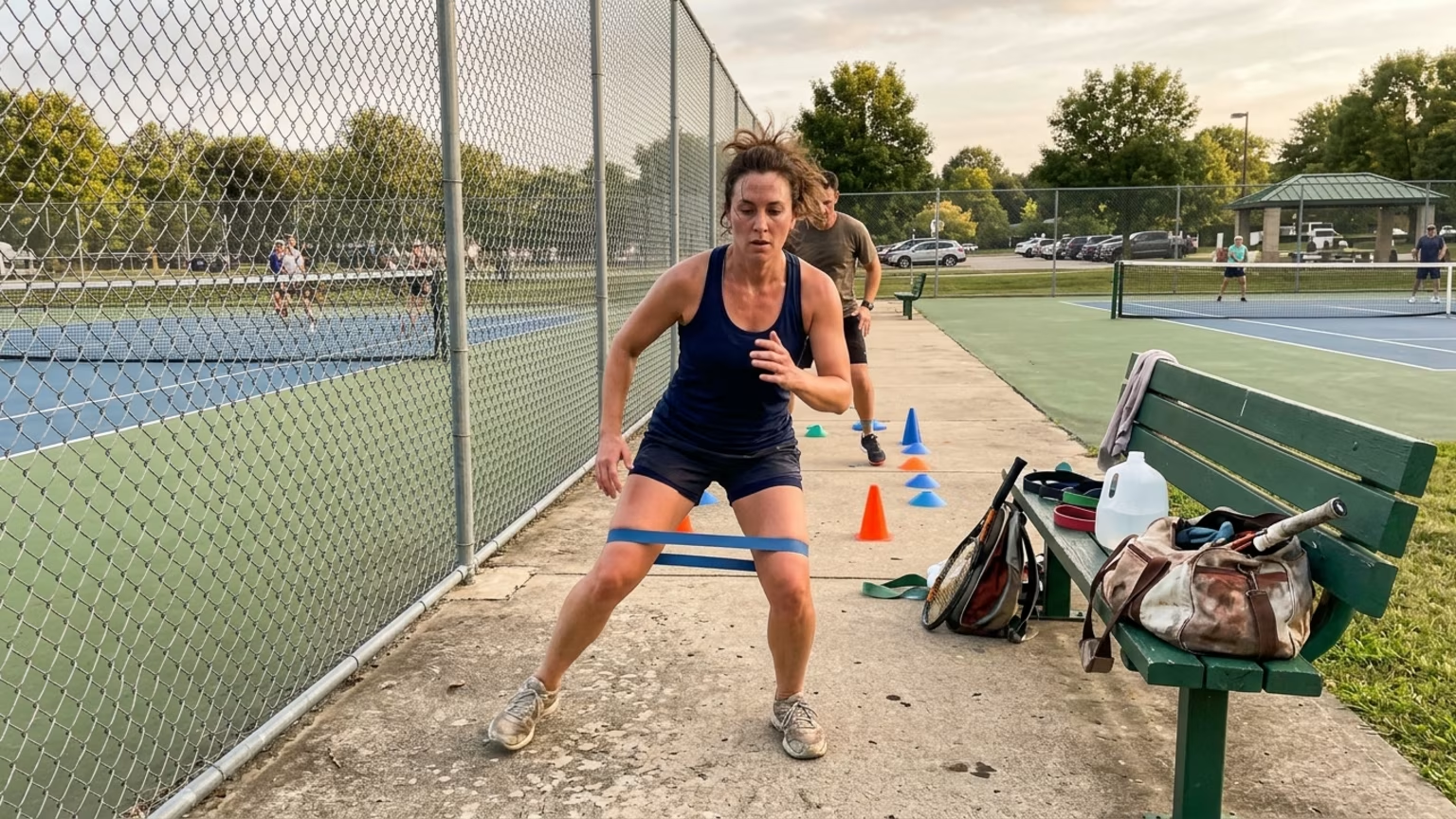

Connect off-court strength to racquet-sport movement, understand the evidence and build a balanced framework around current ability.




Off-court strength training uses resistance exercise to prepare the body for the pushes, stops and strokes of racquet sports. The push toward a wide ball is only part of the job. There is also the stop, the stroke and the return to position.
That is the useful meaning of training for the whole point: looking beyond the hitting arm to the physical tasks surrounding each shot. For adult tennis, pickleball and padel players, it provides a way to think about strength without treating the gym as another competition.
A conditioning overview of tennis and padel identifies lower-body strength and braking as shared demands. It also highlights trunk control, shoulder capacity and coordination. Repeated explosive efforts and changes of direction make strength relevant throughout a rally rather than only at ball contact.
The overview describes tennis as involving more exposure to longer lateral runs and higher-speed braking than padel. Open-court recovery adds another movement task after the shot. That makes pushing off and controlling the stop useful themes for an off-court strength discussion.
For pickleball, the practical framework centres on repeated footwork and changes of direction. Lower-body strength belongs alongside balance and movement control in that discussion. The pickleball research considered below also makes falls a relevant concern for older players.
Padel shares several physical demands with tennis without having identical movement patterns. Lower-body strength, trunk control and shoulder capacity remain relevant. The overview also notes that demands vary with ability and playing circumstances, so a sport's name alone does not define an individual's training needs.
For more movement context, our guide to preparing for court-specific stops and starts looks at lower-body strength and lateral stability.
The research is most useful when its different questions stay separate: general health, physical preparation and actual match outcomes are related topics rather than interchangeable findings.
A 2026 systematic review in BMC Sports Science, Medicine and Rehabilitation included 13 reports on high-intensity interval training in trained tennis players. Improvements were reported most consistently in selected aerobic measures and tennis-specific endurance tests.
An emergency-department analysis, summarised in a pickleball injury guide, estimated 66,350 pickleball-related injuries presenting to US emergency departments from 2013 through 2022. Falls accounted for 65.5% of those estimated injuries. The analysis discussed strength and balance training as possible preventive measures.
A separate secondary report on older pickleball players describes a small 10-week strength, balance and footwork programme. Participants had fallen or feared falling. At five-month follow-up, 25% of the training group and 44% of the comparison group reported a fall during play.
The evidence has clear boundaries. The conditioning overview provides practical exercise categories rather than a tested universal strength routine. The interval-training review concerns trained tennis players rather than recreational strength training, and it noted small samples and methodological limitations. Transfer to competitive match performance remained uncertain.
The emergency-department analysis did not test a training intervention or measure risk relative to playing exposure. Its records also leave out injuries that did not reach emergency care. The small fall study is preliminary and comes through secondary reporting. These findings support a measured discussion of preparation rather than promises that a particular routine prevents injuries or improves everyone's match results.
For athletic longevity, the useful question is which physical tasks deserve attention alongside regular play. The World Health Organization says that any amount of physical activity is better than none and that muscle strengthening benefits everyone. That supports a manageable approach to staying active.
The conditioning overview lists squat, hinge and split-stance variations among its strength options. It also includes calf work, pushing and pulling, carries and trunk exercises. The following grouping translates those categories into court tasks rather than setting out a workout prescription.
Squat, hinge and split-stance variations give the lower body a place in the plan. In court terms, this is the part of the framework concerned with pushing away from the ground and controlling movement into a stop.
A useful planning question is whether the exercise selection reflects both tasks. Thinking only about the initial push leaves the braking part of the point out of the picture. The overview's emphasis on both acceleration and stopping helps keep that distinction visible.
Calf variations belong in the discussion because repeated footwork is part of the court-demand framework. They give this area explicit attention rather than leaving the entire lower-body discussion to larger leg exercises.
The purpose of this category is straightforward: remember the repeated footwork between shots as well as the more obvious effort of reaching a wide ball.
The trunk and upper body also deserve space in a balanced plan. The overview identifies trunk control and shoulder capacity as relevant demands in tennis and padel. Its exercise options include pushing, pulling, carrying and trunk variations.
A practical interpretation is to organise strength around the whole action rather than only the arm holding the racquet. Our discussion of connecting strength work to court movements provides a broader planning lens for that approach.
The overview advises adapting exercise load and movement range to the individual. It also recommends progressing one demand at a time. Those principles keep the emphasis on current ability rather than on copying a professional player's exercise selection.
For an adult player, a manageable framework leaves room to consider strength work alongside matches and recovery. Rest belongs in that planning conversation rather than being treated as whatever time remains after training. Decisions about exercise difficulty can then reflect the person's circumstances instead of a fixed template.
This is also a useful perspective for healthy aging: keep the recurring tasks of play in view while allowing the approach to change with current ability. A player does not need to treat every exercise category as another performance test. Our guide to fitting strength around a sustainable playing week considers that wider planning problem.
If you have fallen during play or fear falling, raise that with a qualified physiotherapist or healthcare provider. Those were the concerns represented in the small older-player study, and they deserve individual attention rather than assumptions based on an exercise list.
Seek individual advice as well when you are unsure how to adapt exercise load or movement range to your current ability. A general framework can organise the conversation without making those personal decisions for you.
Return to the wide ball: the push matters, but so do the stop and the return to position. If any part of that sequence feels beyond your current capacity, it is a useful starting point for a conversation with a qualified professional.
Follow Evercourts for practical insights on tennis, pickleball and padel performance, movement, recovery and healthy ageing. Stay connected for new articles, research-led guidance and ideas to help you play well and keep playing for years.


Learn how to turn, track and recover for pickleball lobs with a gentle partner drill, plus what fall research says about balance and footwork.

Tennis match data explain why conditioning involves repeated bursts and recovery. Apply the pattern without treating research averages as personal targets.

A flexible pickleball warm-up progressing from easy movement to controlled lunges, side steps, shadow swings and dinking, with readiness-based adjustments.
Read practical guidance for better movement, smarter preparation and a game that keeps working for you.
explore the Blog
