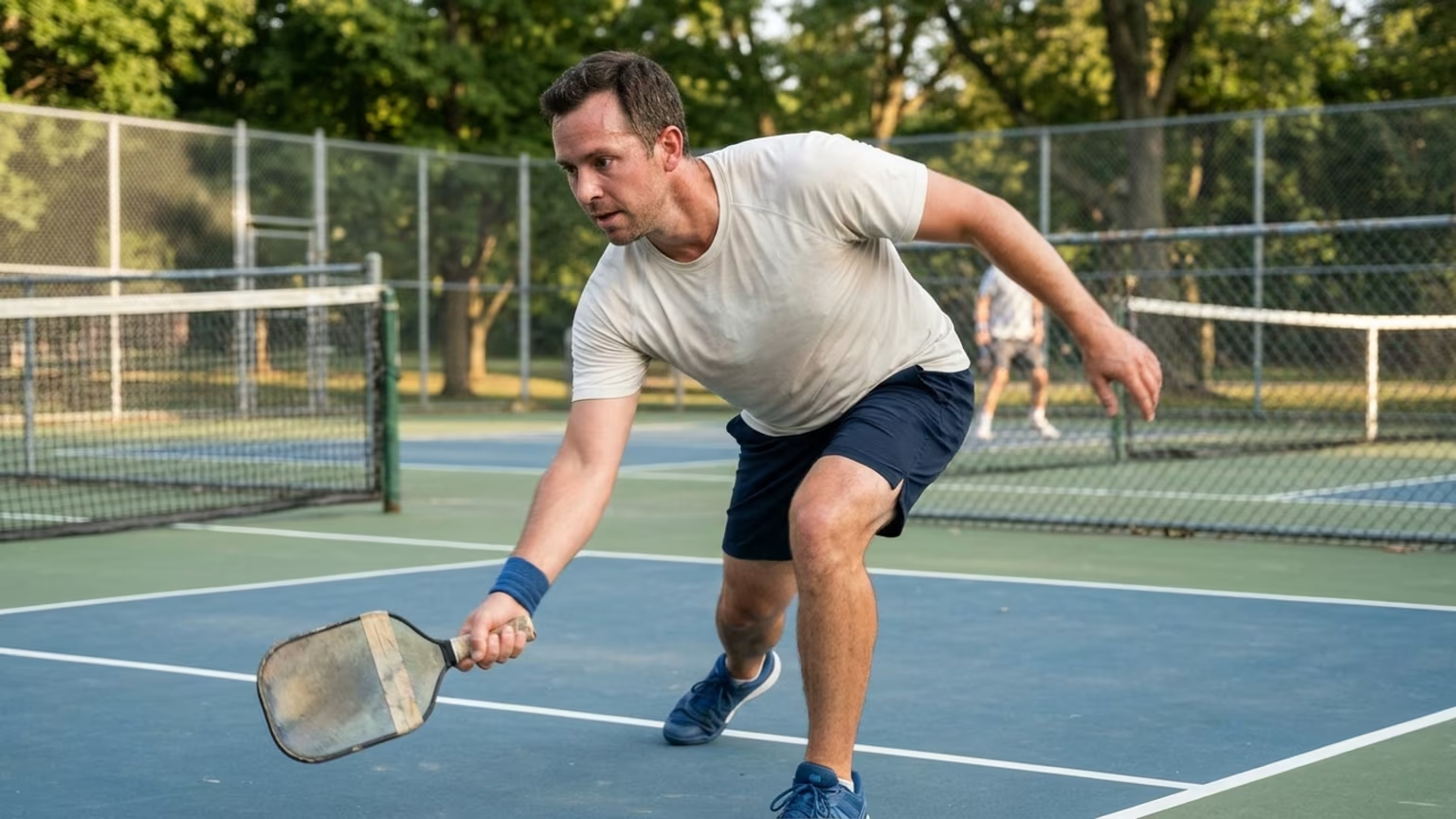

A practical strength framework for tennis, pickleball and padel, with movement-based exercise options, evidence limits and guidance on seeking help.




Strength training is exercise in which your muscles work against resistance. For racquet players, its purpose is to support actions such as pushing off, turning and reaching overhead. The useful starting point is the movement you want to support rather than the complexity of the exercise.
A practical framework considers the legs and hips, trunk, shoulders and forearms. These areas appear in the tennis and pickleball practitioner guidance discussed below. The aim is a manageable menu that fits alongside play.
Tennis, pickleball and padel combine repeated explosive efforts with changes of direction. Looking only at the hitting arm misses much of the physical task.
Tennis: A tennis-conditioning guide organises training around lower-body strength and stability, hip work, trunk rotation and upper-body capacity. Its whole-body approach connects strength work with movement around the court rather than treating every shot as an arm-strength problem.
Pickleball: A physiotherapy article on pickleball recommends lower-body strength for movement and turning. It also includes shoulder and upper-back work for overhead and paddle actions. The smaller playing space does not make those movement categories irrelevant.
Padel: Pushing off and changing direction sit alongside repeated reaching demands. These actions give players a practical reason to consider both lower-body capacity and shoulder function. Keeping the discussion connected to how players move around a padel court is more useful than choosing exercises solely because they look sport-specific.
These sources provide practitioner guidance rather than trials of a complete strength routine. The tennis-conditioning guide notes that evidence for specific tennis injury-prevention programmes is limited. A separate tennis training resource cautions that strength work cannot guarantee freedom from shoulder problems.
The categories are therefore a framework rather than a universal sequence or progression. For padel, they are a movement-based interpretation rather than a validated sport-specific protocol. The sources also do not establish a minimum dose that guarantees continued play or show that strength work alone extends playing life or lifespan.
The useful takeaway is narrower: organise work around court actions and adapt it to the player. Exercise names can help organise that discussion. They do not settle questions about suitable difficulty or workload.
Understanding strength by movement gives adult players a clear way to think about maintaining capability. A routine can reflect the actions that matter to their game instead of becoming an ever-growing exercise list. That is the practical connection to athletic longevity: a framework for ongoing work as capacity and circumstances change.
The following menu draws its categories and exercise examples from the tennis-conditioning guide. Pickleball guidance overlaps in lower-body and shoulder work. Think of the menu as options to adapt rather than a sequence to complete.
Squats and lunges are examples in the tennis guide's lower-body category. They give the framework a clear place for leg strength and stability rather than leaving that entire area to match play.
The practical question is whether the selected movement is controllable at the player's current capacity. A familiar exercise adapted appropriately is a more sensible starting point than complexity chosen for its own sake.
Hinges appear in the guide's hip and posterior-chain category. They provide a distinct place for hip-focused strength alongside squats and lunges.
The point is not to collect variations. It is to check that the menu reflects the different movement capacities a player wants to maintain. This is also a useful way to spot a routine built around favourite exercises rather than a clear purpose.
Rotational exercises are the guide's examples for trunk work. This category keeps turning and control in the framework instead of treating the middle of the body as an afterthought.
For a player reviewing a routine, the useful question is whether trunk work has a clear relationship to court actions. That movement-first approach also helps when judging which strength work is relevant to your game.
The tennis guide lists rows and external rotations among its exercise examples. Pickleball practitioner guidance also includes shoulder and upper-back work for overhead and paddle actions.
Shoulder exercises belong beside the rest of the body rather than replacing it. Their place in a routine should also be considered alongside the reaching and hitting already present in a player's week.
Wrist work and grip capacity complete the tennis guide's menu. This gives repeated racquet and paddle demands a place in the framework without making arm training the whole programme.
The tennis guidance recommends that shoulder and forearm work complement the on-court workload rather than simply duplicate it. More exercises for a heavily used area are not automatically the most useful addition.
The tennis training resource advises matching exercise selection and loading to experience, current capacity, symptoms and existing workload. The conditioning guide also recommends adapting training volume to playing demands and recovery. Together, those principles put the player's circumstances ahead of a fixed template.
For an adaptable menu, the supported approach is to choose a controllable movement for each relevant area. Difficulty can then reflect the player's ability rather than an assumed standard. The exercise categories remain useful even when the particular choices change.
As an editorial principle, favour regular and manageable practice over unnecessary complexity. That means considering strength work within the wider court schedule rather than treating it as a separate obligation. A framework for fitting training around a busy life can help keep that planning grounded.
Pain or other symptoms that make exercise choice or loading uncertain are a reason to consult a qualified physiotherapist or healthcare provider. Individual advice also matters when your current capacity makes a general routine difficult to adapt. These are personal decisions that an exercise menu cannot resolve.
Bring the discussion back to the factors identified in the tennis training guidance: your experience, symptoms, present capacity and court workload. A qualified professional can help assess those factors rather than leaving you to guess which general recommendation applies.
Good guidance belongs in the long game.
Follow Evercourts for practical insights on tennis, pickleball and padel performance, movement, recovery and healthy ageing. Stay connected for new articles, research-led guidance and ideas to help you play well and keep playing for years.


Why a specialist urges assessment for persistent pain, and how guided tendon rehabilitation differs from resting or playing through symptoms.

Compare scheduled leagues with flexible club play, using tennis, pickleball and padel examples to judge commitments, partner arrangements and fit.

ACSM highlighted an active-aging coordination model. Here is what it means for recreational racquet-sport players and what the evidence supports.
Read practical guidance for better movement, smarter preparation and a game that keeps working for you.
explore the Blog
