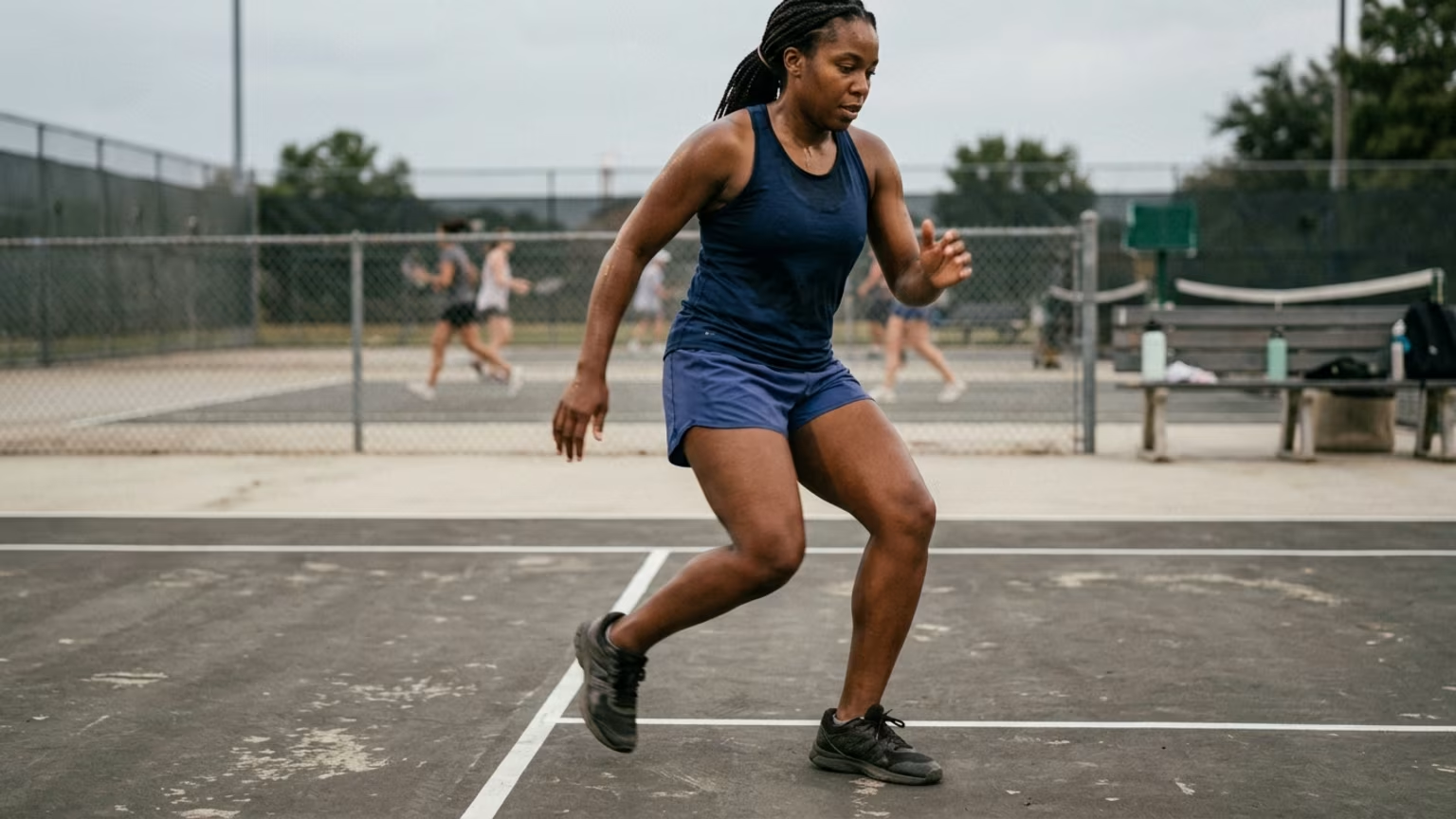

Learn how controlled braking and deceleration mechanics can improve your shot preparation, protect your lower body, and extend your racquet sports longevity.




Deceleration on the court is the physical ability to absorb your forward momentum, lower your center of mass, and arrive balanced before hitting the ball. A player sprints wide for a forehand, feels the grip of the surface under their shoe, and uses three short steps to bleed off speed. They plant their outside foot with total control. The racket is already prepared, and the body is completely stable for the swing.
Many players focus entirely on acceleration and explosive first steps. They practice sprinting toward the ball but spend very little time learning how to arrive safely. Controlled braking is an essential and trainable movement skill. Learning this skill transforms a desperate lunge into a balanced platform for your next shot.
The court dimensions across different racquet sports vary greatly. However, the fundamental requirement to decelerate safely remains exactly the same. Pickleball players face frequent short accelerations and low lunges at the kitchen line. Padel players perform rapid repositioning after wall rebounds and make constant lateral adjustments to stay in the point.
Tennis, pickleball, and padel require constant and unpredictable changes of direction. The game forces players to accelerate rapidly, stop suddenly, and reverse course over short distances. This repeated cycle places enormous mechanical demand on the entire lower body. The legs must absorb heavy vertical and horizontal forces during every abrupt stop.
The physical toll of these movements accumulates throughout a tough match. The transition from sprinting to braking requires eccentric muscle control, where muscles lengthen under tension. This heavy force absorption challenges the knees, ankles, and feet repeatedly. Without proper movement mechanics, players often plant a single leg hard into the ground.
The speed of modern racquet sports continues to increase at the recreational level. Racket technology and lighter paddles allow players to hit the ball with more pace than ever before. Faster rallies mean players have less time to react, sprint, and prepare for the next shot. This compressed timeline makes efficient deceleration an absolute necessity rather than an optional skill.
Rushed directional changes are especially common when players try to reach a difficult ball. Players often sprint toward the ball, plant their foot heavily, and try to recover before regaining their balance. This desperate movement sequence leaves the lower extremities vulnerable to immense mechanical stress. Mastering mobility strategies for different playing environments can help players manage these sudden directional adjustments safely.
Current research highlights the specific physical demands that racquet sports place on adult players. A cross-sectional study published from data collected at three South Korean pickleball tournaments between April and October 2025 surveyed 383 adult participants. The group included 249 men and 134 women with a mean age of 47.0 years. Among those participants, 146 individuals reported at least one pickleball-related injury during the previous 12 months, which represented 38.1% of the group.
The researchers noted that lower-extremity injuries accounted for 44.0% of 266 valid body-part responses in their survey. The knee was the most frequently reported lower-extremity site at 21.4%, followed closely by the ankle and foot at 15.8%. Of the 144 participants who provided injury-onset information, 52.1% of reported injuries were classified as overuse injuries and 47.9% as traumatic injuries. The researchers suggested that repeated multidirectional demands may help explain this lower-extremity injury pattern.
The study also found a connection between weekly playing volume and injury reports. Each additional weekly playing hour was associated with a 6% increase in injury odds in the study's regression model, with an odds ratio of 1.06 and a 95% confidence interval of 1.02 to 1.11. The regression analysis found that male participants had higher odds of reporting injury than female participants, with an odds ratio of 1.74 and a 95% confidence interval of 1.04 to 2.90. This data shows that cumulative court time requires careful management and adequate rest.
Movement mechanics are a growing focus in sports science literature. A 2026 systematic review and Bayesian network meta-analysis compared 10 resisted-movement training approaches across 24 randomized controlled trials involving 744 recreationally active and trained participants. The review ranked vertically resisted plyometric training highest with a reported 93.0% SUCRA value. The authors proposed that directional changes require athletes to absorb and redirect vertical forces efficiently.
Research also connects neuromuscular training with potential performance improvements on the court. A 2026 systematic review and meta-analysis examined structured neuromuscular training in 18 studies involving 670 healthy male tennis players. The review found a pooled effect favoring intervention groups for stroke velocity and sprint performance. However, the authors noted that the certainty of this evidence was low, reinforcing that science is still catching up to on-court application.
The tennis review authors emphasized the need for high-quality trials before establishing one superior training method. They observed that shot-placement accuracy did not show a significant pooled effect across the examined literature. The practical takeaway is that better braking provides a promising foundation for movement and preparation. It should be viewed as a mechanical advantage rather than a guaranteed formula for winning matches.
Improving your deceleration mechanics directly supports healthy aging and sustainable play. Players who learn to brake properly reduce the sudden impact forces absorbed by their joints. Lowering the center of mass before the final step creates a much more stable base. Flexing at the hips, knees, and ankles helps distribute the load evenly across the entire lower body.
Using multiple short steps to brake is safer than relying on one desperate plant. A controlled sequence of adjustment steps spreads the deceleration over several ground contacts. This progressive braking technique gives your muscles adequate time to handle the momentum safely. Players who invest in deceleration training for racquet sports often notice better stability during long matches.
Court surfaces also play a major role in how your body handles deceleration. Hard courts offer immense friction, which stops your shoe instantly but transfers that entire force up into your knees and hips. Clay courts allow players to slide into their shots, extending the braking phase over a longer distance. Understanding these surface differences helps you adjust your movement style appropriately.
Adjusting your footwork based on the playing environment is a smart strategy. When playing on high-friction surfaces, players should be especially mindful of using multiple steps to brake. Attempting a clay-court slide on a gritty hard court can abruptly lock the ankle. A realistic and adaptable movement framework keeps adults enjoying their favorite sport without unnecessary risk.
Arriving under control also creates optimal conditions for your shot preparation. A balanced arrival gives you more time to prepare the racket and choose a clean contact point. Rather than lunging wildly, you arrive organized and ready to hit an accurate ball. Understanding that faster braking skills protect racquet players allows you to stay competitive and active for years.
Coaches often emphasize arriving balanced before you prepare the stroke. The objective is not to stop completely before every single shot. Instead, the goal is to reduce enough forward momentum to organize your feet and trunk. This structured approach to court movement gives you a reliable physical foundation for your game.
Managing your weekly court volume is just as important as upgrading your footwork. Players should monitor sudden increases in court time and schedule dedicated recovery days. A sustainable routine balances intense tournament play with relaxed technical sessions. Listening to your body and respecting fatigue helps you enjoy the game over the long haul.
Even with excellent movement mechanics, adults playing racquet sports may encounter physical setbacks. You should see a qualified physiotherapist if you experience sharp pain during sudden stops. Lingering joint stiffness that does not improve after a few days of rest is another clear signal. Muscle and tendon injuries represented 43.3% of 199 valid tissue-type responses in the 2025 pickleball study, making professional guidance essential for proper recovery.
A healthcare professional can assess your specific movement limitations and prescribe appropriate interventions. Do not add heavy plyometrics or weighted vests to your routine without professional clearance, especially if you have a history of joint pain. Every player has a unique medical history and individual strength profile. A physical therapist will help you build a personalized resilience plan.
Taking swift action when symptoms arise keeps small problems from becoming chronic issues. Among injured participants with available time-loss data in the South Korean study, 16.9% reported missing at least one month of play, while 19.0% reported missing two to four weeks. Seeking prompt medical advice minimizes your time away from the sport. Move well, respect your limits, and keep enjoying your time on the court with Evercourts.
Follow Evercourts for practical insights on tennis, pickleball and padel performance, movement, recovery and healthy ageing. Stay connected for new articles, research-led guidance and ideas to help you play well and keep playing for years.


Holger Rune withdrew from the European Open with a back problem. The facts behind his decision and a grounded perspective for recreational players.

The Dink’s October 17 guide emphasizes deep returns, ball-height decisions and positioning against faster pickleball opponents.

A new report outlines padel and tennis gear trends. Learn how to assess adjustable rackets, sensor feedback and smart-court claims.
Read practical guidance for better movement, smarter preparation and a game that keeps working for you.
explore the Blog
